
Apparatus and method for monitoring biological cell culture
- Summary
- Abstract
- Description
- Claims
- Application Information
AI Technical Summary
Benefits of technology
Problems solved by technology
Method used
Image

Examples
first embodiment
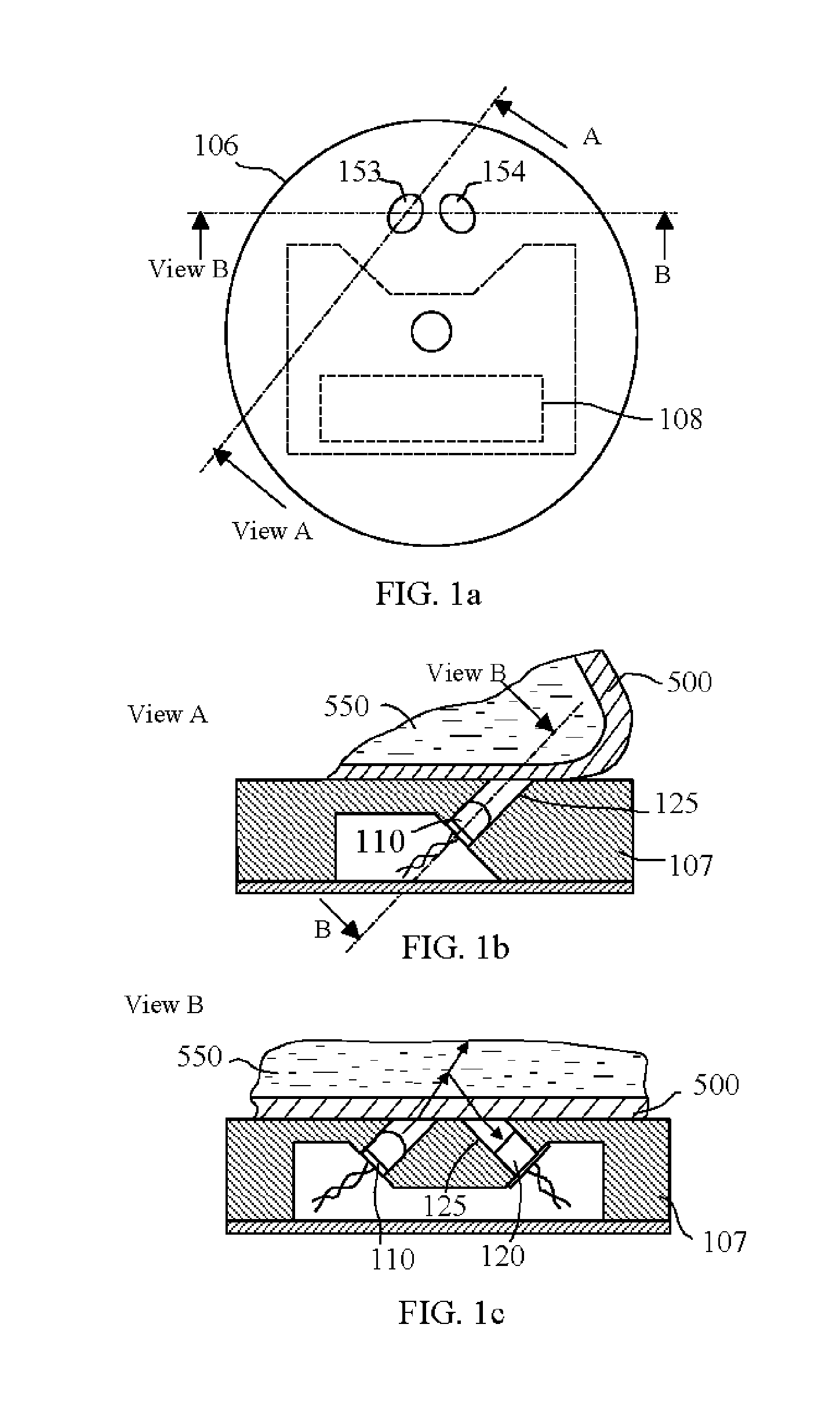
[0027] In the first embodiment, a light scattering probe 106 is schematically shown in FIG. 1a-c. The probe includes a probe enclosure 107, electronic circuitry 108, at least a light source 110 and at least a photodetector 120. Electronic circuitry 108 usually includes a power supply or driver for light source 110, photodetector sensing circuitry with a pre-amplifier for photodetector 120, or / and temperature control circuitry for light source 110 or / and photodetector 120. Source 110 can be a monochromic source like a semiconductor laser source, Light Emission Diode (LED) or a non-monochromic source like ordinary flash lamp, tungsten lamp and broadband LED. The source 110 can be in UV, visible or NIR wavelength. The photodetector 120 can be a photodiode, a phototransistor, a photoconductive cell (CdS), a photomultiplier tube or a CCD detector. The detector 120 is to detect the scattered light from a medium 550 through a transparent wall of a biological medium container 500. The scatt...
third embodiment
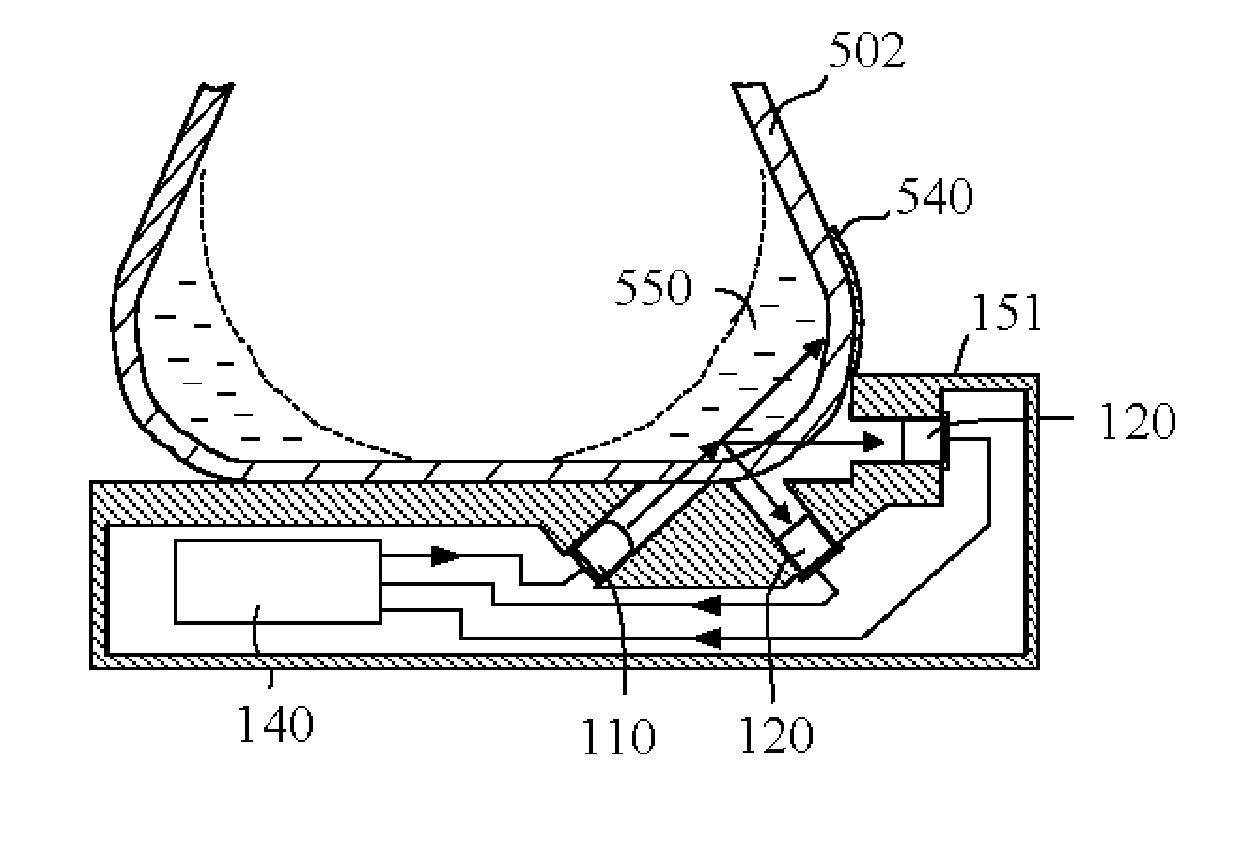
[0036] In the third embodiment, a probe 151 can be constructed for multi-angle scattering detection as schematically shown in FIG. 4. The probe 151 comprises a light source 110, two photodetectors 120 and electronic circuitry 140. One photodetector is designed for a small angle (502 shows a typical air-medium interface curve when the medium with the container are in an orbital shaking circumstance. Furthermore, to reduce the reflection noise caused by the outside surface of the flask 502, a light absorption layer 540 (a black color paint) can be utilized on the small area that the incident light beam of source 110 strikes.
fourth embodiment
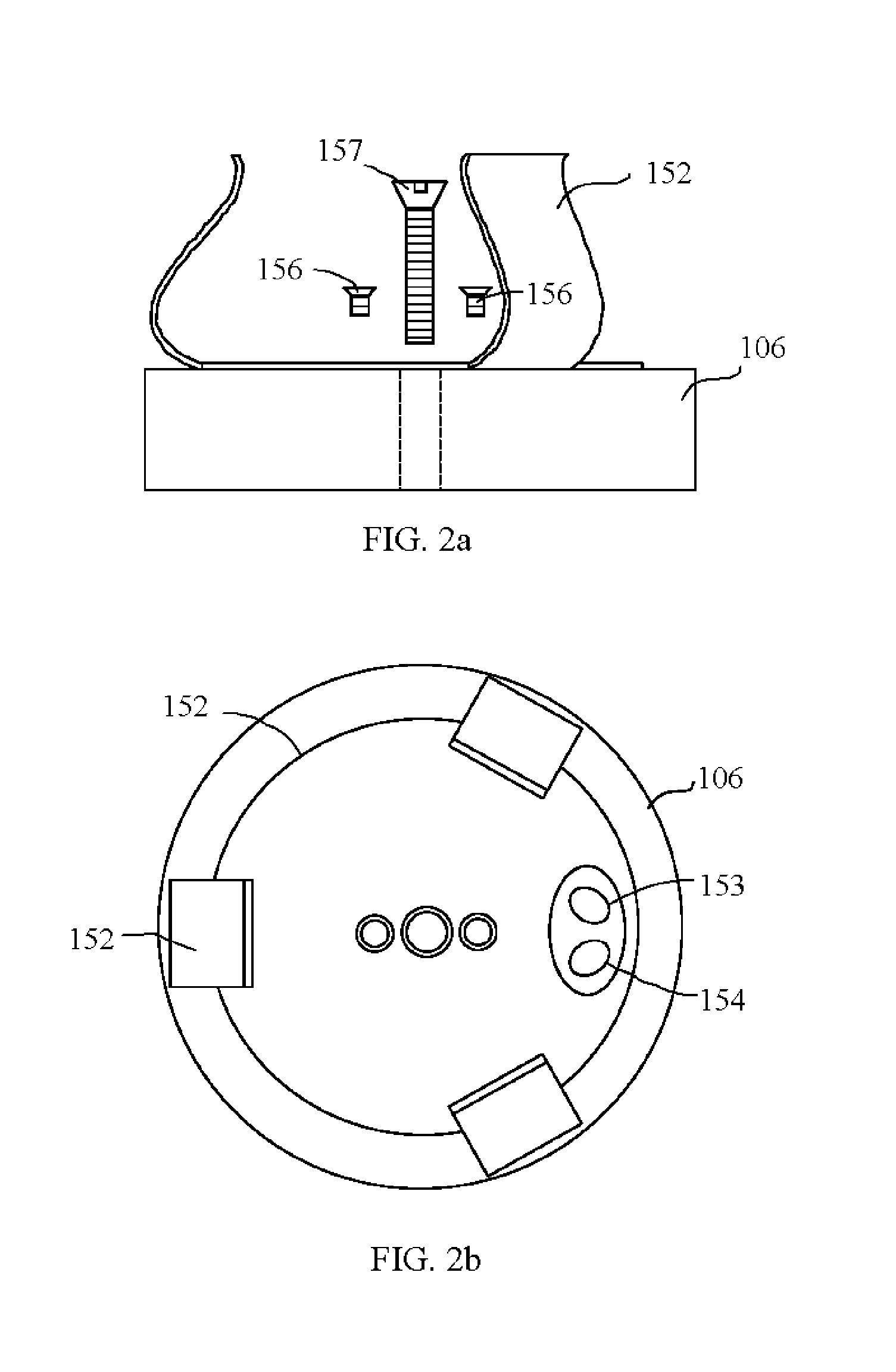
[0037] In the fourth embodiment, a typical standalone cell culture monitoring system mainly comprises one or more probes 106, a signal processing module 200 and a computer 600 as shown in FIG. 5. For flask culture in a typical incubator / shaker, the system also includes a culture flask 502, a flask clamp 152 and an opaque dark cover 155 that has a cup shape. Module 200 may comprises power supplies for probe 106, a signal conditioner, a user interface panel or buttons and its circuitry, a digital LED display, an alarm buzzer and a data acquisition circuitry that including an A / D converter and digital communication I / O. The communication I / O can be USB or RS232 or Ethernet that can be connected to computer 600 via wire or wireless method.
PUM
 Login to View More
 Abstract
Description
Claims
Application Information
 Login to View More