

Ceramic Particle Group and Method for Production Thereof and Use Thereof
a ceramic particle and ceramic technology, applied in the field of ceramic particle group, can solve the problems of inability to control the number, the particle diameter of the calcium phosphate (cap) particle cannot be uniformly controlled, and the hydroxyapatite (hap) particle (primary particle) fuses together, so as to achieve uniform particle diameter and small average particle diameter.
- Summary
- Abstract
- Description
- Claims
- Application Information
AI Technical Summary
Benefits of technology
Problems solved by technology
Method used
Image

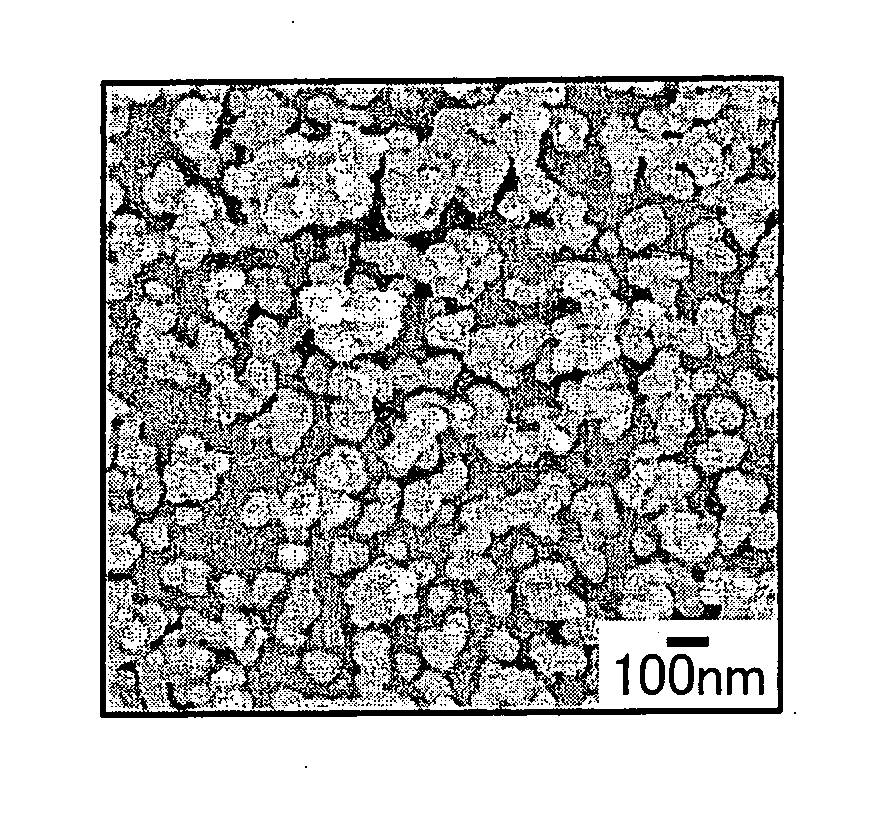
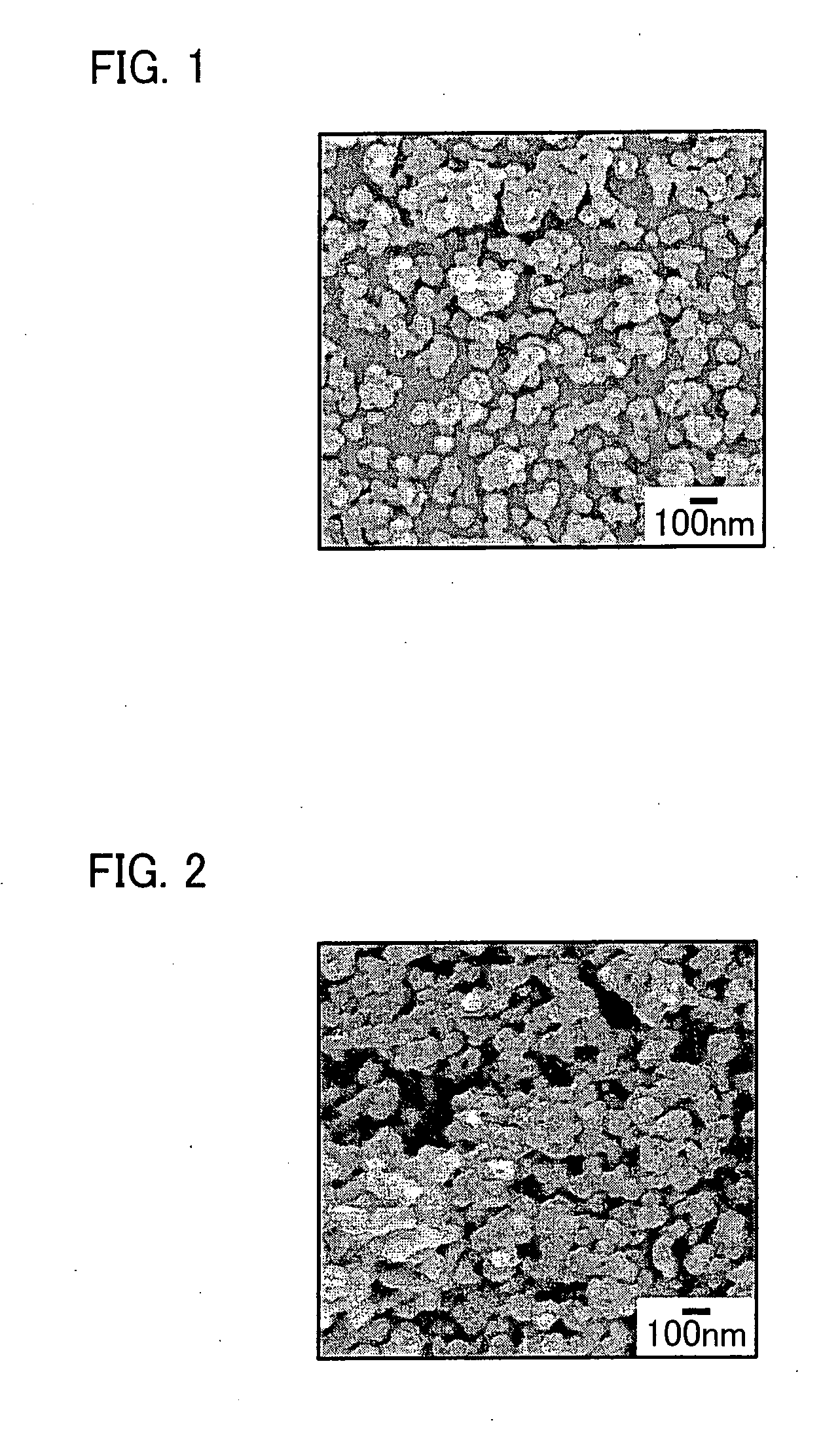
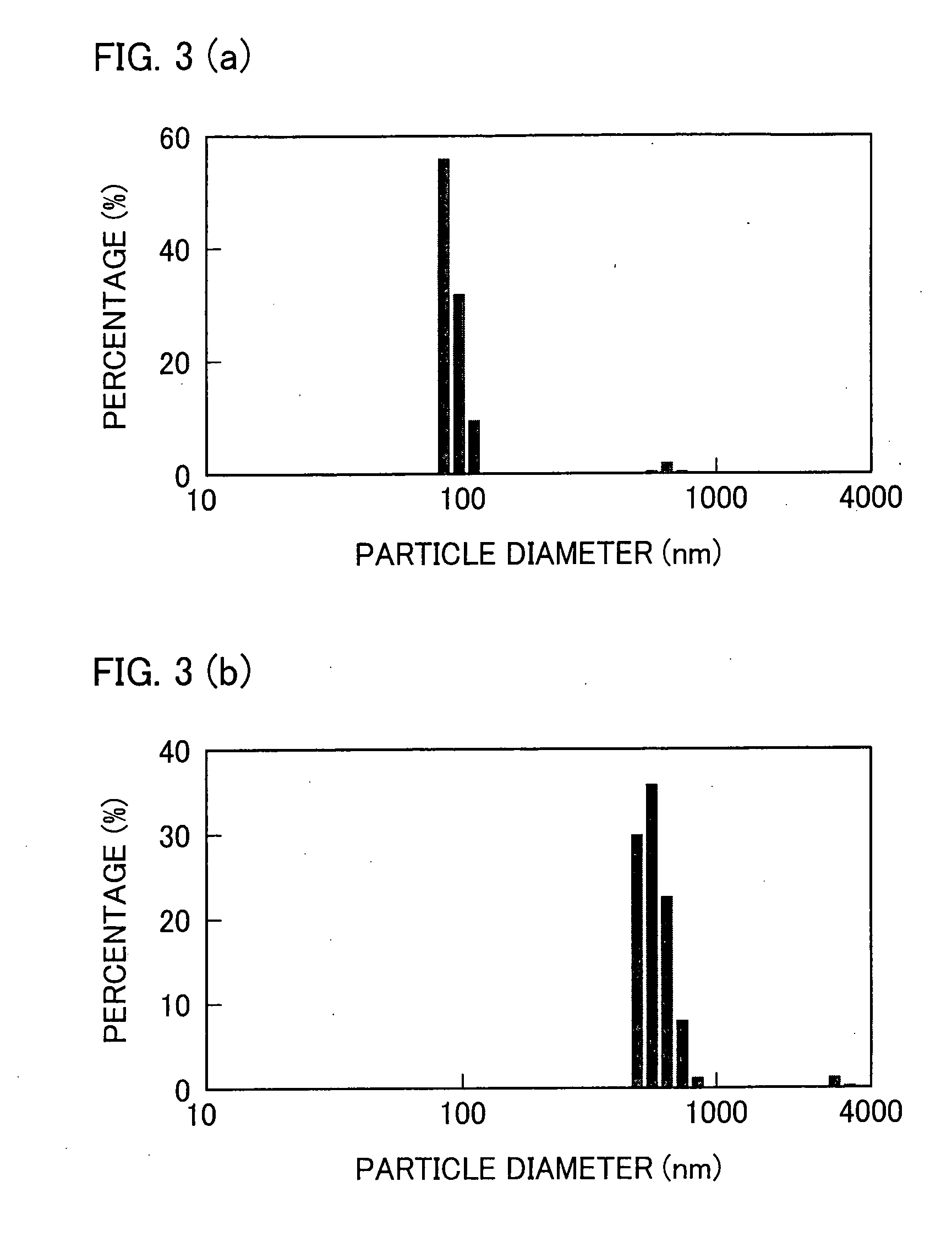
Examples
example 1
[0166] (Primary Particle Generating Step)
[0167] As a continuous oil phase, dodecane [CH3(CH2)10CH3] was used. As a non-ionic detergent, pentaethylene glycol dodecylether [CH3(CH2)10CH2O (CH2CH2O)4CH2CH2OH] with the cloud point of 31° C. was used. At room temperature, 40 ml of continuous oil phase containing 0.5 g of the non-ionic detergent was prepared. Then, 10 ml of 2.5 mol / l calcium hydroxide [Ca(OH)2]-dispersed aqueous solution was added to the continuous oil phase to prepare a water-in-oil solution (W / O solution). Then, 10 ml of 1.5 mol / l potassium dihydrogen phosphate [(KH2PO4)] solution was added to the W / O solution with agitation. The mixture was stirred for 24 hours at room temperature to promote reaction.
[0168] The product of reaction was separated and washed by centrifugation to obtain primary particles of hydroxyapatite (HAp). The primary particles in a primary particle group of hydroxyapatite (HAp) had a particle diameter of 30 nm to 100 nm. A coefficient of variation...
example 2
[0183] (Primary Particle Generating Step)
[0184] As a continuous oil phase, dodecane [CH3(CH2)10CH3] was used. As a non-ionic detergent, pentaethylene glycol dodecylether [CH3(CH2)10CH2O(CH2CH2O)4CH2CH2OH] with the cloud point of 31° C. was used. At room temperature, 40 ml of continuous oil phase containing 0.5 g of the non-ionic detergent was prepared. Then, 10 ml of 2.5 mol / l calcium hydroxide [Ca(OH)2]-dispersed aqueous solution was added to the continuous oil phase to prepare a water-in-oil solution (W / O solution). Then, 10 ml of 1.5 mol / l potassium dihydrogen phosphate [(KH2PO4)] solution was added to the W / O solution with agitation. The mixture was stirred for 24 hours at room temperature to promote reaction.
[0185] The product of reaction was separated and washed by centrifugation to obtain primary particles of hydroxyapatite (HAp). The primary particle groups of hydroxyapatite (HAp) were dispersed in ethanol and particle size distributions (distributions of particle diameter...
example 3
[0198] (Primary Particle Generating Step)
[0199] As a continuous oil phase, dodecane [CH3(CH2)10CH3] was used. As a non-ionic detergent, pentaethylene glycol dodecylether [CH3(CH2)10CH2O(CH2CH2O)4CH2CH2OH] with the cloud point of 31° C. was used. At room temperature, 40 ml of continuous oil phase containing 0.5 g of the non-ionic detergent was prepared. Then, at 95° C., 10 ml of 2.5 mol / l calcium hydroxide [Ca(OH)2]-dispersed aqueous solution was added to the continuous oil phase to prepare a water-in-oil solution (W / O solution). Then, 10 ml of 1.5 mol / l potassium dihydrogen phosphate [KH2PO4] aqueous solution was added to the W / O solution with agitation. The mixture was stirred for 24 hours at 95° C. to promote reaction.
[0200] The product of reaction was separated and washed by centrifugation to obtain primary particles of hydroxyapatite (HAp). The primary particle groups of hydroxyapatite (HAp) were dispersed in ethanol and particle size distributions (distributions of particle d...
PUM
| Property | Measurement | Unit |
|---|---|---|
| Fraction | aaaaa | aaaaa |
| Fraction | aaaaa | aaaaa |
| Particle diameter | aaaaa | aaaaa |
Abstract
Description
Claims
Application Information
 Login to View More