
Microorganism modified for the production of 1,3-propanediol
a technology of 1,3-propanediol and microorganisms, which is applied in the direction of biochemical equipment and processes, enzymes, lyases, etc., can solve the problems of e. coli not being naturally capable of producing pdo, affecting the cost-efficient and environmentally friendly chemical production of pdo, and low product yields
- Summary
- Abstract
- Description
- Claims
- Application Information
AI Technical Summary
Benefits of technology
Problems solved by technology
Method used
Image

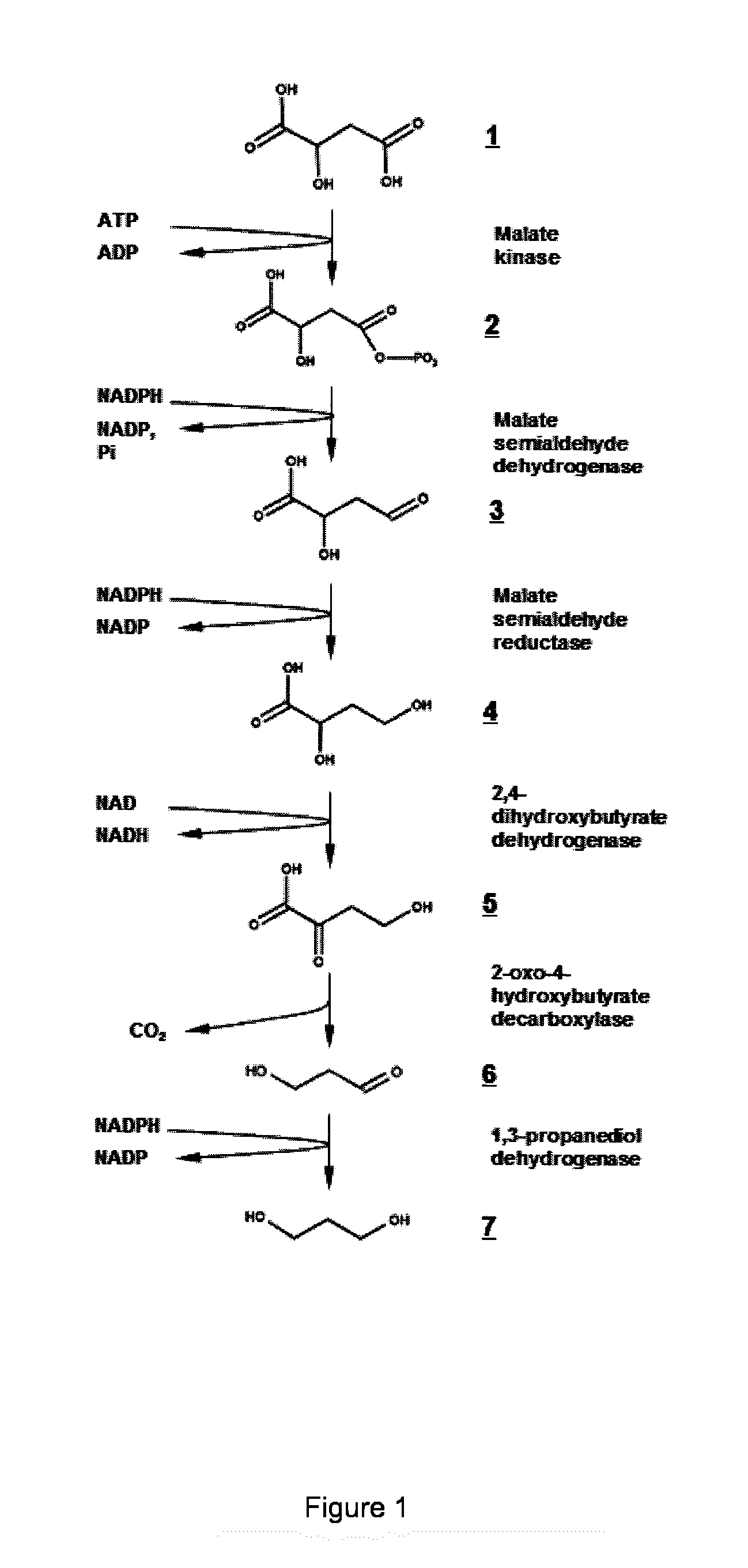
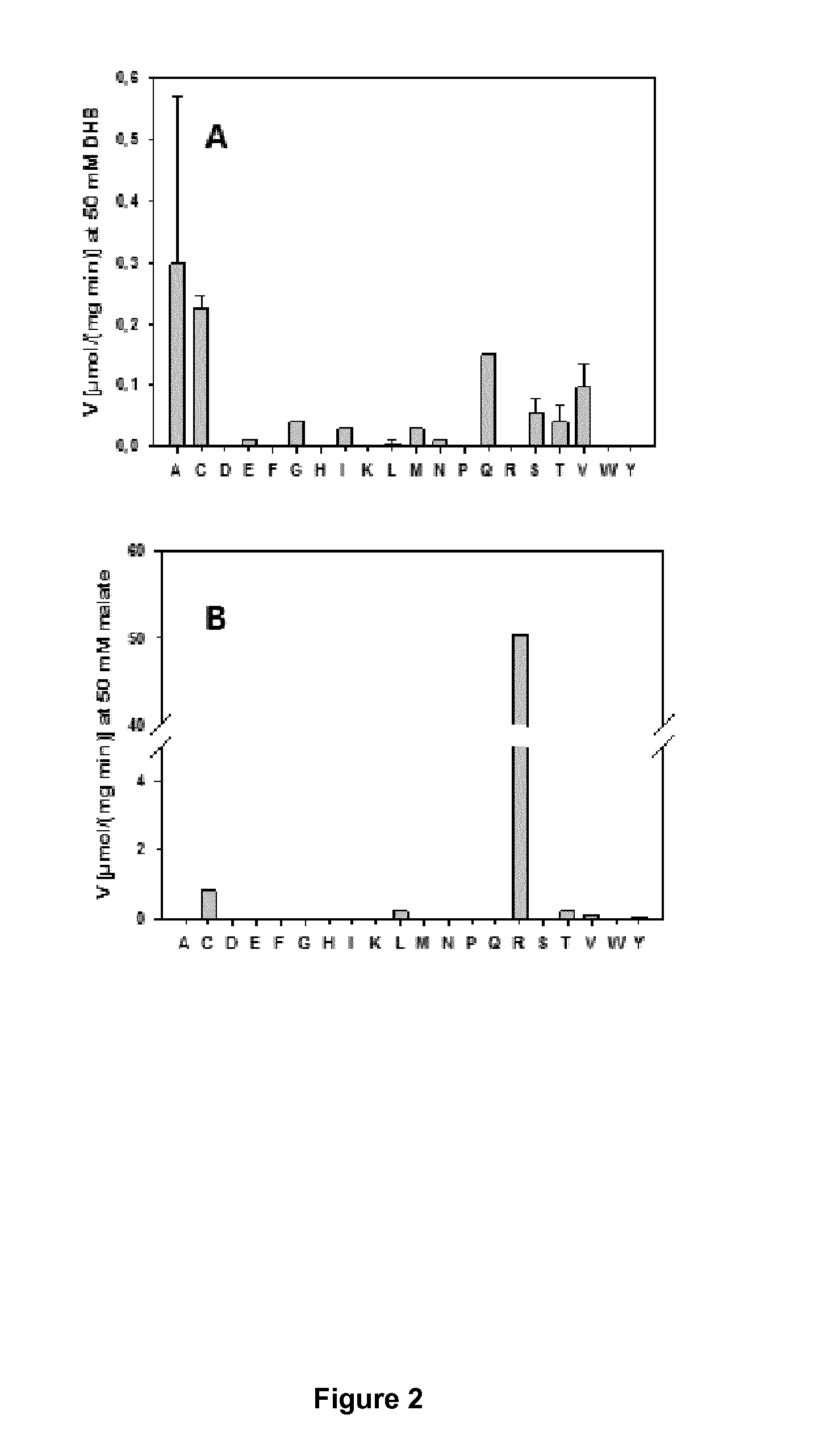
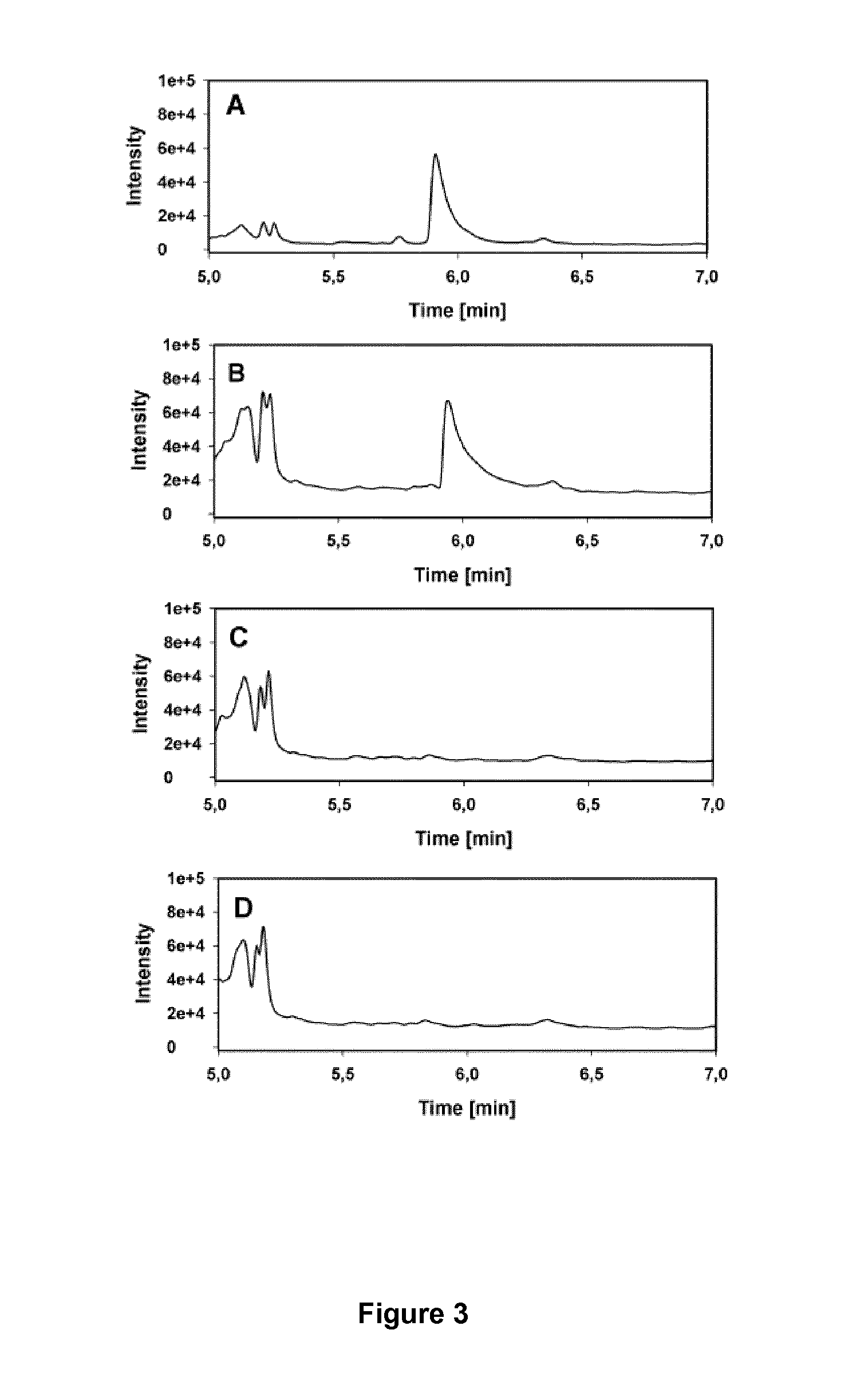
Examples
example 1
Demonstration of 2,4-dihydroxybutyrate dehydrogenase activity
Construction of Plasmids Containing Wild-Type Genes Coding for Candidate DHB Dehydrogenase Enzymes
[0067]The genes coding for (L)-lactate dehydrogenase of Lactococcus lactis, IdhA, (L)-malate dehydrogenase of Escherichia coli, mdh, (L)-malate dehydrogenase of Bacillus subtilis, mdh, and for the membrane associated (L)-lactate dehydrogenase of E. coli, lldD, were amplified by PCR using the high-fidelity polymerase Phusion™ (Fermentas) and the primers listed in Table 1. Genomic DNAs of E. coli MG1655, L. Lactis IL1403, and B. subtilis strain 168 were used as the template. The primers introduced restriction sites (Table 1) upstream of the start codon and downstream of the stop codon, respectively, facilitating the ligation of the digested PCR products into the corresponding sites of the pET28a+ (Novagen) expression vector using T4 DNA ligase (Fermentas). Ligation products were transformed into E. coli DH5α cells. The resulting...
example 2
Construction of Malate Dehydrogenase Enzymes with Improved DHB Dehydrogenase Activity
[0080]Site-directed mutagenesis of the E. coli mdh and the B. subtilis mdh genes were carried out using the oligonucleotide pairs listed in Table 3 and the pET28-Ec-mdh and the pET28-Bs-mdh plasmids as the templates. Point mutations to change the amino acid sequence were introduced by PCR (Phusion 1 U, HF buffer 20% (v / v), dNTPs 0.2 mM, direct and reverse primers 0.04 μM each, template plasmid 50 ng, water) using the oligonucleotide pairs listed in Table 3. Mutated genes contained a new restriction site listed in Table 3 (introduced using silent mutations) in addition to the functional mutation to facilitate identification of mutated clones. The PCR products were digested by Dpnl at 37° C. for 1 h to remove template DNA, and transformed into competent E. coli DH5-alpha cells (NEB). The mutated plasmids were identified by restriction site analysis and verified to carry the desired mutations by DNA se...
example 3
Construction of (L)-Lactate Dehydrogenase Enzymes with Improved DHB Dehydrogenase Activity
[0084]Site-directed mutagenesis of the E. coli lldD gene was carried out using the oligonucleotide pairs listed in Table 5 and the pET28-Ec-lldD plasmid as the template.
Table 5Oligonucleotides used to mutate (L)-lactatedehydrogenaseIIdD from E. coli.Primer sequences RestrictionProteinMutation5′-3′siteEc-LldDV108CTTCCGTTTACTCTGTCHinCIIGACGTGTTCCGTTTGCCCGA(SEQ ID NO. 173)TCGGGCAAACGGAACCCGTCGACAGAGTAAACGGAA(SEQ ID NO. 174)
[0085]Mutant enzymes were expressed, purified and tested for DHB dehydrogenase and lactate dehydrogenase activity as described in Example 1. The results of the enzymatic measurements are summarized in Table 6. It was demonstrated that replacement of Val108 by cysteine changes the specificity of the enzyme in favour of DHB.
TABLE 6Summary of kinetic parameters of E. coli lactatedehydrogenase, LldD, mutants on lactate and DHBMax. specific activityKmMutant[μmol / (mg min)][mM]EnzymeS...
PUM
| Property | Measurement | Unit |
|---|---|---|
| pH | aaaaa | aaaaa |
| bed volume | aaaaa | aaaaa |
| pH | aaaaa | aaaaa |
Abstract
Description
Claims
Application Information
 Login to View More