Method for making a friction stir welding tool
a friction stir and welding tool technology, applied in welding/soldering/cutting articles, other manufacturing equipment/tools, non-electric welding apparatus, etc., can solve the problems of tungsten from the tool being diffused into the steel, tool exposed to harsh conditions, and void defects at the root of some welded regions
- Summary
- Abstract
- Description
- Claims
- Application Information
AI Technical Summary
Benefits of technology
Problems solved by technology
Method used
Image

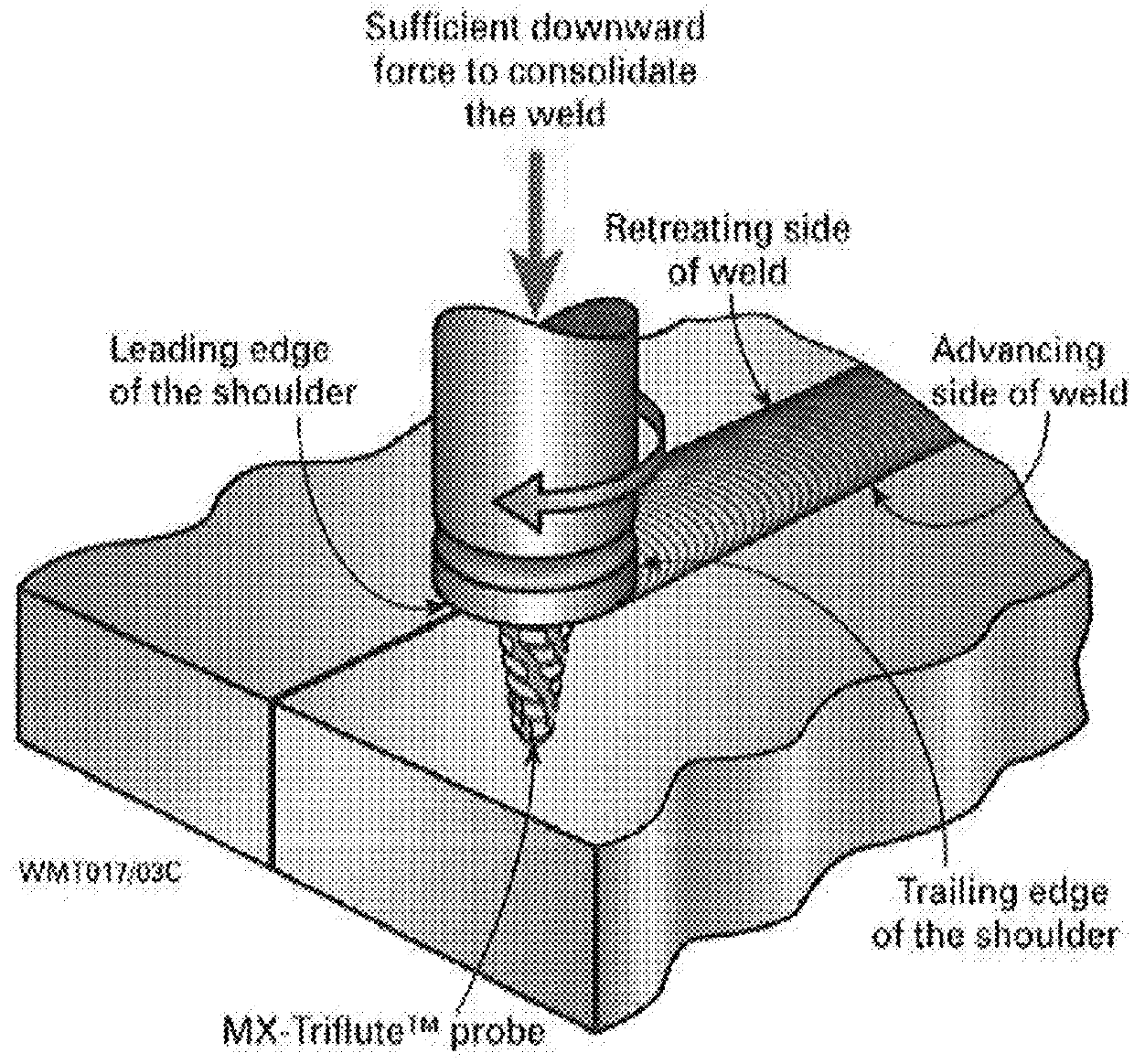
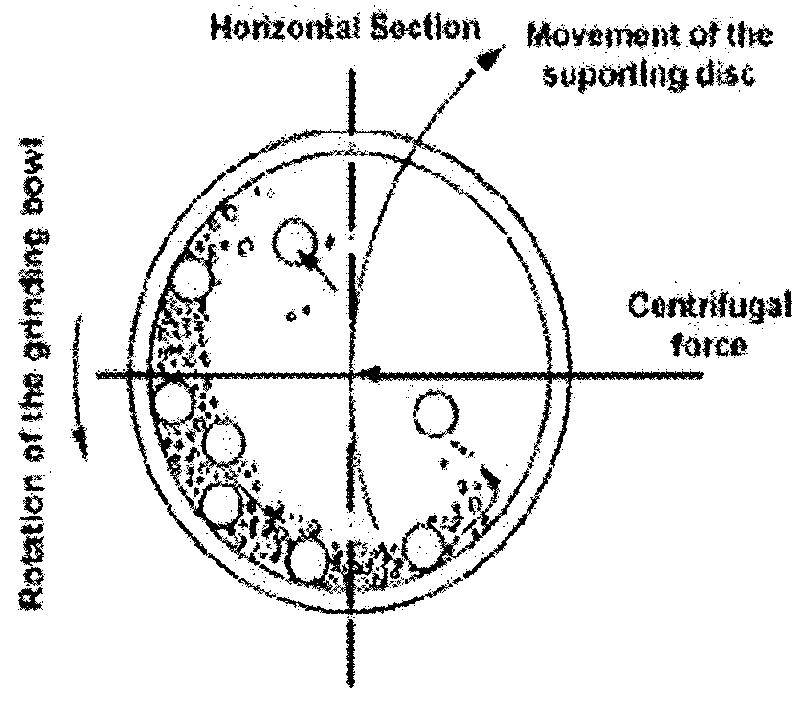
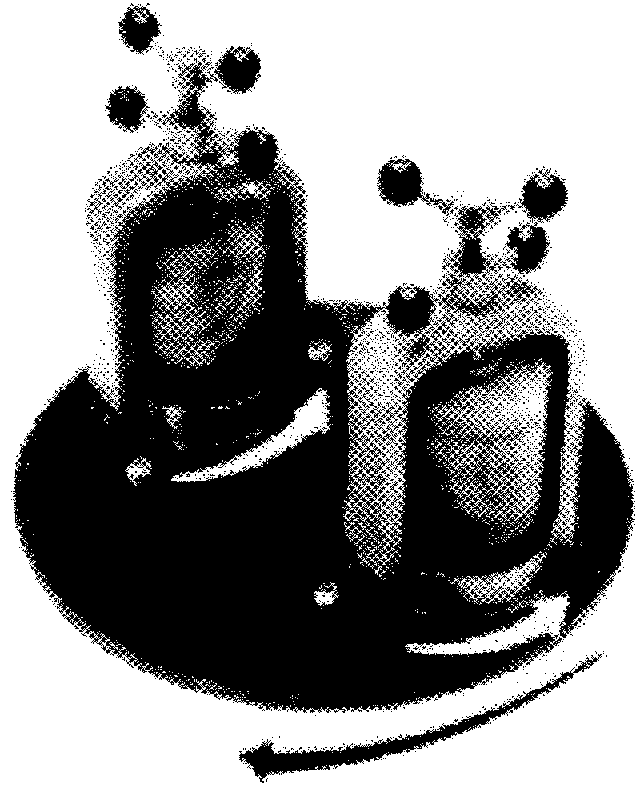
Examples
example 1
[0240]The following examples demonstrate the synthesis of W-25% Re nanocrystalline alloy reinforced with Hafnium Carbide HfC by using mechanical alloying and Spark Plasma Sintering (SPS), which was shown to have a relatively high hardness and high wear resistance, and it can tolerate the harsh conditions of FSW of steel. One reason for selecting a composite of W-25% Re nanocrystalline alloy reinforced with Hafnium Carbide for this investigation is to employ the advantage of superior high temperature properties of these elements (all the components have melting points more than 3000° C.). The addition of Re will decrease the ductile to brittle transition temperature of the tool. Nanocrystalline W-25% Re solid solution can be synthesized by mechanical alloying (MA) and Spark plasma sintering (SPS). The homogenous dispersion of HfC particles inside the W-25% Re will enhance the strengthening effect at high temperature.
example 2
& Method
[0241]A W-25% Re alloy was chosen as the best candidate for the development of the tool. One best mode of synthesis of W-25 wt % Re alloy and W-25 wt % Re+Xvol % HfC composites powders via mechanical alloying has been overviewed in this example.
[0242]Semi-alloyed W-25-wt. % Re and HfC powders supplied by Rhenium Alloys, USA, were used in this investigation. Nanostructured W-25Re alloy and homogenous W-25Re-HfC composites containing 5 and 10 vol. % of HfC particles were produced using MA. The experiments were carried out in a planetary ball mill (Fritsch Pulverisette, P5, Idar-Oberstein, Germany). Since the use of steel vials and balls introduces Fe contamination, tungsten carbide vials (250 mL in volume) and balls (10 mm in diameter) were used to avoid contamination of the powders. See M. S. Boldrick, E. Yang, C. N. J. Wagner J. Non-Cryst. Solids, 150 (1992), pp. 478-482; and E. Y Ivanov, C Suryanarayana, B. D Bryskin, Synthesis of a nanocrystalline W-25 wt. % Re alloy by me...
example 3
ization of as-Received Powders
[0245]Particles Size Analysis
[0246]As-received powders were characterized for particle size analysis by particle size analyzer. It was found that both the powders were in the sub-micrometer size as shown in FIG. 11 and FIG. 12 respectively. The result shows that partially alloyed W-25% Re powder was in the early stages of milling.
[0247]Field Emission-SEM and XRD Pattern of HfC
[0248]FE-SEM image of HfC powder is presented in FIG. 13A. The particles have sub-micron size and various shapes ranging from elongated to irregular. FIG. 13B shows XRD pattern of HfC powder, the compound has a cubic crystal structure of the NaCl type.
PUM
| Property | Measurement | Unit |
|---|---|---|
| crystallite size | aaaaa | aaaaa |
| temperature | aaaaa | aaaaa |
| crystallite size | aaaaa | aaaaa |
Abstract
Description
Claims
Application Information
 Login to View More
 - R&D
- Intellectual Property
- Life Sciences
- Materials
- Tech Scout
- Unparalleled Data Quality
- Higher Quality Content
- 60% Fewer Hallucinations
Browse by: Latest US Patents, China's latest patents, Technical Efficacy Thesaurus, Application Domain, Technology Topic, Popular Technical Reports.
© 2025 PatSnap. All rights reserved.Legal|Privacy policy|Modern Slavery Act Transparency Statement|Sitemap|About US| Contact US: help@patsnap.com