
Nucleic acid, composition and conjugate containing same, preparation method, and use thereof
a technology of nucleic acid and composition, applied in the field of preparation method, can solve problems such as threatening the health of patients worldwide, and achieve the effects of inhibiting expression, high stability and/or higher activity in vivo, and excellent performan
- Summary
- Abstract
- Description
- Claims
- Application Information
AI Technical Summary
Benefits of technology
Problems solved by technology
Method used
Image

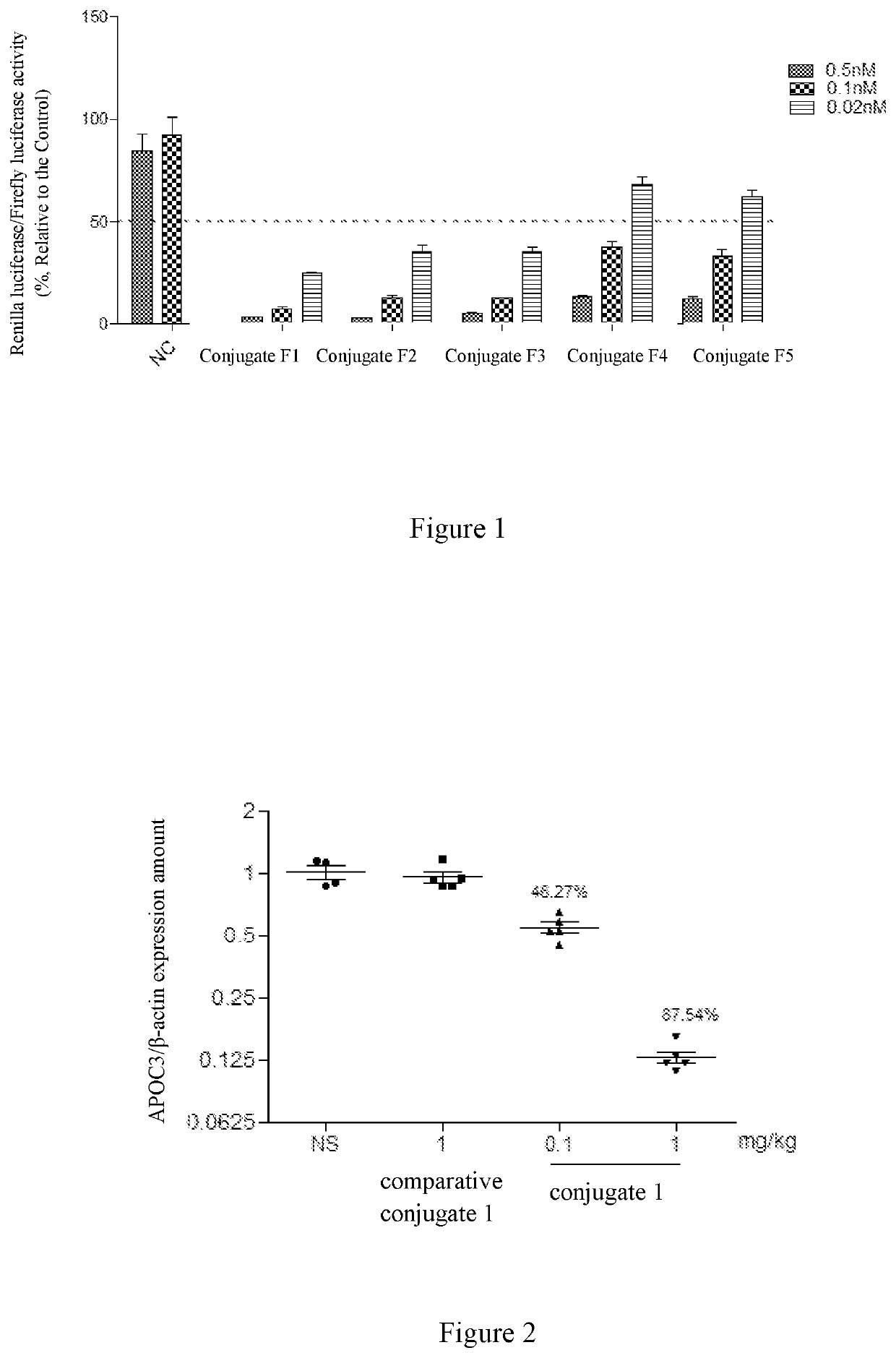
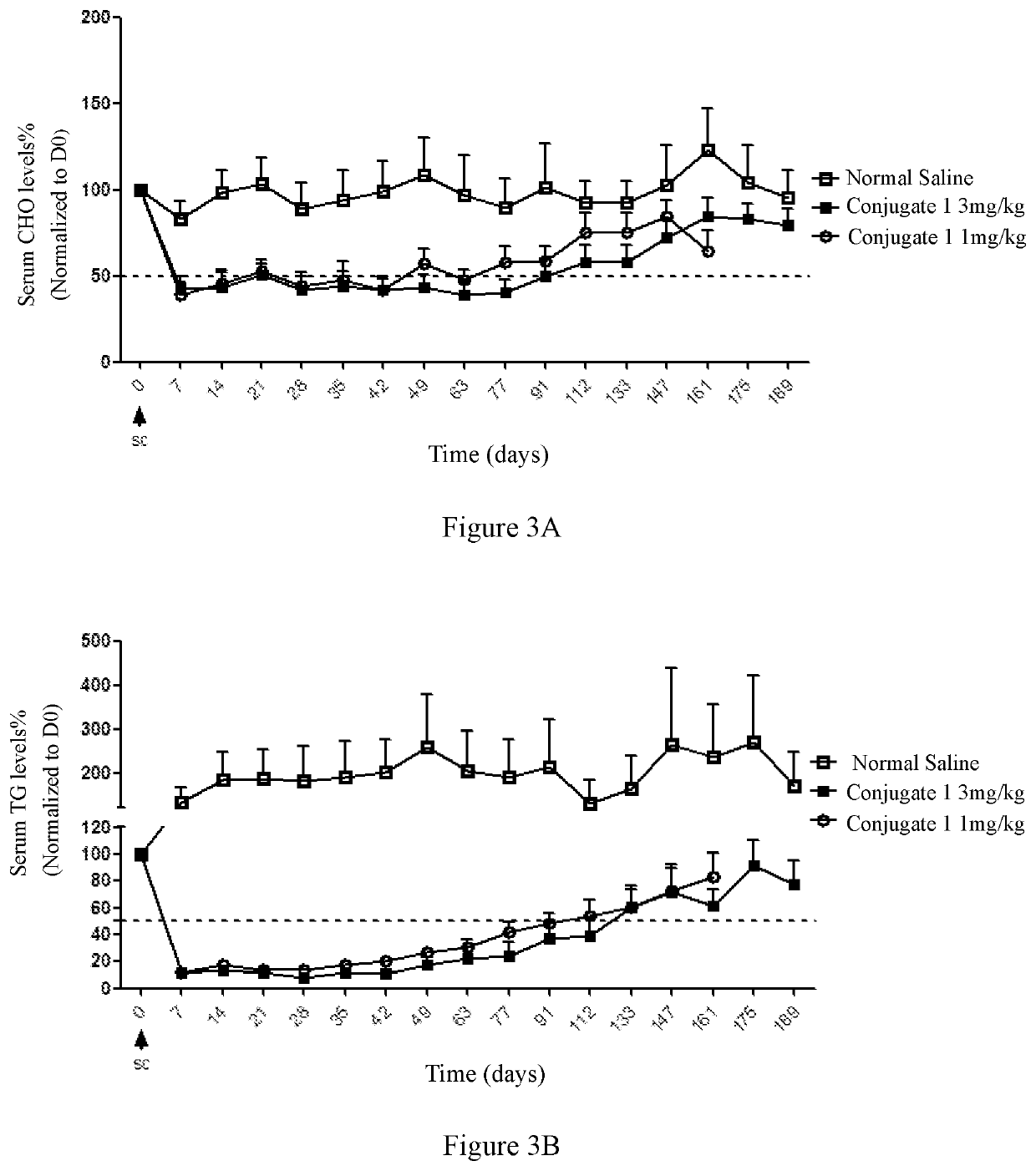
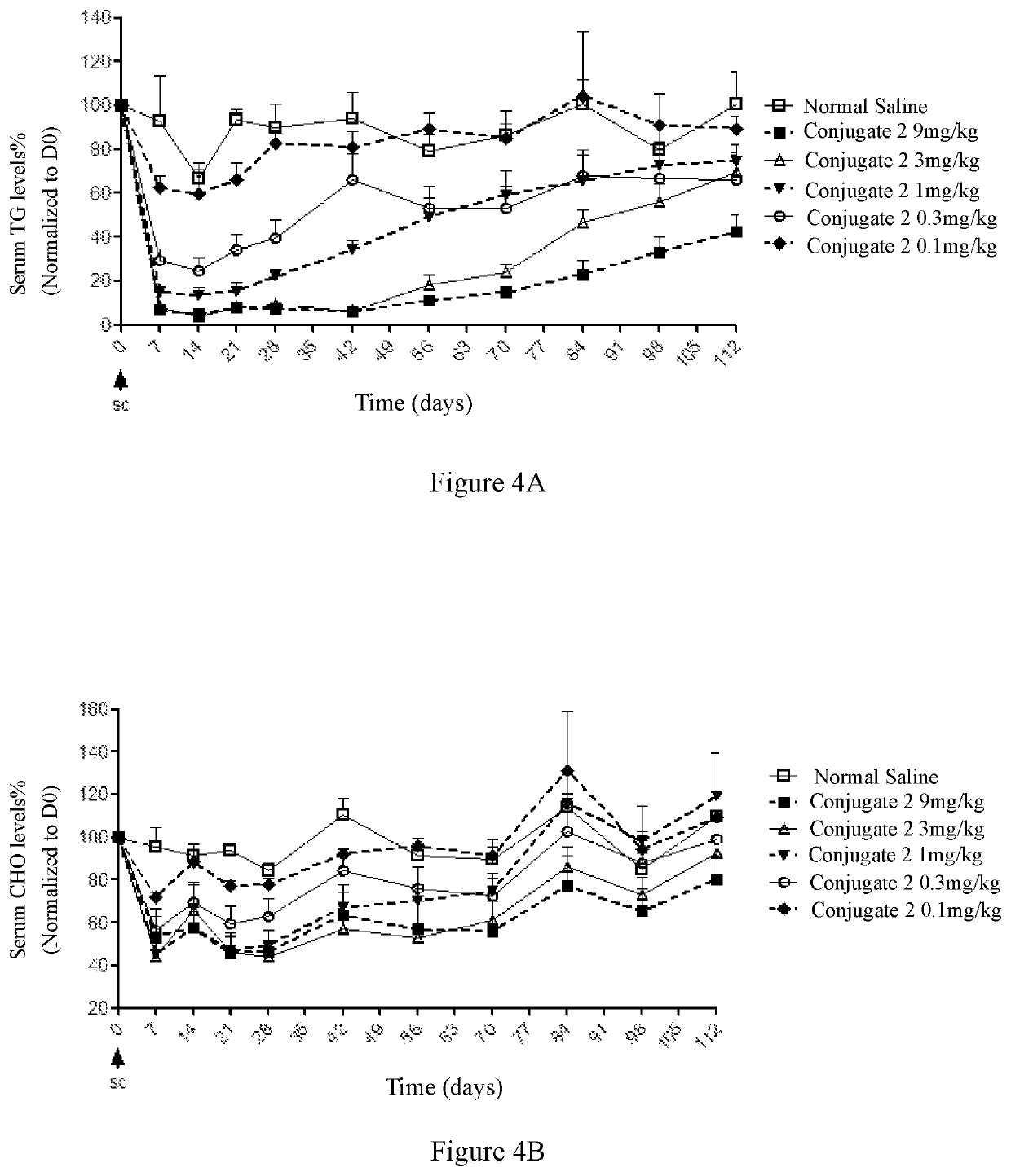
Examples
preparation example 1
onjugates 1-3
[0418]In this preparation example, conjugates 1-3 (hereinafter also referred to as L10-siAP1M2SVP, L10-siAP1M2 SP and L10-siAP1M2SPs conjugate respectively) were synthesized. The above-mentioned conjugates were those formed by conjugating L-9 conjugating molecule with the siRNA No. siAP1M2SVP, siAP1M2SP, or siAP1M2SPs. The sequences of the conjugated siRNAs in said conjugates were shown in Table 3.
[0419](1-1) Synthesis of Compound L-10:
[0420]Compound L-10 was synthesized according to the following method.
[0421](1-1-1) Synthesis of the Conjugating Terminal Segment GAL-5:
[0422](1-1-1a) Synthesis of GAL-2:
[0423]100.0 g of GAL-1 (N-acetyl-D-galactosamine hydrochloride, CAS No.: 1772-03-8, purchased from Ning Bo hongxiang bio-chem Co., Ltd., 463.8 mmol) was dissolved in 1000 ml of anhydrous pyridine, to which 540 ml of acetic anhydride (purchased from Enox Inc., 5565.6 mmol) was added in an ice water bath to react for 1.5 hours under stirring at room temperature. The resulti...
preparation example 2
ates 4-21 and Comparative Conjugates 1-2
[0488]Comparative conjugates 1-2 were synthesized, and conjugates 4-21 were expected to be prepared by using the same method as that in Preparation Example 1, except that: 1) the siRNAs respectively have the sequences as shown in Table 3 corresponding to comparative conjugates 1-2 and conjugates 4-21; 2) when the target sequence comprises unmodified nucleotides, in the cleavage and deprotection conditions, after treatment with aqueous ammonia, the product was dissolved in N-methylpyrrolidone in an amount of 0.4 ml / μmol, followed by addition of 0.3 ml / μmol of triethylamine and 0.6 ml / μmol of triethylamine trihydrofluoride, with respect to the amount of the single strand nucleic acid, thereby removing the 2′-TBDMS protection on ribose.
TABLE 3siRNA ConjugatessiRNASEQ IDConjugateNo.Sequence Direction 5′-3′NOconjugate1L10-siAP1M2SVPSCmsAmsAmUmAmAmAfGfCfUmGmGmAmCmAm22AmGmAmAmASVP-UmsUfsCmUmUmGfUmCmCmAmGmCmUmUf40UmAfUmUmGmsGmsGmconjugate2L10-siAP1M2S...
preparation example 3
AP1M2SP Conjugate (Conjugate 22) (3-1) Synthesis of Compound P-10
[0489]Compound P-10 was synthesized according to the following method:
[0490](3-1-1) Synthesis of GAL5-C4-1
[0491]GAL-5 (13.43 g, 30.0 mmol) obtained according to the method described in (1-1-1) above, t-butyl 4-aminobutyrate hydrochloride (5.87 g, 30.0 mmol), O-benzotriazol-tetramethyluronium hexafluorophosphate (13.65 g, 36.0 mmol) and diisopropylethylamine (11.63 g, 90.0 mmol) were added to 40 ml of N,N-dimethylformamide, dissolved uniformly and then stirred at room temperature to react for 5 hours. 300 ml of saturated aqueous sodium bicarbonate solution was added to the reaction solution, and then extracted three times, each with 200 ml of ethyl acetate. The organic phases were combined and washed once with 200 ml of saturated brine. The organic phase was isolated and dried with anhydrous sodium sulfate. The solvent was evaporated to dryness under reduced pressure to give 30.3 g of crude product GAL5-C4-1 as oil, whi...
PUM
| Property | Measurement | Unit |
|---|---|---|
| diameter | aaaaa | aaaaa |
| diameter | aaaaa | aaaaa |
| diameter | aaaaa | aaaaa |
Abstract
Description
Claims
Application Information
 Login to View More