
Laser irradiation apparatus, laser irradiation method, and method of manufacturing a semiconductor device
a laser irradiation and semiconductor technology, applied in metal working apparatus, transistors, manufacturing tools, etc., can solve the problems of fluctuation among tfts on the same substrate, and achieve excellent uniformity of energy distribution, lightening of weight, and enhancing durability or the like
- Summary
- Abstract
- Description
- Claims
- Application Information
AI Technical Summary
Benefits of technology
Problems solved by technology
Method used
Image

Examples
embodiment 1
This embodiment gives a description on energy density suitable for annealing in the present invention with reference to FIG. 19.
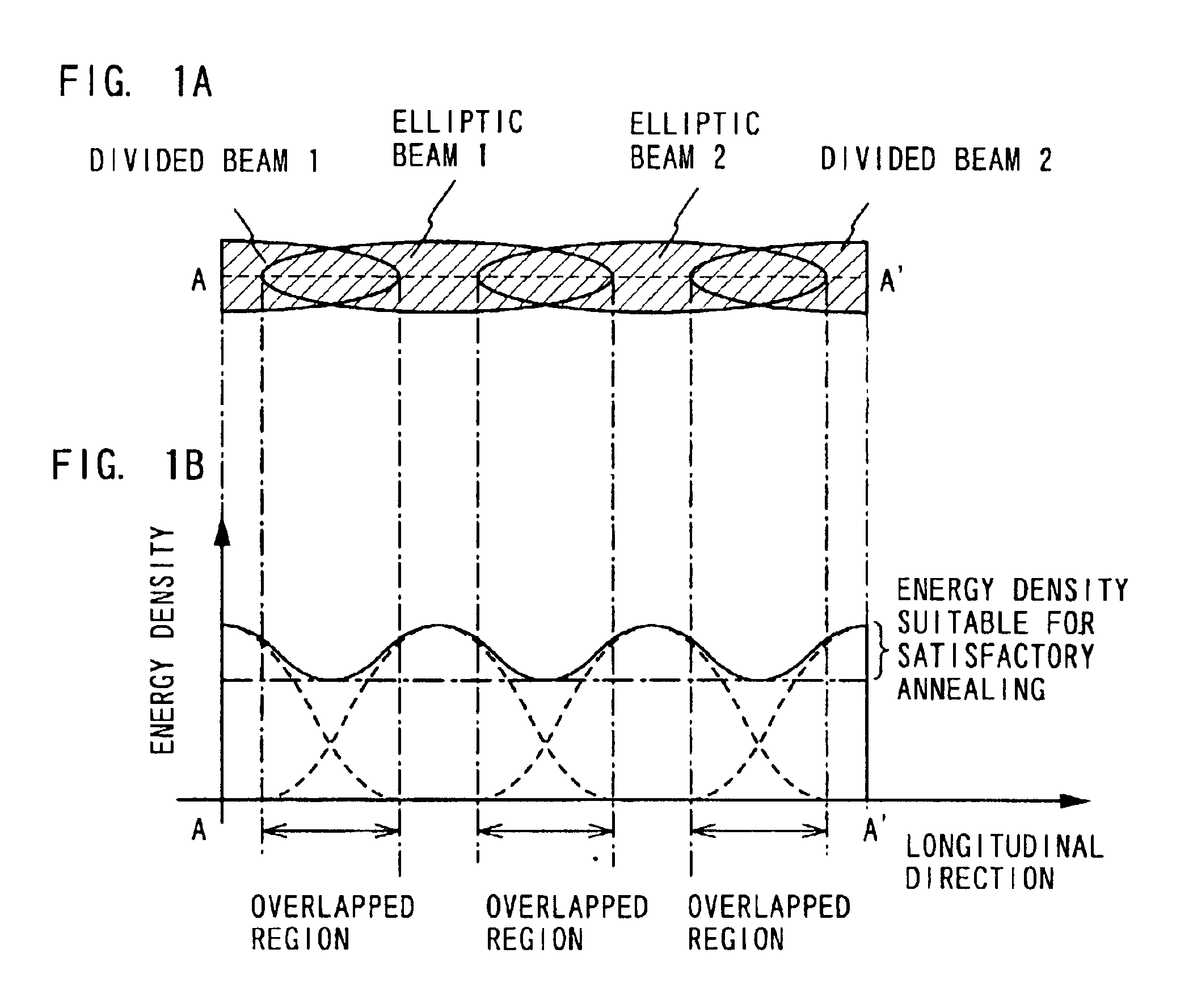
FIG. 19 is the simulation result of energy density distribution when one of laser beams emitted from three lasers is divided and attenuation regions of the divided laser beams are synthesized with attenuation regions of other laser beams as shown in FIGS. 1A to 1B. The lasers used here are YAG lasers and laser beams emitted from the lasers are converted into the second harmonic by LBO crystals. The beam diameter of the laser light is set to 2.25 mm (1 / e2 width) and the TEM∞ mode is employed. In FIG. 19, the dotted line indicates the energy density in the longitudinal direction and the solid line indicates the energy density in the lateral direction.
FIG. 19 shows that distribution of the energy density in the longitudinal direction is within ±10% of the average of the energy density except for attenuation regions. A region with crystals of large diameters ca...
embodiment 2
This embodiment describes an example of laser irradiation apparatus for carrying out the present invention with reference to FIG. 3.
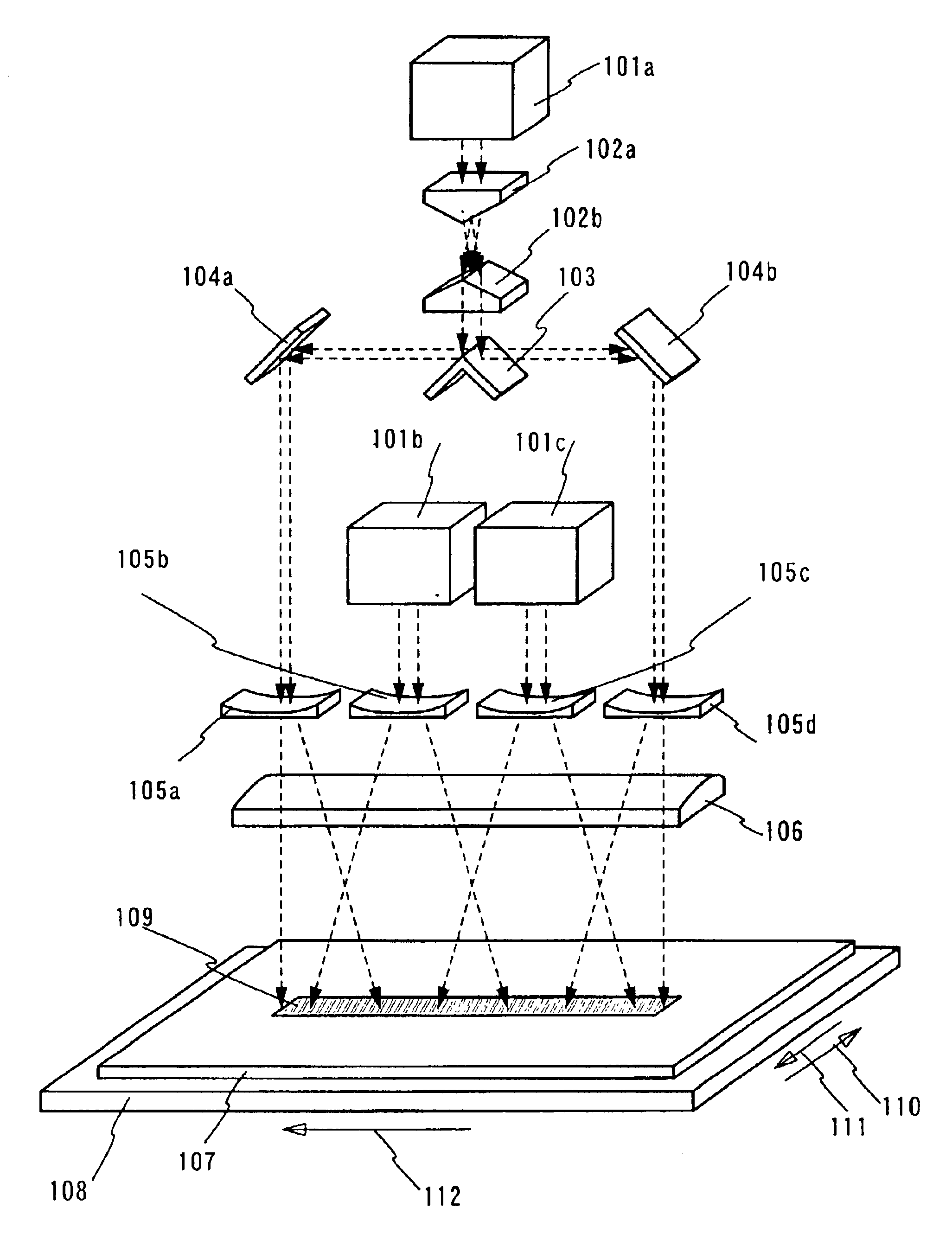
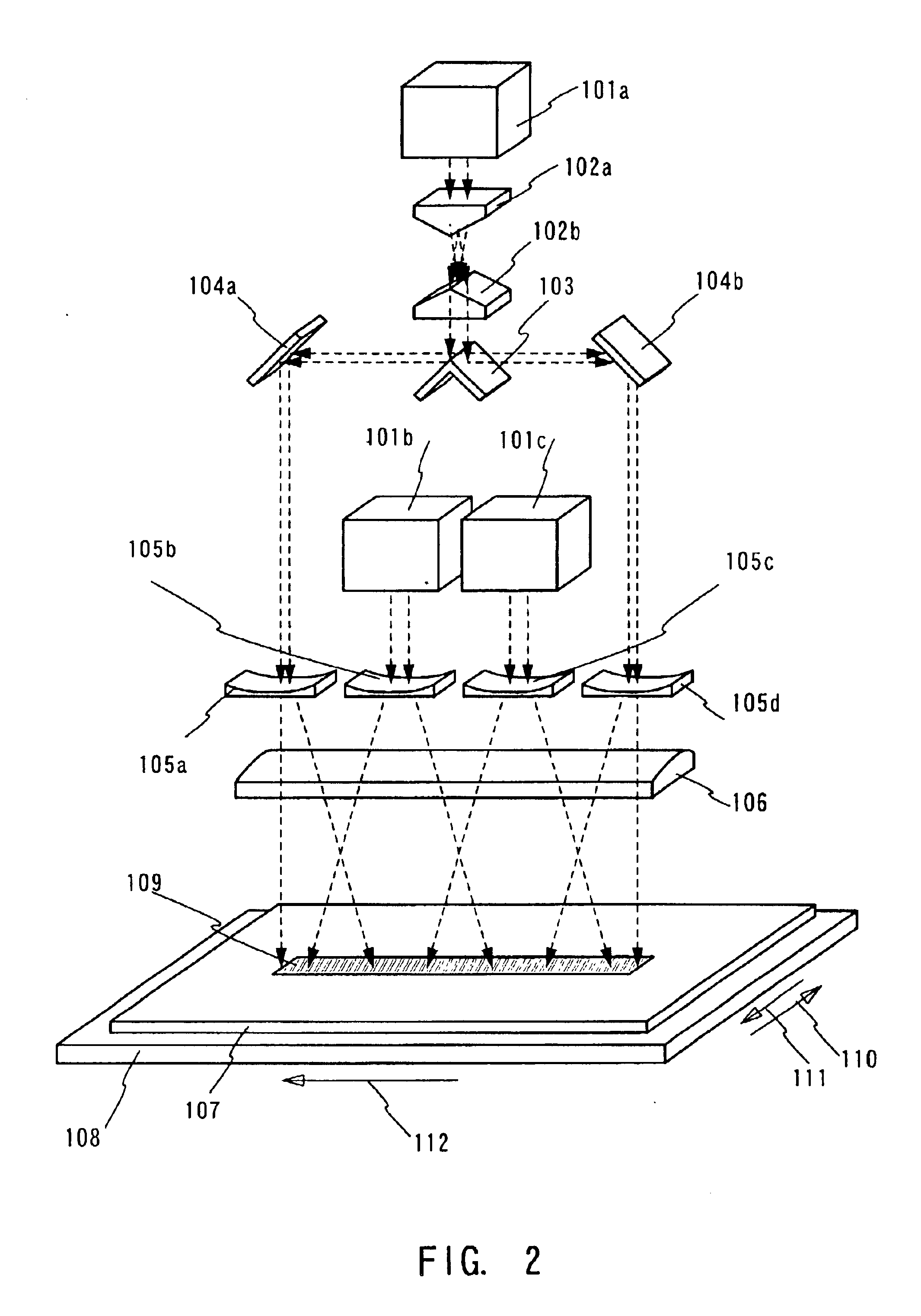
Laser beams emitted from lasers 101b and 101c are widened in the longitudinal direction by concave cylindrical lenses 105b and 105c, respectively. Though not shown in the drawing, beam collimators for changing the laser beams emitted from the lasers 101b and 101c into parallel beams and beam expanders for expanding laser light may be placed between the lasers 101b and 101c and the concave cylindrical lenses 105b and 105c. The laser beams reach a substrate 107 after they are collected in the lateral direction by a convex cylindrical lens 106 that has curvature in the lateral direction.
On the other hand, laser light emitted from a laser 101a is divided by a mirror 103 in two directions. Though not shown in the drawing, a beam collimator for changing a laser beam emitted from the laser 101a into parallel beams and a beam expander for expanding laser light ...
embodiment 3
This embodiment describes with reference to FIG. 4 apparatus and method for irradiating a substrate with laser light from lasers placed on both sides of the substrate.
Lasers 101a to 101c are arranged such that they are staggered with respect to a substrate 107. Laser beams emitted from the lasers 101a to 101c are collected in the lateral direction by convex cylindrical lenses 122a to 122c, respectively, and then reach the substrate 107. Though not shown in the drawing, beam collimators for changing the laser beams emitted from the lasers 101a to 101c into parallel beams and beam expanders for expanding laser light may be placed between the lasers 101a to 101c and the convex cylindrical lenses 122a to 122c.
On the other hand, laser light emitted from a laser 101d is divided by mirrors 123a and 123b in two directions. This is for forming, on the substrate 107, laser light 129 every part of which has enough energy density. By dividing the laser light emitted from the laser 101d (initia...
PUM
| Property | Measurement | Unit |
|---|---|---|
| wavelength | aaaaa | aaaaa |
| aspect ratio | aaaaa | aaaaa |
| aspect ratio | aaaaa | aaaaa |
Abstract
Description
Claims
Application Information
 Login to View More