Check patentability & draft patents in minutes with Patsnap Eureka AI!

Method for preparing brewers wort

a technology of brewers wort and wort, which is applied in the field of preparation of brewers wort, can solve the problems identifying real-world opportunities to manage the diacetyl problem, and imposing the prior predictability of what effects the diacetyl production can have, and achieves the effect of reducing the production of -acetolacta

Inactive Publication Date: 2007-02-06
LABATT BREWING CO LTD
View PDF1 Cites 0 Cited by
  • Summary
  • Abstract
  • Description
  • Claims
  • Application Information

AI Technical Summary

Benefits of technology

[0016]Broadly speaking, present invention provides an opportunity to control diacetyl production but based on a better fundamental understanding of the effects of wort composition and depletion during fermentation, especially as it relates to amino acid biosynthetic pathways—and in particular in the context of the industrial environment where the yeast physiology / biochemistry of production brewing strains acting on complex industrial media is a reality. A priori predictability of what effects diacetyl production is enormously complicated owing to the nature of brewery wort. It is a complex mixture of several hundreds of different chemical components, some of which include carbohydrates, proteins, amino acids, polypeptides, lipids, polyphenols, organic ions, vitamins, hop components, and other numerous nutrients, minerals, etc.—with the result that identifying real-world opportunities to manage the diacetyl problem is enormously complicated.
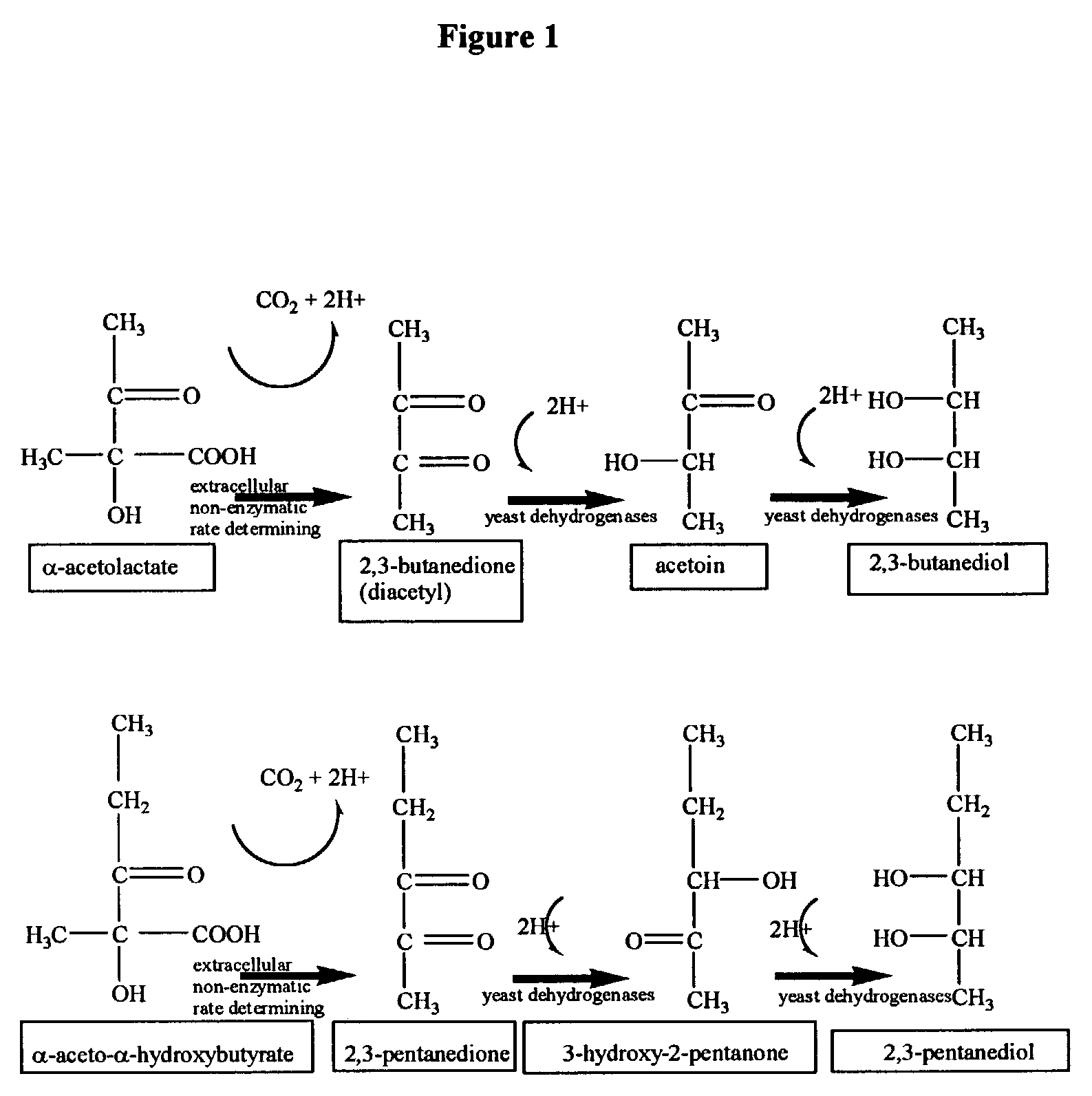
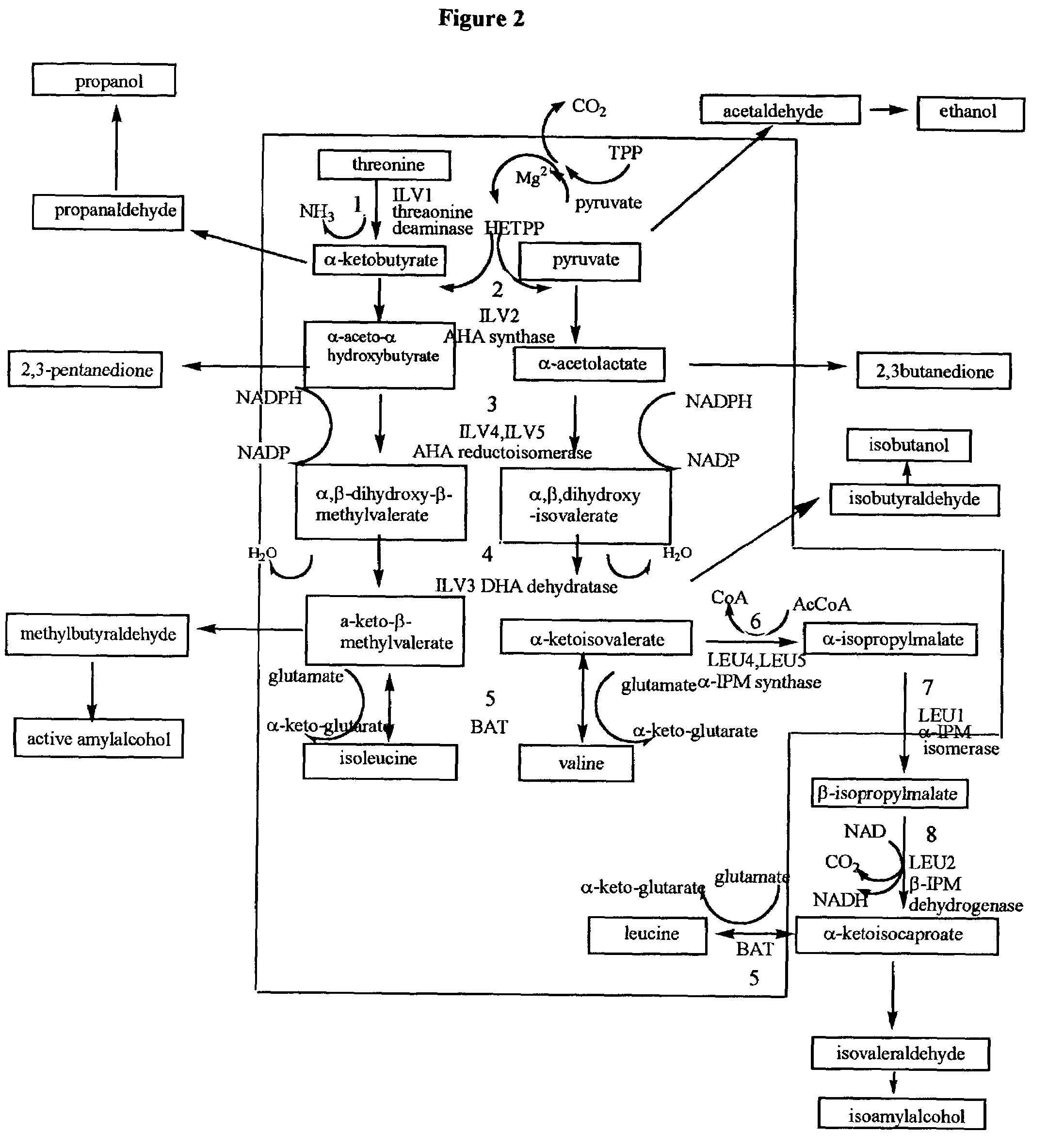
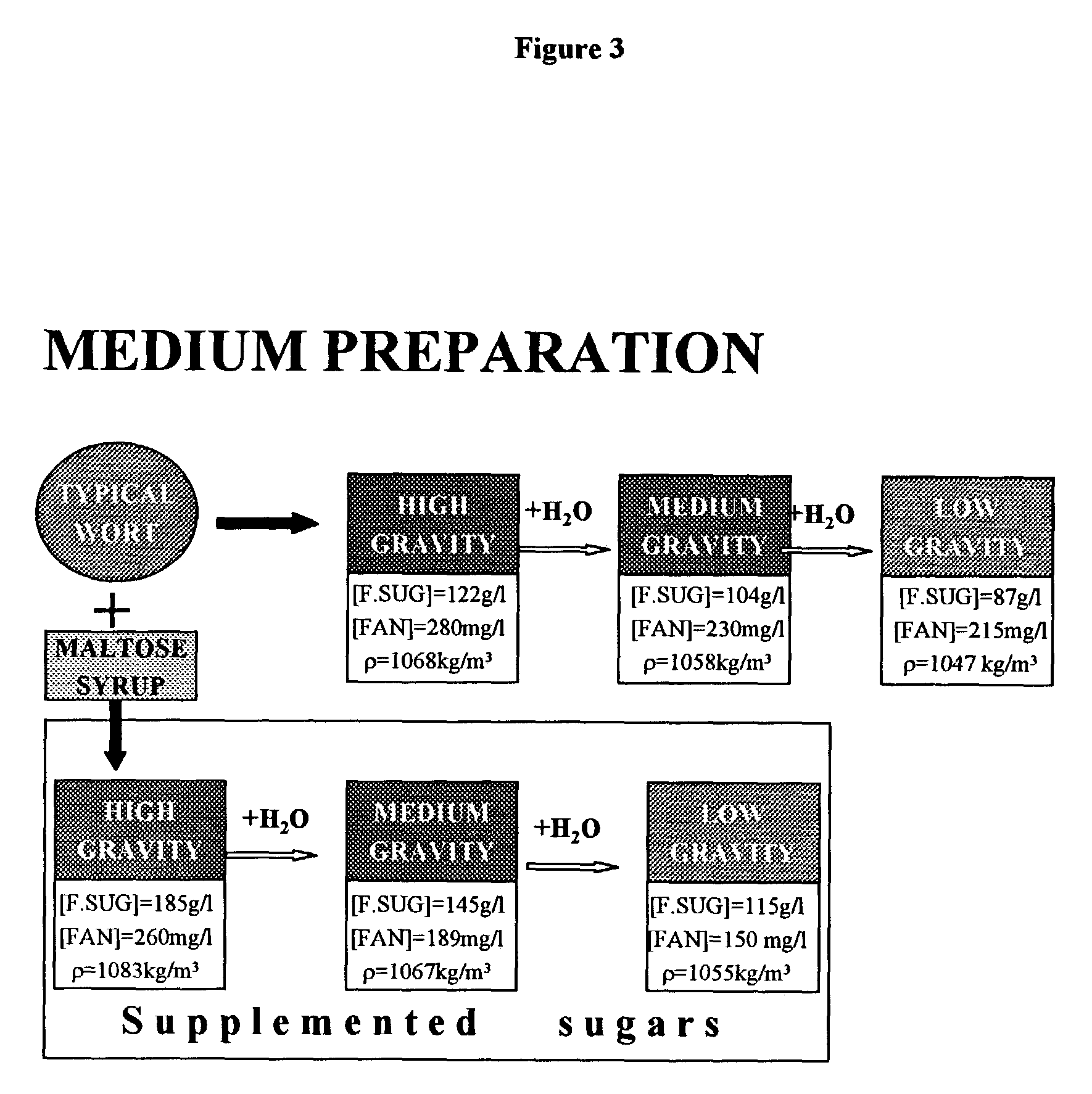
[0017]Nevertheless, and in accordance with the present invention, diacetyl formation can be reliably dealt with by managing the interrelationship between initial carbohydrate and free amino nitrogen (FAN) concentrations and the specific gravity, of the wort composition. Although the merits of the present invention are in no way dependent upon the veracity of this hypothesis, it is presently believed that during the sequential uptake of type ‘B’ amino acids, the internal valine concentration becomes high enough that the enzyme AHA synthase is repressed. This reduces the production of α-acetolactate, the flux of the valine biosynthetic pathway and thus diacetyl production. At this point in time, the diacetyl profile now enters its first ‘net’ reduction phase. As the internal valine is either catabolized or compartmentalized (i.e. contained within intra-cellular structures), the effects are reversed and a derepression of AHA synthase occurs. If under these evolving conditions, sufficient fermentable sugars remain available, and the yeast are healthy and viable, the valine biosynthetic pathway once again proceeds with an increased flux and increased diacetyl production results. This period after derepression is called the second ‘net’ production phase. If the fermentable sugars have been reduced to a minimum by this time, this second ‘net’ production phase is less pronounced or non-existent. Often this second peak gets stuck at high levels, with little diacetyl reducing power so late in fermentation. Based on this reasoning, the balance and timing of the fermentative power, supplied by the fermentable sugar content and the valine content which ultimately controls the repression / derepression cycle is critical and, for that reason, is predictable from the outset in accordance with the present invention. It is this interrelationship that is important in the prevention of the exhaustion of key type ‘B’ amino acids before the fermentable sugar concentration is depleted which prevents the production of diacetyl once again later in fermentation. The present invention is based on the discovery that it is the ratio of these three initial wort characteristics which determines the late fermentation production (e.g. the appearance of the second diacetyl peak) in wort fermentations.

Problems solved by technology

A priori predictability of what effects diacetyl production is enormously complicated owing to the nature of brewery wort.
It is a complex mixture of several hundreds of different chemical components, some of which include carbohydrates, proteins, amino acids, polypeptides, lipids, polyphenols, organic ions, vitamins, hop components, and other numerous nutrients, minerals, etc.—with the result that identifying real-world opportunities to manage the diacetyl problem is enormously complicated.
This reduces the production of α-acetolactate, the flux of the valine biosynthetic pathway and thus diacetyl production.
Often this second peak gets stuck at high levels, with little diacetyl reducing power so late in fermentation.

Method used

the structure of the environmentally friendly knitted fabric provided by the present invention; figure 2 Flow chart of the yarn wrapping machine for environmentally friendly knitted fabrics and storage devices; image 3 Is the parameter map of the yarn covering machine
View more

Image

Smart Image Click on the blue labels to locate them in the text.
Viewing Examples
Smart Image
  • Method for preparing brewers wort
  • Method for preparing brewers wort
  • Method for preparing brewers wort

Examples

Experimental program
Comparison scheme
Effect test

Embodiment Construction

[0044]In order to better illustrate the present invention, forty-two different fermentations were carried out and the results compared. These fermentations were carried out in a series of six (three liter capacity) magnetically stirred Belco bioreactors that had been modified for the control of oxygen by featuring: stirring rod with magnetic stir bar and impeller; a gas purge port; a sampling port for positive pressure sampling; a pressure control port equipped with an air lock bunging attachment, and; a septum injection port for needle entry facilitating O2 purging. A high quality precious metal magnetic stir controller was installed inside a wall incubator where the bioreactors were housed. A stainless steel water bath with false floor enabled water circulation under and around each bioreactor.

[0045]Biomass scale-up was initiated by inoculating test tubes with 10 ml of industrial plant wort with a pure yeast culture from the Labatt culture collection (S. cerevisiae, LCC#3021). The...

the structure of the environmentally friendly knitted fabric provided by the present invention; figure 2 Flow chart of the yarn wrapping machine for environmentally friendly knitted fabrics and storage devices; image 3 Is the parameter map of the yarn covering machine
Login to View More

PUM

PropertyMeasurementUnit
temperaturesaaaaaaaaaa
concentrationaaaaaaaaaa
Login to View More

Abstract

A method for predicting late fermentation production of diacetyl in a brewing process comprises determining the ratio of FAN (free amino nitrogen content) to sugar (fermentable) to specific gravity in an initial wort composition. In addition there is provided a process for preventing incipient late fermentation production of diacetyl in a brewing process, comprising measuring and variously adjusting the initial FAN, sugar and specific gravity of the wort such that the ratio[f.sugar⁡(g / L)]initial[FAN⁡(g / L)]initial⁡[Gravity⁡(°P)]initial,for the adjusted wort has a value of 37 or less.

Description

[0001]We claim the benefit Under Title 35, United States Code, §120 to U.S. Provisional Application No. 60 / 328,448, filed Oct. 12, 2001, entitled THE EFFECT OF FERMENTATION MEDIA COMPOSITION ON VICINAL DIKETONE EVOLUTION.FIELD OF THE INVENTION[0002]The invention relates to the preparation of brewers wort, and more specifically, to the preparation thereof for use in batch fermentations in which late diacetyl formation is controlled as a function of initial wort constitution.BACKGROUND OF THE INVENTION[0003]The dynamics of yeast fermentation is of fundamental importance to the success of the brewing process. Hundreds, if not thousands of biochemical reactions transform the wort into the finished beer and through their various interactive combinations and permutations have a cumulative impact on flavor, ethanol content, productivity, colour, aroma, body and foam stability. In the end, these figure largely as determinants of the ultimate quality / cost of the product, and in turn, the con...

Claims

the structure of the environmentally friendly knitted fabric provided by the present invention; figure 2 Flow chart of the yarn wrapping machine for environmentally friendly knitted fabrics and storage devices; image 3 Is the parameter map of the yarn covering machine
Login to View More

Application Information

Patent Timeline
no application Login to View More
Patent Type & Authority Patents(United States)
IPC IPC(8): C12C7/00C12C11/00C12C5/00C12N1/18
CPCC12C5/00C12N1/18C12C11/003C12C7/00
Inventor PETERSEN, ERIN ELLICEMARGARITIS, ARGYRIOSSTEWART, ROBERT JOSEPHPILKINGTON, PHYLLIS HEATHERMCGARRITY, MICHAEL J.MENSOUR, NORMAND ANTHONYFORSTER, CLEMENSSOBCZAK, JADWIGA A.
Owner LABATT BREWING CO LTD
Features
  • R&D
  • Intellectual Property
  • Life Sciences
  • Materials
  • Tech Scout
Why Patsnap Eureka
  • Unparalleled Data Quality
  • Higher Quality Content
  • 60% Fewer Hallucinations
Social media
Patsnap Eureka Blog
Learn More