
Method for preparing cadmium sulfide or zinc sulfide hollow nano diamonds by using non-template method
A hollow nano, non-template technology, applied in the nano field, can solve the problems of limited output, complex process, harsh preparation conditions, etc., and achieve the effect of simple operation, mild reaction conditions, and strong repeatability
- Summary
- Abstract
- Description
- Claims
- Application Information
AI Technical Summary
Problems solved by technology
Method used
Image

Examples
Embodiment 1
[0021] (1) Weigh 2 mmol of cadmium chloride and 2 mmol of sulfur powder, add them into 500 ml of tetrahydrofuran, ultrasonically disperse for 120 min, and ultrasonic power is 400 W; (2) Weigh out 2 mmol of sodium borohydride, add into In 500 ml of tetrahydrofuran, ultrasonically disperse for 120 min with ultrasonic power of 400 W; (3) Add the solution obtained in step (2) dropwise to the solution obtained in step (1), and continue the ultrasonic reaction for 120 min with ultrasonic power of 400 W; (4) The precipitate obtained in step (3) was centrifuged 5 times with absolute ethanol, and the obtained product was vacuum-dried at 20°C for 24 h.
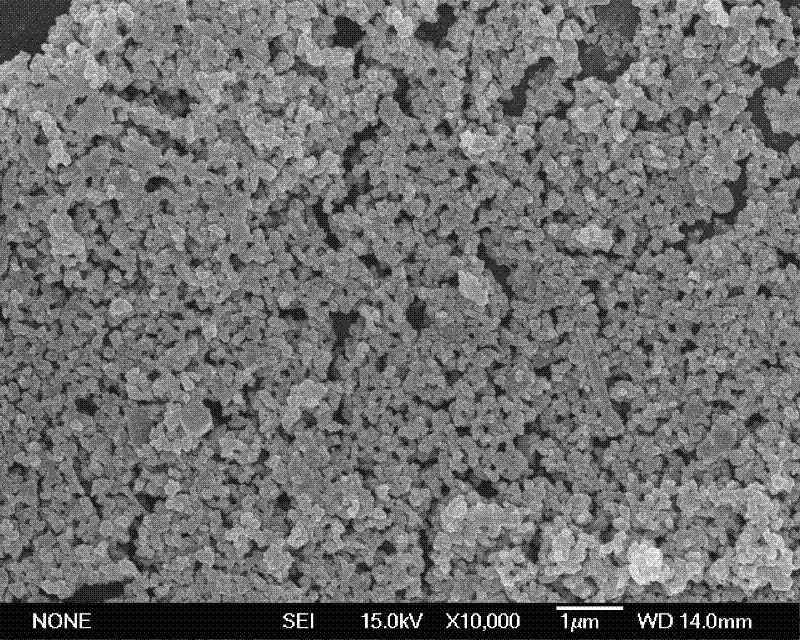
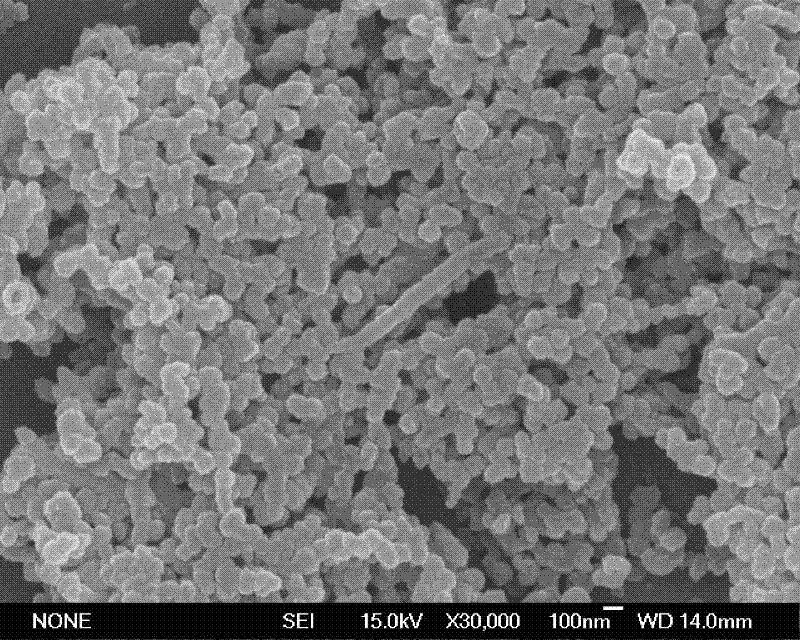
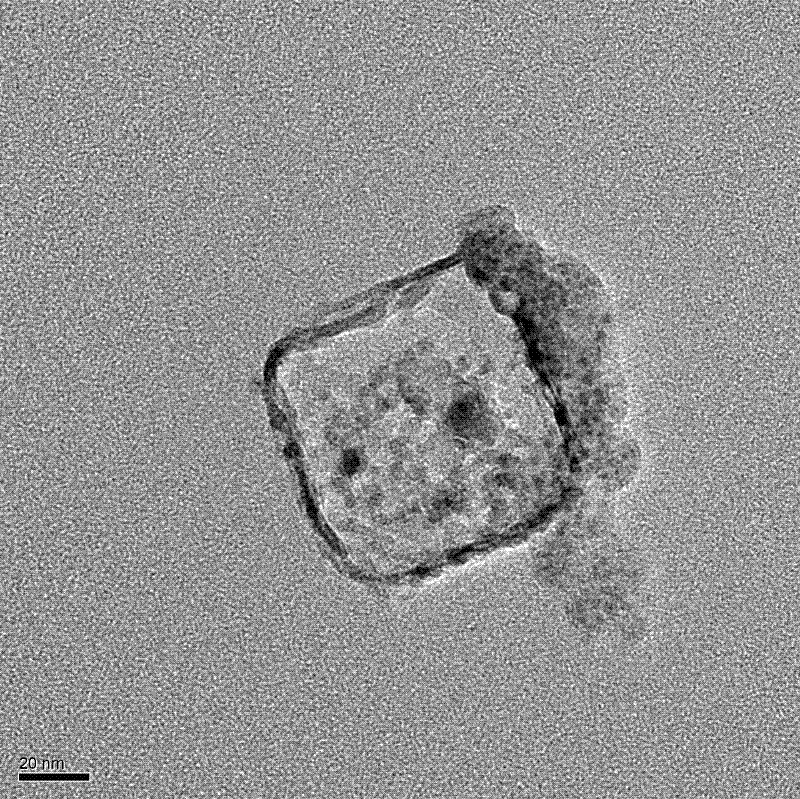
[0022] figure 1 and figure 2 The transmission electron micrographs and scanning electron micrographs of the prepared cadmium sulfide are respectively. It can be seen from the figure that the cadmium sulfide has a hollow nano-square structure, and the particle size is below 100 nm.
Embodiment 2
[0024] (1) Weigh 2 mmol of cadmium nitrate and 2 mmol of sulfur powder, add to 500 ml of tetrahydrofuran, ultrasonically disperse for 120 min, ultrasonic power 100 W; (2) weigh 2 mmol of sodium borohydride, add to 500 In ml of tetrahydrofuran, ultrasonically disperse for 120 min, ultrasonic power 100 W; (3) Add the solution obtained in step (2) dropwise to the solution obtained in step (1), continue ultrasonic reaction for 120 min, ultrasonic power 100 W; ( 4) The precipitate obtained in step (3) was centrifuged 5 times with absolute ethanol, and the obtained product was vacuum-dried at 200°C for 1 h. The result is similar to Example 1.
Embodiment 3
[0026] (1) Weigh 2 mmol of cadmium acetate and 2 mmol of sulfur powder, add to 300 ml of tetrahydrofuran, ultrasonically disperse for 60 min, ultrasonic power 200 W; (2) weigh 2 mmol of sodium borohydride, add to 300 In ml of tetrahydrofuran, ultrasonically disperse for 60 min, ultrasonic power 200 W; (3) Add the solution obtained in step (2) dropwise to the solution obtained in step (1), continue ultrasonic reaction for 60 min, ultrasonic power 200 W; ( 4) The precipitate obtained in step (3) was centrifuged 5 times with absolute ethanol, and the obtained product was vacuum-dried at 100°C for 12 h. The result is similar to Example 1.
PUM
| Property | Measurement | Unit |
|---|---|---|
| size | aaaaa | aaaaa |
Abstract
Description
Claims
Application Information
 Login to View More