
Method for reducing amide compounds
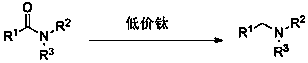
A technology of amine compounds and reduction of amides, which is applied in the preparation of organic compounds, preparation of amino compounds, chemical instruments and methods, etc., can solve the problems of post-processing troubles, high reaction costs, C-N bond breakage, etc. The effect of simple operation and mild reaction conditions
- Summary
- Abstract
- Description
- Claims
- Application Information
AI Technical Summary
Problems solved by technology
Method used
Image


Examples
Embodiment 1
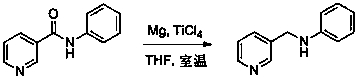
[0023] Example 1: Reduction of benzanilide
[0024]
[0025] Under the protection of Ar gas, Mg powder (10mmol) and THF (60mL) were added to the reaction flask, stirred in an ice bath, and TiCl was injected into the system. 4 (5 mmol), the reaction system was raised to room temperature and reacted for two hours to obtain a black suspension. The system was placed in an ice bath, and a solution of benzanilide (1 mmol) in THF (15 mL) was slowly added dropwise. After the dropwise addition, the mixture was raised to room temperature for reaction. After the reaction was completed, the reactant was placed in an ice bath, and saturated aqueous sodium bicarbonate solution was added thereto, and then 20% aqueous sodium hydroxide solution was added until the pH > 9. The reactant was filtered, the filtrate was extracted with dichloromethane, and the extract was concentrated to obtain a crude amine compound, which was then subjected to silica gel column chromatography to obtain N-ben...
Embodiment 2
[0026] Example 2: Reduction of 4-methyl-N-phenylbenzamide
[0027]
[0028] The experimental operation was similar to that of Example 1, and N-(4-methylbenzyl)aniline was obtained as a colorless oil with a yield of 82%. 1 H NMR (400 MHz, CDCl 3 ) δ (ppm): 7.16 (d, J = 8.0 Hz, 2H), 7.03-7.10 (m, 4H), 6.61 (t, J = 8.0 Hz, 1H), 6.52 (d, J = 8.0 Hz, 2H), 4.15 (s, 2H), 3.77 (brs, 1H), 2.24 (s, 3H). 13 C NMR (100 MHz, CDCl 3 ) δ (ppm): 148.3, 136.9, 136.5, 129.4, 129.3, 127.6, 117.6, 112.9, 48.1, 21.2. HRMS (ESI): m / z calcd for C 14 h 16 N[M+H] + : 198.1283, found: 198.1287.
Embodiment 3
[0029] Example 3: Reduction of 4-methoxy-N-phenylbenzamide
[0030]
[0031] The experimental operation was similar to Example 1, and a colorless solid N-(4-methoxybenzyl)aniline was obtained with a yield of 86%. 1 H NMR (400 MHz, CDCl 3 ) δ (ppm): 7.28 (d, J = 8.0 Hz, 2 H), 7.16 (t, J = 8.0 Hz, 2H), 6.87 (d, J = 8.0 Hz, 2 H), 6.70 (t, J = 8.0 Hz, 1H), 6.63 (d, J = 8.0 Hz, 2H), 4.23 (s, 2H), 3.78 (s, 3H), 3.60 (brs, 1H). 13 C NMR (100 MHz, CDCl 3 ) δ (ppm): 158.9, 148.2, 131.4, 129.3, 128.9, 117.6, 114.1, 112.9, 55.3, 47.9. HRMS (ESI): m / z calcd for C 14 h 16 NO [M+H] + : 214.1232, found: 214.1238.
PUM
 Login to View More
 Abstract
Description
Claims
Application Information
 Login to View More