
Method for preparing ternary anode material of long-service-life and high-capacity lithium ion battery
A technology for lithium-ion batteries and cathode materials, which is applied in battery electrodes, electrical components, circuits, etc., can solve the problems of reducing the reversible specific capacity and cycle performance of lithium-ion batteries, the energy density needs to be further improved, and the utilization rate of cathode materials is limited. Achieve the effect of obvious industrial application, reduce irreversible capacity loss, and prolong the discharge platform.
- Summary
- Abstract
- Description
- Claims
- Application Information
AI Technical Summary
Problems solved by technology
Method used
Image

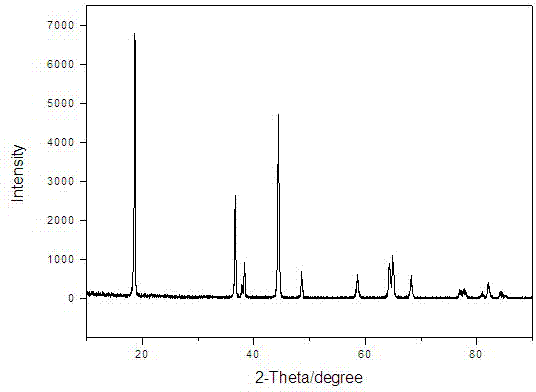
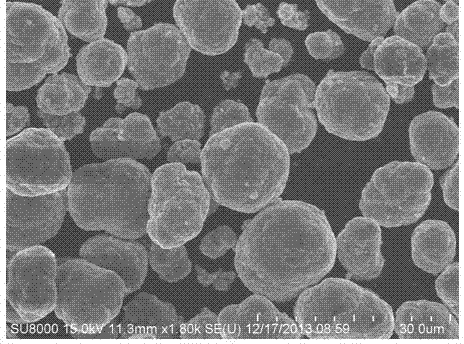
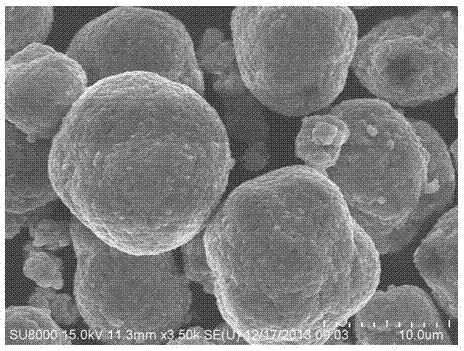
Examples
specific Embodiment approach 1
[0027] Specific implementation mode 1: In this implementation mode, the secondary lithium-added calcined ternary positive electrode material is prepared according to the following steps:
[0028] 1. Weigh nickel sulfate, cobalt sulfate, and manganese sulfate respectively in a molar ratio of 1:1:1, and dissolve them in deionized water and mix them evenly. Add 2 mol / L precipitant sodium carbonate and a certain amount of complexing agent ammonia water one by one. Add it dropwise, control the molar ratio of metal salt to ammonia water to be 1:0.75, the pH value of the reaction is between 8 and 9, react at 60°C for 12 h, and stir continuously at a speed of 600 rpm, and suction filter after the reaction. Wash repeatedly to remove impurities, dry at 80°C for 24 h, and synthesize the precursor of ternary cathode material (NiCoMn)(OH) 2 , and its D50 particle size is 8 microns.
[0029] Ternary precursors are also available commercially.
[0030] 2. Molar ratio Li:NiCoMn(OH) 2 =1.05...
specific Embodiment approach 2
[0034] Specific implementation mode 2: In this implementation mode, the secondary lithium-added calcined ternary positive electrode material is prepared according to the following steps:
[0035] 1. Weigh nickel sulfate, cobalt sulfate, and manganese sulfate respectively in a molar ratio of 5:2:3, and dissolve them in deionized water and mix them uniformly. 2mol / L precipitant sodium hydroxide and a certain amount of complexing agent ammonia Add it dropwise, control the molar ratio of metal salt to ammonia water to be 1:0.75, the pH value of the reaction is between 10~11, react at 60°C for 12h, and stir continuously at a speed of 600 rpm. Wash, remove impurities, dry at 80°C for 24h, and synthesize the precursor of ternary cathode material (Ni 0.5 co0.2 mn 0.3 )(OH) 2 , and its D50 particle size is 9 microns.
[0036] Ternary precursors are also available commercially.
[0037] Two, Moore ratio Li:(Ni 0.5 co 0.2 mn 0.3 )(OH) 2 =1.03:1 Weigh lithium acetate and ternary c...
specific Embodiment approach 3
[0041] Specific embodiment three: In this embodiment, the secondary lithium-added calcined ternary positive electrode material is prepared according to the following steps:
[0042] 1. Mole ratio Li:Ni 0.42 co 0.16 mn 0.42 (OH) 2 =1.10:1 Weigh lithium carbonate and ternary cathode material precursors, mix them uniformly in a mixed solution of deionized water and ethanol, raise the temperature from room temperature to 500 °C at a heating rate of 20 °C / min, pre-calcine for 5 h, and then Raise to 1000°C at the same heating rate and calcined for 10 h to obtain the ternary cathode material;
[0043] 2. Weigh the ternary positive electrode material with a molar ratio of 1:0.015:0.002, the above-mentioned lithium source, and nano-TiO 2 , uniformly mixed in a mixed solution of deionized water and ethanol;
[0044] 3. Put the above mixture into an industrialized kiln in an air atmosphere, and calcinate it at a heating rate of 20°C / min from room temperature to 850°C for 5 hours to ...
PUM
| Property | Measurement | Unit |
|---|---|---|
| particle size | aaaaa | aaaaa |
| particle size | aaaaa | aaaaa |
| particle size | aaaaa | aaaaa |
Abstract
Description
Claims
Application Information
 Login to View More