Check patentability & draft patents in minutes with Patsnap Eureka AI!

Novel lactic acid bacterium and method for preparing silage or fermented feed by using the same

A technology for silage and lactic acid bacteria, applied in the field of lactic acid bacteria, can solve the problems of unclear production of bacteriocin, no change, no improvement of fermentation quality, etc., and achieve the effects of good feed intake and high safety for livestock

Active Publication Date: 2014-05-07
SNOW BRAND SEED
View PDF8 Cites 4 Cited by
  • Summary
  • Abstract
  • Description
  • Claims
  • Application Information

AI Technical Summary

Problems solved by technology

Therefore, lactic acid bacteria producing high concentrations of nisin in a synthetic medium and nisin producing in a fermented barley extract medium have also been reported (Patent Document 1, Non-Patent Document 6), but no synthetic Existing literature on the production of high concentrations of nisin in culture medium or fermented barley extract medium, and in silage materials with different nutrient sources
[0007] In addition, in the case of silage as an object, a silage preparation method in which bacteriocin-producing Lactococcus lactis RO50 strain is added to silage material grass has been reported (Patent Document 2), but it has also been reported that sufficient silage is not obtained. In the case of improving the fermentation quality, the effect is not stable, and it is completely unclear whether bacteriocin is produced in the silage (Non-Patent Documents 7 and 8)
In addition, in Patent Document 3, there is also a report on a method for preparing silage by adding nisin-producing lactic acid bacteria and nisin-resistant lactic acid bacteria. Although 200 IU / g of nisin activity was detected in the silage, but Since there is no change in the fermentation quality such as pH, organic acid content, and ammoniacal nitrogen concentration relative to total nitrogen compared with other lactic acid bacteria that do not produce nisin, good fermentation can be obtained even with common lactic acid bacteria The results of the sugar content (5.0% or more in the dry product, 1.0% or more in the raw material) are not yet clear about the effect of this lactic acid bacteria under the strict conditions of low sugar content

Method used

the structure of the environmentally friendly knitted fabric provided by the present invention; figure 2 Flow chart of the yarn wrapping machine for environmentally friendly knitted fabrics and storage devices; image 3 Is the parameter map of the yarn covering machine
View more

Image

Smart Image Click on the blue labels to locate them in the text.
Viewing Examples
Smart Image
  • Novel lactic acid bacterium and method for preparing silage or fermented feed by using the same
  • Novel lactic acid bacterium and method for preparing silage or fermented feed by using the same
  • Novel lactic acid bacterium and method for preparing silage or fermented feed by using the same

Examples

Experimental program
Comparison scheme
Effect test

Embodiment 1

[0061] Nisin activity in forage boiling juice medium

[0062] The nisin activity of the supernatant of the culture broth when each lactic acid bacteria was cultured in the forage boiling juice medium was measured.

[0063] The forage boiled juice medium is prepared according to the following method. Add 1 liter of distilled water to 100 g of alfalfa pellets, and cook for 30 minutes after the liquid temperature in the boiling water bath reaches 90°C. Filter with gauze, squeeze the residue, centrifuge the filtrate and filter with filter paper. Dilute the filtrate to 1 liter, divide it into test tubes, and sterilize in an autoclave (115°C, 20 minutes).

[0064] The sugar content in the forage cooking juice medium is determined according to the following method. Add 840 μl of acetonitrile to 360 μl of the medium to mix, and let stand at room temperature for 15 minutes. The precipitate was removed by centrifugation (15000 rpm, 15 minutes), and the supernatant was filtered with a 0.2 ...

Embodiment 2

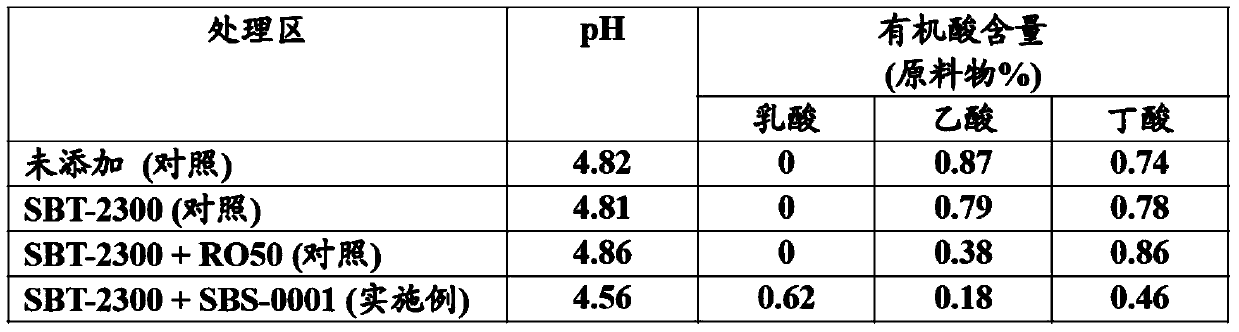
[0084] Silage preparation and fermentation quality

[0085] Each lactic acid bacteria was added to pasture to prepare silage, and the fermentation quality was investigated.

[0086] The lactic acid bacteria, that is, the strains shown in Table 6, were prepared in the following manner. The GYP liquid medium was inoculated with each strain and cultured at 37°C for 24 hours. Centrifuge the culture broth (6500 rpm, 15 minutes), discard the supernatant, add 10% trehalose, 1% sodium glutamate solution to the remaining bacteria to suspend, and dry with a freeze dryer.

[0087] [Table 6]

[0088]

[0089] The silage preparation was carried out according to the following method. Timothy grass, orchardgrass, grass reeds, wheatgrass, Italian ryegrass, and rye were cut at the heading stage, and alfalfa was cut at the flowering stage and cut into a length of about 2 cm. The freeze-dried powder of each lactic acid bacteria was dissolved in water. In the case of only one strain, 1.0×10 per 1g of...

the structure of the environmentally friendly knitted fabric provided by the present invention; figure 2 Flow chart of the yarn wrapping machine for environmentally friendly knitted fabrics and storage devices; image 3 Is the parameter map of the yarn covering machine
Login to View More

PUM

No PUM Login to View More

Abstract

An object of the present invention is to provide a lactic acid bacterium, in a silage or fermented feed material on which any sufficient fermentation quality-improving effect cannot be established by conventional lactic acid bacteria because of a low saccharide content thereof and therefore which undergoes butyric acid fermentation, the lactic acid bacterium inhibiting the butyric acid fermentation and thus enabling stable preparation of a silage or fermented feed having good qualities. A lactic acid bacterium capable of producing 40 IU or greater, per mL of supernatant, of nisin in a grass extract medium having a total content of monosaccharides and disaccharides of 0.1-0.4 mass%; a microbial preparation for preparing silages, the preparation containing the aforethe lactic acid bacterium; and a method for preparing a silage or fermented feed using the preparation.

Description

Technical field [0001] The present invention relates to lactic acid bacteria capable of inhibiting butyric acid fermentation, a microbial preparation containing the same, and a method for preparing silage or fermented feed using the preparation. Background technique [0002] The silage obtained by lactic acid fermentation under anaerobic conditions for the staple food of livestock, such as forage grass and fodder crops, is a necessary feed in the dairy industry. The preparation of high-quality silage is a very important technology for dairy farmers. At this time, the problem called poor fermentation frequently occurs. This is because the growth of butyric acid bacteria in silage is more advantageous than that of lactic acid bacteria. As a result, the content of butyric acid in the silage becomes higher. Silage with a higher concentration of butyric acid not only causes a decrease in the hobby and feed intake of cattle, but also becomes a problem related to diseases such as ketosi...

Claims

the structure of the environmentally friendly knitted fabric provided by the present invention; figure 2 Flow chart of the yarn wrapping machine for environmentally friendly knitted fabrics and storage devices; image 3 Is the parameter map of the yarn covering machine
Login to View More

Application Information

Patent Timeline
no application Login to View More
Patent Type & Authority Applications(China)
IPC IPC(8): C12N1/20A23K1/00A23K1/16A23K1/18
CPCC07K14/315A23K10/12A23K50/10A23K30/18C12R2001/46C12N1/205A23V2400/231
Inventor 北村亨大渊俊本间满上西宽司副岛洋
Owner SNOW BRAND SEED
Features
  • R&D
  • Intellectual Property
  • Life Sciences
  • Materials
  • Tech Scout
Why Patsnap Eureka
  • Unparalleled Data Quality
  • Higher Quality Content
  • 60% Fewer Hallucinations
Social media
Patsnap Eureka Blog
Learn More