Method for preparing dye-sensitized solar cell through in-situ growth of TiO2 nano-particles/nanotubes
A solar cell and nanoparticle technology, applied in nanotechnology, photosensitive equipment, circuits, etc., can solve the problems of clogging the diameter of nanotubes, complicated experimental procedures, affecting optoelectronic properties, etc., to improve adsorption capacity, broad application prospects, and experimental process. simple effect
- Summary
- Abstract
- Description
- Claims
- Application Information
AI Technical Summary
Problems solved by technology
Method used
Image

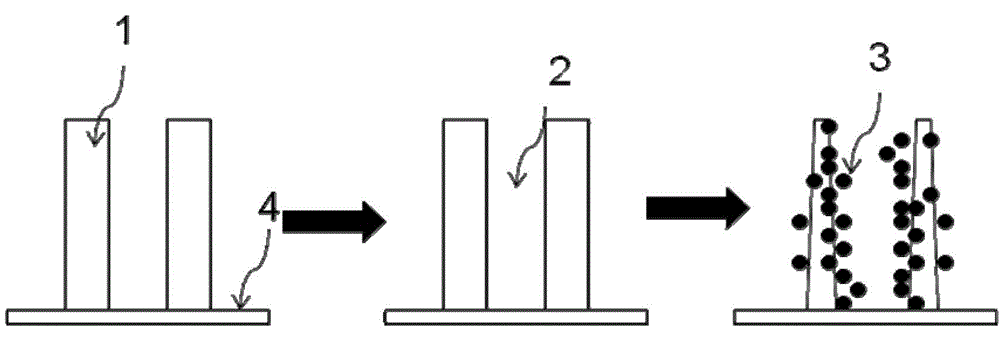


Examples
preparation example Construction
[0031] The invention provides an in-situ growth TiO 2 A method for preparing a nanoparticle / nanotube dye-sensitized solar cell. The preparation method solves the problems that the experimental conditions cannot be accurately controlled and the composite structure is difficult to form in the traditional processing method. The operation steps are simple, the experiment cost is low, and the experimental by-products are not polluting to the environment; in addition, the prepared TiO 2 The overall structure of the nanoparticle / nanotube composite structure is clear, the size of the nanoparticles is uniform, and the pore thickness of the nanotubes is controllable, which can be effectively used in the treatment of environmental pollution, photodegradation of water, solar cells, biological coatings, etc. Causes a burden and has a good application prospect.
[0032]The present invention uses titanium sheets as the substrate, and controls the reaction time through a two-step electrochem...
Embodiment 1
[0051] Example 1: TiO 2 The nanoparticle / nanotube electrode preparation process is as follows:
[0052] (1) Pretreatment of commercial titanium sheets: Cut commercial titanium sheets with a thickness of 0.2mm into a comb-like structure of a certain size. Ultrasonic cleaning is performed sequentially with deionized water, acetone, alcohol, and deionized water to clean the impurities on the surface of the titanium sheet. Air dry with a hair dryer and set aside. In this experimental procedure, inexpensive commercial titanium discs (99.6% pure) were used. During the ultrasonic cleaning process, the ultrasonic treatment time in each cleaning process was 10 minutes, and the surface of the titanium sheet was kept as smooth as possible.
[0053] (2) Preparation of anodic oxidation solution: NH 4 F was added into the analytically pure anhydrous organic solvent ethylene glycol according to the mass percentage of 0.2wt%, added a magnetic stirrer, and stirred on a magnetic stirrer at ...
Embodiment 2
[0065] Example 2: TiO 2 The nanoparticle / nanotube electrode preparation process is as follows:
[0066] (1) Pretreatment of commercial titanium sheets: Cut commercial titanium sheets with a thickness of 0.3mm into a comb-like structure of a certain size. Ultrasonic cleaning is performed sequentially with deionized water, acetone, alcohol, and deionized water to clean the impurities on the surface of the titanium sheet. Air dry with a hair dryer and set aside. In this experimental procedure, a high-purity titanium sheet with a purity of 99.7% was used. During the ultrasonic cleaning process, the ultrasonic treatment time was 15 minutes in each cleaning process, and the surface of the titanium sheet was kept as smooth as possible.
[0067] (2) Preparation of anodic oxidation solution: NH 4 F was added to the analytically pure ethylene glycol solvent according to the mass percentage of 0.2wt%, a magnetic stirrer was added, and it was placed on a magnetic stirrer at room temper...
PUM
| Property | Measurement | Unit |
|---|---|---|
| Thickness | aaaaa | aaaaa |
Abstract
Description
Claims
Application Information
 Login to View More