Unlock instant, AI-driven research and patent intelligence for your innovation.

Preparation method of graphene-based nanosilicon compound electrode material

A graphene-based, electrode material technology, applied in the direction of battery electrodes, circuits, electrical components, etc., can solve the problems of low capacity of silicon alloys, difficulty in uniform compounding, complicated process, etc., and achieve high discharge capacity, uniform dispersion, and good cycle performance Effect

Active Publication Date: 2014-08-27
SHANDONG UNIV
View PDF2 Cites 12 Cited by
  • Summary
  • Abstract
  • Description
  • Claims
  • Application Information

AI Technical Summary

Problems solved by technology

In this preparation method, the capacity of silicon alloy is low, and the coating of graphene needs to be carried out in two steps, which requires heating, the process is complicated and costly, and it is difficult to uniformly compound, and the final product also contains silicon alloy.

Method used

the structure of the environmentally friendly knitted fabric provided by the present invention; figure 2 Flow chart of the yarn wrapping machine for environmentally friendly knitted fabrics and storage devices; image 3 Is the parameter map of the yarn covering machine
View more

Image

Smart Image Click on the blue labels to locate them in the text.
Viewing Examples
Smart Image
  • Preparation method of graphene-based nanosilicon compound electrode material
  • Preparation method of graphene-based nanosilicon compound electrode material
  • Preparation method of graphene-based nanosilicon compound electrode material

Examples

Experimental program
Comparison scheme
Effect test

Embodiment 1

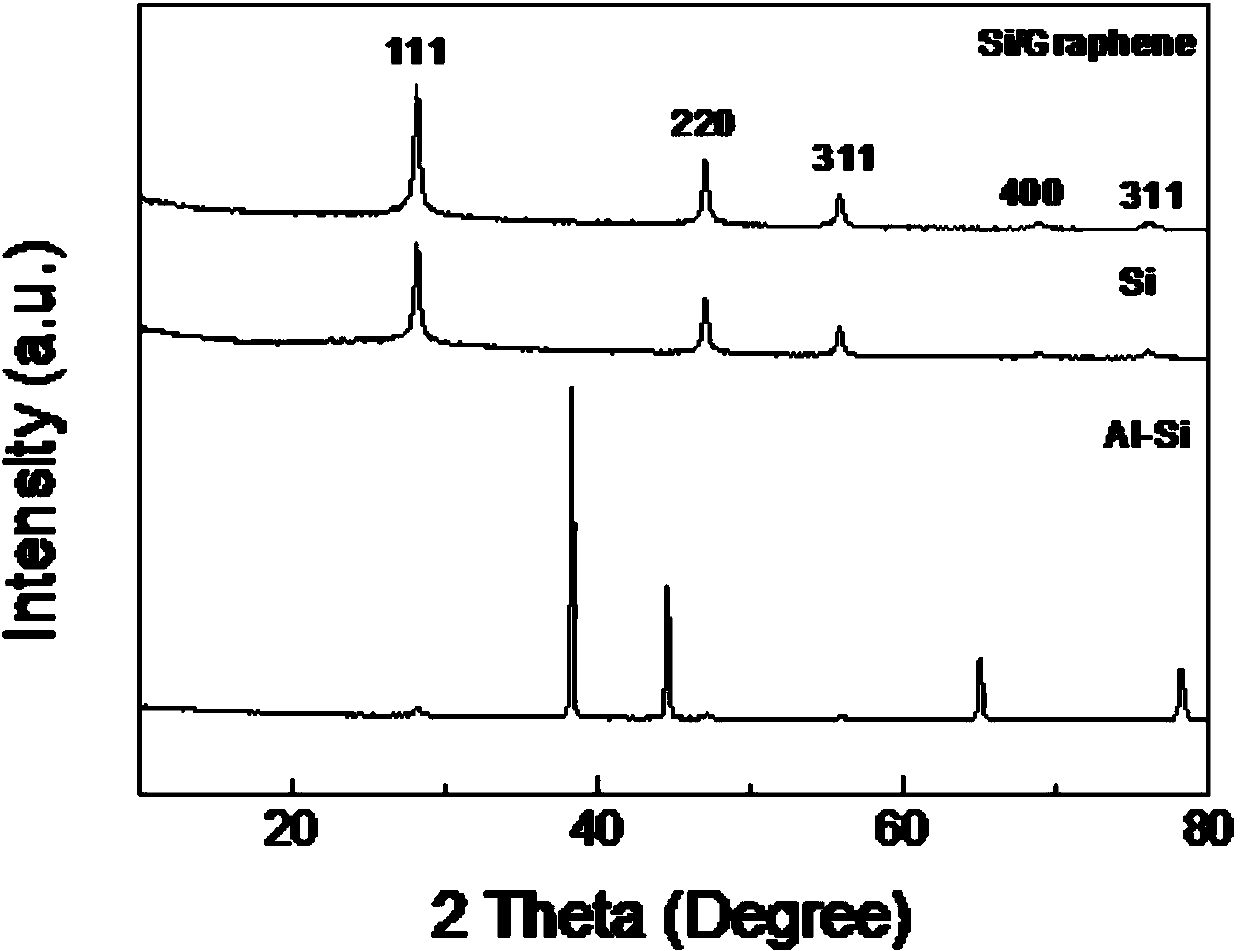
[0023] Disperse 0.2 grams of graphene oxide in 100 milliliters of 3 mol / liter hydrochloric acid solution, then weigh 8.5 grams of aluminum-silicon alloy (graphene content is 10%), add in the above-mentioned acid solution, react for 24 hours, wait for reaction No bubbles are generated, filtered, washed the solid, and dried in a vacuum oven at 80°C to obtain the silicon / graphene composite. The resulting complex looks like figure 2 As shown, it can be seen from the TEM image of the nano-silicon / graphene powder that the silicon particles are less than 10 μm and have an obvious nano-fishbone structure. The fine and dense pores in the particles are formed after the aluminum component in the silicon-aluminum alloy reacts with hydrochloric acid to dissolve and lose. The fine pores are evenly distributed throughout the particle. Nano-silicon and graphene are tightly combined. figure 1 is the XRD pattern of porous silicon powder. In the figure, the characteristic diffraction peaks ...

Embodiment 2

[0025] 0.2 gram of graphene oxide is dispersed in 100 milliliters of 1 mol / liter of sulfuric acid, and then 12 grams of magnesium-silicon alloy (graphene content is 8%) is weighed, added in the above-mentioned acid solution, and reacted for 12 hours. Bubbles are generated, filtered, the solid is washed, and dried in a vacuum oven at 80°C to obtain a silicon / graphene composite.

Embodiment 3

[0027] 0.2 gram of graphene oxide is dispersed in 100 milliliters of 5 mol / liter oxalic acid, and then 5 grams of magnesium-silicon alloy (graphene content is 16%) is weighed, added in the above-mentioned acid solution, and reacted for 36 hours. Bubbles are generated, filtered, the solid is washed, and dried in a vacuum oven at 80°C to obtain a silicon / graphene composite.

the structure of the environmentally friendly knitted fabric provided by the present invention; figure 2 Flow chart of the yarn wrapping machine for environmentally friendly knitted fabrics and storage devices; image 3 Is the parameter map of the yarn covering machine
Login to View More

PUM

No PUM Login to View More

Abstract

The invention relates to a preparation method of a graphene-based nanosilicon compound electrode material. The method comprises the following steps: blending an oxidized graphene and an inorganic acid to form a solution, wherein the mass concentration of the oxidized graphene in the solution is between 0.01% and 50%; putting silicon alloy powder into the solution and reacting for 0.5 to 48 hours at 0 DEG C to 90 DEG C; and filtering until bubbles are not generated in the reaction, washing a solid and carrying out vacuum drying, thereby obtaining a silicon / graphene compound. According to the method, the prepared nanosilicon / graphene compound has the advantages of small granule, uniform dispersion and the like, and is high in discharge capacity, good in cyclicity and good in multiplying power discharge performance. Meanwhile, the reaction process is simple and the generated waste gas is utilized, so that the production procedure and the cost are reduced. Thus, the high production efficiency is realized.

Description

technical field [0001] The invention relates to a preparation method of a graphene-based nano-silicon composite electrode material for a lithium ion battery, belonging to the field of new energy. Background technique [0002] Due to the advantages of high specific energy, long cycle life, small self-discharge, and no pollution, lithium batteries have become the most promising power supply system for electronic products and electric vehicles. With the development of science and technology, people have higher and higher requirements for batteries. At present, the anode materials of lithium-ion batteries are mainly graphite electrode materials, and their theoretical specific energy is only 372mAh / g, which limits the improvement of the overall performance of lithium batteries. There is an urgent need to develop new high-energy anode material systems. Metal silicon and lithium can form Li4.4Si alloy, the theoretical specific energy can be as high as 4212mAh / g, and silicon has a ...

Claims

the structure of the environmentally friendly knitted fabric provided by the present invention; figure 2 Flow chart of the yarn wrapping machine for environmentally friendly knitted fabrics and storage devices; image 3 Is the parameter map of the yarn covering machine
Login to View More

Application Information

Patent Timeline
no application Login to View More
IPC IPC(8): H01M4/38
CPCH01M4/366H01M4/386H01M4/625H01M10/0525Y02E60/10
Inventor 冯金奎慈立杰
Owner SHANDONG UNIV
Features
  • R&D
  • Intellectual Property
  • Life Sciences
  • Materials
  • Tech Scout
Why Patsnap Eureka
  • Unparalleled Data Quality
  • Higher Quality Content
  • 60% Fewer Hallucinations
Social media
Patsnap Eureka Blog
Learn More