

Synthesis method of quinazolin-4(3H)-ketone
A technology for synthesizing quinazoline and heterocyclic compounds is applied in the synthetic field of preparing quinazoline-4-ketone-ones) heterocyclic compounds, which can solve problems such as toxicity and difficult operation, and achieve simple process, short reaction time, Response applies a wide range of effects
- Summary
- Abstract
- Description
- Claims
- Application Information
AI Technical Summary
Problems solved by technology
Method used
Image

Examples
Embodiment 1
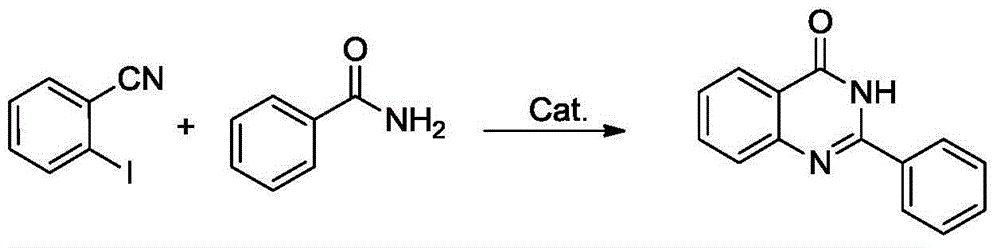
[0021] Add 1mmol 2-iodobenzonitrile, 1.2mmol benzamide, 10ml N-methylpyrrolidone into a 25ml three-necked flask, add 2mmol sodium hydroxide under stirring, then add 0.05mmol cuprous iodide, and stir the mixture for 10h , after the reaction was completed, the reaction solution was poured into 25ml of ice-water mixture, a mixture of oil and solid was separated out, and the product was separated by column chromatography, ethyl acetate: petroleum ether (1:2, v:v), to obtain 2- Phenyl-quinazolin-4(3H)-one, yield 86%, m.p.240-242°C. The reaction formula of 2-iodobenzonitrile and benzamide is:
[0022]
[0023] The spectral data of product (1) is: IR(KBr, v, cm -1 ):3194,3167,3061,1668,1602,1481; 1 H NMR (400MHz, DMSO-d 6 )(δ,ppm):12.57(s,1H),8.20-8.16(m,3H),7.85(t,J=15.2Hz,1H),7.75(d,J=7.2Hz,6H),7.62-7.52 (m,4H); 13 C NMR (100MHz, DMSO-d 6 )(δ,ppm):162.25,152.30,148.75,134.59,132.71,131.38,128.60(2C),127.76(2C),127.50,126.58,125.84,120.98; MS(ESI)m / z(%):222.9( [M+H] + ,10...
Embodiment 2
[0025]Add 1mmol 2-bromobenzonitrile, 1.2mmol acetamide, 10ml N-methylpyrrolidone into a 25ml three-necked flask, add 2mmol sodium hydroxide under stirring, then add 0.05mmol cuprous iodide, and stir the mixture for 10h. After the reaction was completed, the reaction solution was poured into 25ml of ice-water mixture, and a mixture of oil and solid was separated out, and the product was separated by column chromatography, ethyl acetate:petroleum ether (2:1, v:v), to obtain 2-ethyl ether yl-quinazolin-4(3H)-one, yield 74%, m.p.236-237°C. The reaction formula of 2-bromobenzonitrile and acetamide is:
[0026]
[0027] The spectral data of product (2) is: IR(KBr, v, cm -1 ):3170,3120,2869,1681,1615,1468; 1 H NMR (400MHz, DMSO-d 6 )(δ,ppm):12.20(s,1H),8.06(d,J=8.0Hz,1H),7.77-7.73(m,1H),7.56(d,J=8.4Hz,1H),7.44(t ,J=14.8Hz,1H),2.34(s,1H); 13 C NMR (100MHz, DMSO-d 6 )(δ,ppm):161.69,154.25,148.98,134.27,126.58,125.85,125.67,120.61,21.42; MS(ESI)m / z(%):161.0([M+H] + ,100).
Embodiment 3
[0029] Propionamide was used instead of acetamide, and the others were the same as in Example 2 to obtain the target compound (3) in a yield of 72%, m.p.230-232°C. The reaction formula of 2-bromobenzonitrile and propionamide is:
[0030]
[0031] The spectral data of product (3) is: IR(KBr, v, cm -1 ):3169,3111,2980,1679,1620,1468; 1 H NMR (400MHz, DMSO-d 6 )(δ,ppm):12.16(s,1H),8.07(d,J=8.0Hz,1H),7.79-7.75(m,1H),7.59(d,J=8.0Hz,1H),7.45(t ,J=14.4Hz,1H),2.65-2.59(m,2H),1.24(t,J=14.8Hz,3H); 13 CNMR (100MHz, DMSO-d 6 )(δ,ppm):162.26,158.77,149.43,134.69,127.27,126.35,126.14,121.30,28.30,11.73; MS(ESI)m / z(%):175.0([M+H] + ,100).
PUM
 Login to View More
 Abstract
Description
Claims
Application Information
 Login to View More