
Preparation method of tert-butyl (3R, 4S, 5S)-5-hydroxy-3-methyl-7-ocentyl-4-carbamate
A carbamate, tert-butyl technology, applied in the field of intermediate synthesis, can solve the problems of low stereoselectivity, inconvenient operation, low reaction yield, etc., to simplify the experimental operation process, reduce the reaction time, The effect of cheap and easy to obtain raw materials
Patent Information
- Authority / Receiving Office
- CN · China
- Patent Type
- Applications(China)
- Current Assignee / Owner
- Publication Date
- 2016-05-11
- Estimated Expiration
- Not applicable · inactive patent
Smart Images

Figure 1 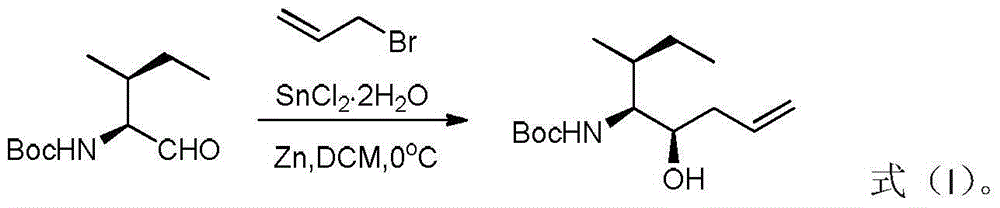
Figure 2 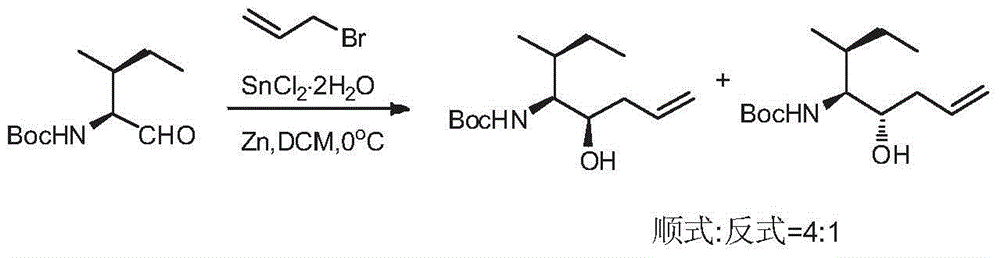
Figure 3
Abstract
Description
technical field
[0001] The invention relates to a synthetic method of an intermediate of a natural product with antitumor activity, in particular to a tert-butyl (3R, 4S, 5S)-5-hydroxyl-3-methyl-7-octene-4- A method for preparing carbamate, the intermediate of Dil, the key synthon (dolaisoleuine) Dil of dolastatin 10. Background technique
[0002] Aplysia toxin is a highly active anti-cancer active peptide, which is mainly used for the treatment of solid tumors such as small cell lung cancer, ovarian cancer, melanoma and prostate, especially D-10 has entered phase II clinical trials. Due to its definite mechanism of action and mild toxicity, D-10 is likely to become one of the preferred drugs for combination therapy. The yield of natural D-10 is extremely small, and the existing synthetic methods and routes are limited to laboratory scale, which cannot meet the growing demand. One of the reasons is that the most complex component in D-10, Dil with three chiral centers, cou...
Examples
Embodiment 1
[0024] At room temperature, measure N-tert-butoxycarbonyl-L-isoleucinaldehyde (3.22g, 15mmol), allyl bromide (3.64g, 30mmol), dissolve in dichloromethane (35mL) under uniform stirring, Cool in an ice-water bath to 0°C, then add stannous dichloride dihydrate (6.78g, 30mmol) and zinc powder (1.96g, 30mmol) respectively. After the addition, keep the ice-water bath, stir and react for 0.5 hours, and monitor by TLC to determine the end point of the reaction. After the reaction was completed, the ice-water bath was removed, the solid in the reaction flask was removed by filtration, the filtrate was concentrated under reduced pressure, and the residue was directly separated and purified by column chromatography, and the eluent was a mixed solvent of petroleum ether and ethyl acetate with a volume ratio of 5:1. , 2.73 g of cis-tert-butyl (3R, 4S, 5S)-5-hydroxy-3-methyl-7-octene-4-carbamate was obtained, and the yield was 71%.
[0025] 1 HNMR (400MHz, CDCl 3 )δ5.80-5.90(m,1H), 4.98-5...
Embodiment 2
[0027] At room temperature, measure N-tert-butoxycarbonyl-L-isoleucinaldehyde (3.22g, 15mmol), allyl bromide (3.28g, 27mmol), dissolve in dichloromethane (32mL) under uniform stirring, Cool in an ice-water bath to 0°C, then add stannous dichloride dihydrate (6.10g, 27mmol) and zinc powder (1.76g, 27mmol) respectively. After the addition, keep the ice-water bath, stir and react for 0.5 hours, and monitor by TLC to determine the end point of the reaction. After the reaction was completed, the ice-water bath was removed, the solid in the reaction flask was removed by filtration, the filtrate was concentrated under reduced pressure, and the residue was directly separated and purified by column chromatography, and the eluent was a mixed solvent of petroleum ether and ethyl acetate with a volume ratio of 5:1. , 2.65 g of cis-tert-butyl (3R, 4S, 5S)-5-hydroxy-3-methyl-7-octene-4-carbamate was obtained, and the yield was 69%.
[0028] 1 HNMR (400MHz, CDCl 3 )δ5.80-5.90(m,1H), 4.98-5...
Embodiment 3
[0030] At room temperature, measure N-tert-butoxycarbonyl-L-isoleucinaldehyde (3.22g, 15mmol), allyl bromide (4.0g, 33mmol), dissolve in dichloromethane (35mL) under uniform stirring, Cool in an ice-water bath to 0°C, then add stannous dichloride dihydrate (7.46g, 33mmol) and zinc powder (2.16g, 33mmol) respectively. After the addition, keep the ice-water bath, stir and react for 0.5 hours, and monitor by TLC to determine the end point of the reaction. After the reaction was completed, the ice-water bath was removed, the solid in the reaction flask was removed by filtration, the filtrate was concentrated under reduced pressure, and the residue was directly separated and purified by column chromatography, and the eluent was a mixed solvent of petroleum ether and ethyl acetate with a volume ratio of 5:1. , 2.69 g of cis-tert-butyl (3R, 4S, 5S)-5-hydroxy-3-methyl-7-octene-4-carbamate was obtained, and the yield was 70%.
[0031] 1 HNMR (400MHz, CDCl 3)δ5.80-5.90(m,1H), 4.98-5.1...