
Si3N4-BN-MAS ceramic composite material and preparation method thereof
A ceramic composite material, -si3n4 technology, applied in the field of Si3N4-BN-MAS ceramic composite material and its preparation, can solve the problems of poor machining performance, high sintering temperature, high sintering pressure, etc., and achieve high density and performance, The effect of low sintering temperature and easy molding
- Summary
- Abstract
- Description
- Claims
- Application Information
AI Technical Summary
Problems solved by technology
Method used
Image

Examples
specific Embodiment approach 1
[0036] Specific embodiment one: the Si described in this embodiment 3 N 4 -The preparation method of BN-MAS ceramic composite material is to finish according to the following steps:
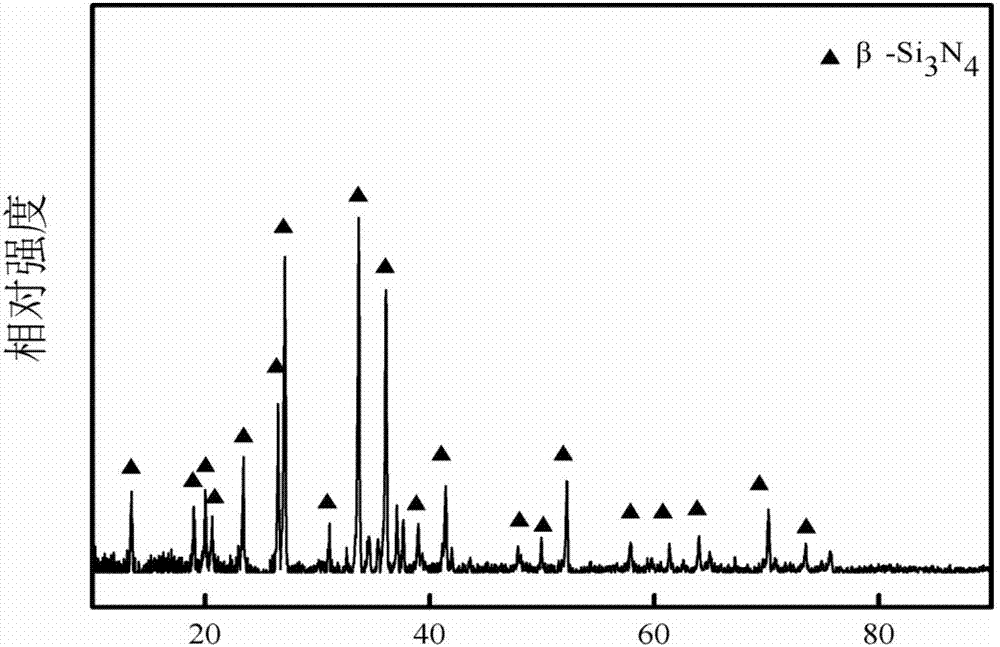
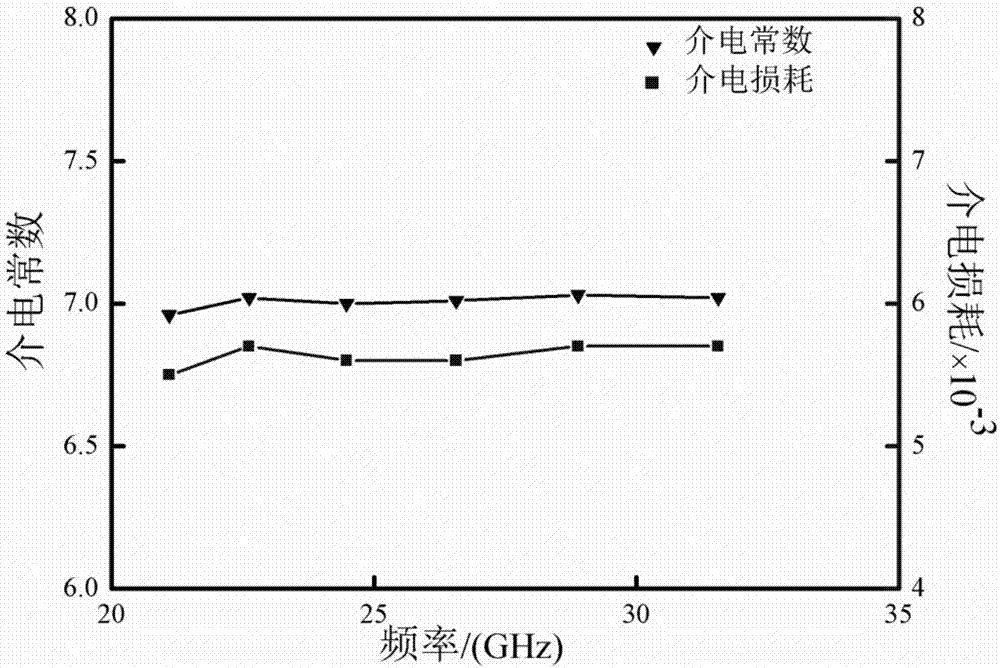
[0037] Step 1, by mass fraction, the MgO powder of 1.37%, the Al of 3.49% 2 o 3 Powder, 5.14% SiO 2 powder, 0.01% of BN powder and the balance of α-Si 3 N 4 After the powders are mixed, put them in a container, add an appropriate amount of absolute ethanol, and ball mill at a rate of 150r / min for 24 hours; wherein, the ratio of the mass of the balls to the total mass of all the above powders is 6:1;
[0038] Step 2, then drying at 90°C for 1 hour, grinding, and passing through a 100-mesh sieve to obtain a mixed powder;
[0039] Step 3, the mixed powder obtained in step 2 is packed into a mould, and then pre-pressed under a pressure of 10MPa;
[0040] Step 4, then place it in a sintering furnace, pass nitrogen gas as a protective gas, and sinter for 1 hour at a temperature of 1700 ° C and a...
specific Embodiment approach 2
[0042] Specific embodiment two: the difference between this embodiment and specific embodiment one is: in step one, by mass fraction, the MgO powder of 1.37%, the Al of 3.49% 2 o 3 Powder, 5.14% SiO 2 powder, 30% of BN powder and the balance of α-Si 3 N 4 Powder mix. Other steps and parameters are the same as in the first embodiment.
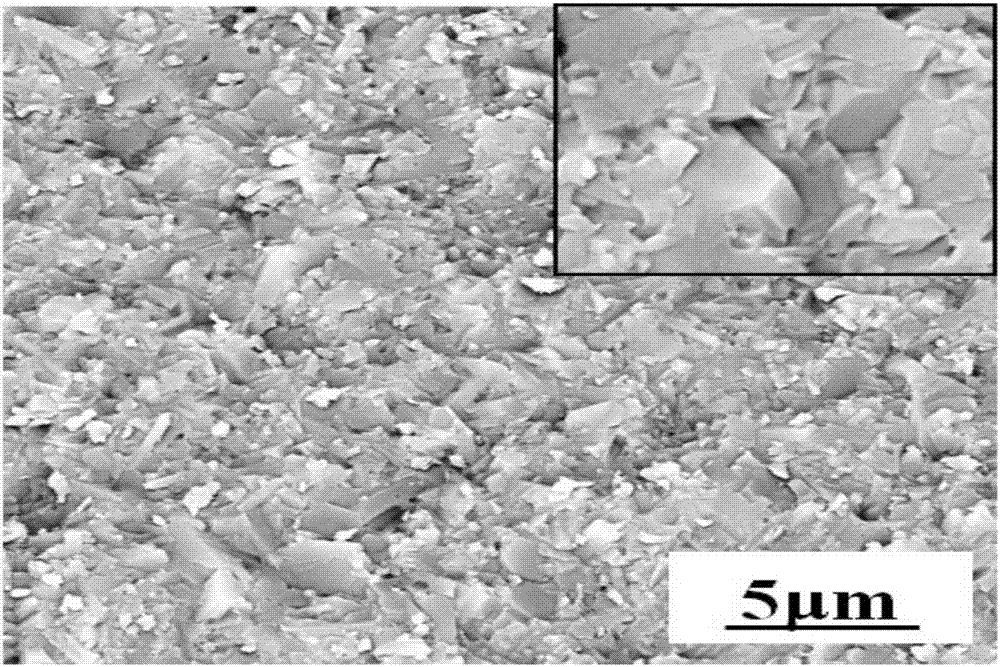
[0043] Si prepared in this embodiment 3 N 4 -BN-MAS composite ceramics have good performances: the main phase after sintering is β-Si 3 N 4 、Si 2 N 2 O; the fracture morphology is dense, and there are more columnar β-Si in the material 3 N 4 , lamellar Si 2 N 2 O grains, the two often exist in the form of cross lamination; the density is 88.36%, the apparent porosity is 2.75%, the bending strength is 461.4±15.6MPa, the fracture toughness is 3.67GPa, the dielectric constant is 4.7±0.21, and the dielectric loss The tangent of the angle is 6.03×10 -3 . The prepared composite ceramics were subjected to thermal shock at 600°C, 800°C, ...
specific Embodiment approach 3
[0044] Specific embodiment three: the difference between this embodiment and specific embodiment one is: in step one, the MgO powder of 1.37%, the Al of 3.49% 2 o 3 Powder, 5.14% SiO 2 powder, 50% of BN powder and the balance of α-Si 3 N 4 Powder mix. Other steps and parameters are the same as in the first embodiment.
[0045] The Si prepared by the method of this embodiment 3 N 4 -BN-MAS composite ceramics have good performances: the main phase after sintering is β-Si 3 N 4 、Si 2 N 2 O, h-BN; the fracture morphology is dense, and there is a small amount of columnar β-Si in the material 3 N 4 , lamellar BN grains, the two often exist in the form of cross lamination; the density is 79.92%, the apparent porosity is 4.36%, the flexural strength is 225.9±12.4MPa, the fracture toughness is 3.03GPa, and the dielectric constant is 4.71± 0.18, the dielectric loss tangent value is 4.57×10 -3 . The prepared composite ceramics were subjected to thermal shock at 600°C, 800°C...
PUM
| Property | Measurement | Unit |
|---|---|---|
| flexural strength | aaaaa | aaaaa |
| flexural strength | aaaaa | aaaaa |
| flexural strength | aaaaa | aaaaa |
Abstract
Description
Claims
Application Information
 Login to View More