Check patentability & draft patents in minutes with Patsnap Eureka AI!

ShRNA sequence for inhibiting replication of influenza A virus and application of shRNA sequence

A type A influenza virus and sequence technology, applied in the direction of DNA / RNA fragments, antiviral agents, recombinant DNA technology, etc., can solve the problems of influenza vaccine failure, evasion of defense, influenza virus human health threats, etc.

Active Publication Date: 2018-01-16
GENERAL HOSPITAL OF THE NORTHERN WAR ZONE OF THE CHINESE PEOPLES LIBERATION ARMY
View PDF2 Cites 0 Cited by
  • Summary
  • Abstract
  • Description
  • Claims
  • Application Information

AI Technical Summary

Problems solved by technology

(2) Due to the continuous mutation of virus antigens, the defense of the immune system against the virus is avoided, making the newly developed influenza vaccine useless
(3) New virulent strains of the virus are produced regularly, causing a pandemic before a new vaccine is successfully developed
Because influenza virus resides in cells, traditional antiviral drugs have limited effect on the prevention and treatment of influenza virus infection, and antiviral drugs have certain toxic and side effects, and the emergence of drug-resistant virus strains limits their application
Therefore, there is currently no effective way to prevent and treat influenza virus infection, and influenza virus is still a great and potential threat to human health

Method used

the structure of the environmentally friendly knitted fabric provided by the present invention; figure 2 Flow chart of the yarn wrapping machine for environmentally friendly knitted fabrics and storage devices; image 3 Is the parameter map of the yarn covering machine
View more

Image

Smart Image Click on the blue labels to locate them in the text.
Viewing Examples
Smart Image
  • ShRNA sequence for inhibiting replication of influenza A virus and application of shRNA sequence
  • ShRNA sequence for inhibiting replication of influenza A virus and application of shRNA sequence
  • ShRNA sequence for inhibiting replication of influenza A virus and application of shRNA sequence

Examples

Experimental program
Comparison scheme
Effect test

Embodiment 1

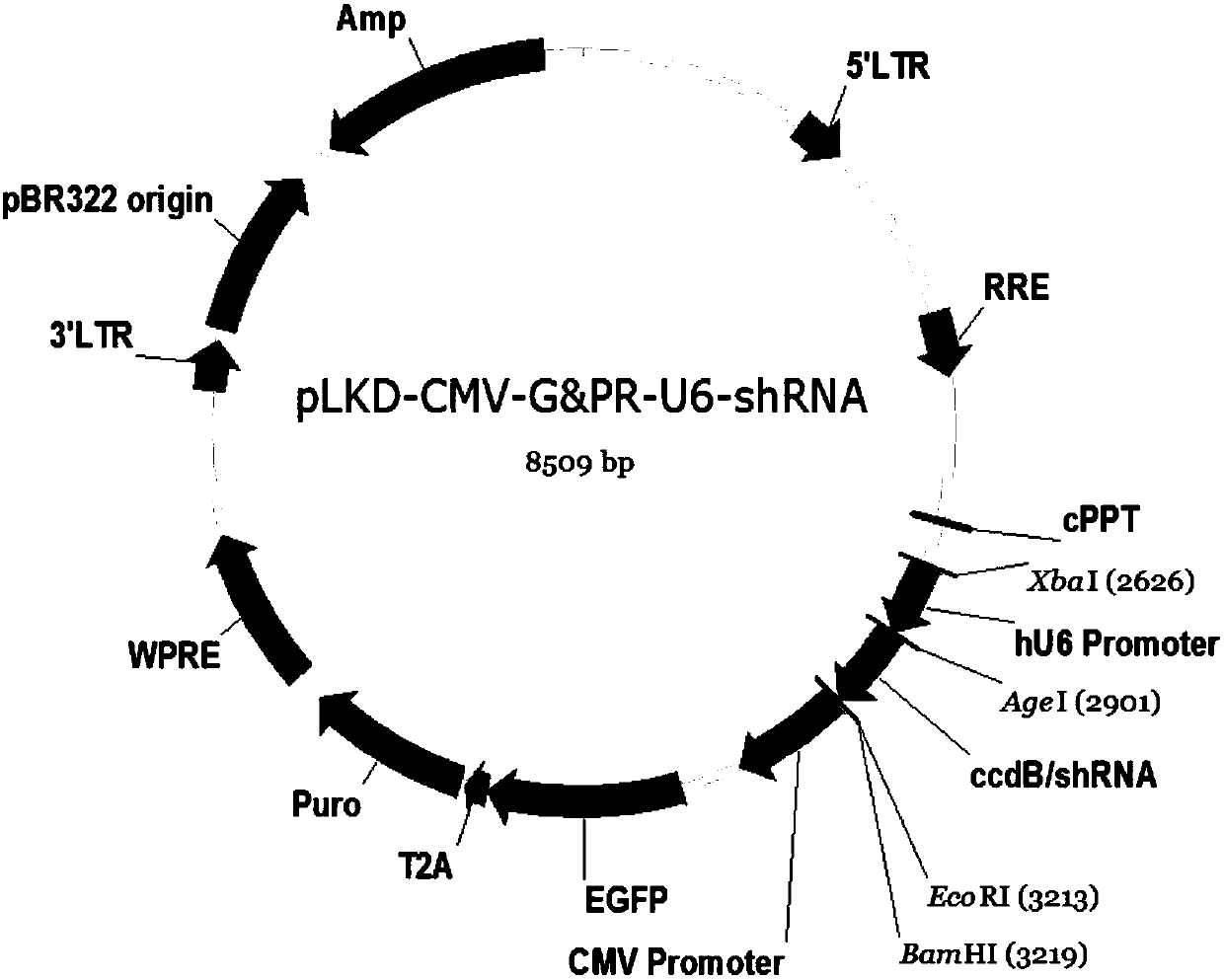
[0038] Construction of influenza virus NP fragment shRNA expression plasmid, transformation of Escherichia coli and screening of positive clones.

[0039] Influenza A virus, A / Shanghai / N33(2008) / H1N1, virus RNA was extracted, reverse transcribed into cDNA, and Sangon (Shanghai) Biotechnology Co., Ltd. was commissioned to perform DNA sequencing. The sequencing results are as follows:

[0040]

[0041] According to the sequencing results, design the shRNA sequence: GCTGGTCTGACTCACATAATG

[0042] Design viral vector construction framework and DNA primer fragments.

[0043] Table 1 Viral vector construction framework

[0044]

[0045] DNA primer fragment:

[0046]NP-391-F CcggGCTGGTCTGACTCACATAATGCTCGAGCATTATGTGAGTCAGACCAGCTTTTTTg

[0047] NP-391-R aattcaaaaaaGCTGGTCTGACTCACATAATGCTCGAGCATTATGTGAGTCAGACCAGC

[0048] Expression vector: lentiviral vector (pLKD-CMV-G&PR-U6-shRNA). The interference fragment was constructed into the downstream of the U6 promoter of the lent...

Embodiment 2

[0086] Influenza virus interference plasmid pLKD-NP-391 inhibits the replication of influenza virus in MDCK cells.

[0087] 1. Plasmid extraction:

[0088] According to Promega's Wizard Plus Minipreps DNA Purification System kit instructions.

[0089] 2. Plasmid transfection into MDCK cells:

[0090]MDCK cells are the Madin–Darby canine kidney cell line, which is the most commonly used tool cell for studying influenza virus infection. After recovery, MDCK cells were cultured in DMEM medium containing heat-inactivated 10% FCS, 2mM L-glutamine, 100 units of penicillin / ml and 100 μg / ml of streptomycin, after 2-3 passages, inoculated In a 24-well cell culture plate, the seeding density was 5×10 4 / hole. 37°C, 5% CO 2 , cultivated at saturated humidity for 24 hours. When the cell layer reached 60%-70% confluence, the MDCK cells were transfected with the interference plasmid pLKD-NP-391 and the empty plasmid pLKD-007, respectively. For the operation steps, see the instructions...

Embodiment 3

[0106] Influenza virus interference plasmid pLKD-NP-391 inhibits the replication of influenza virus in mice.

[0107] 1. Plasmid extraction: Use the AxyPrep Endotoxin-Free Plasmid Mass Kit of Aisijin Biotechnology (Hangzhou) Co., Ltd. to extract interfering plasmids and empty plasmids. The operating steps were in accordance with the kit instructions provided by the company.

[0108] 2. Experimental animals and grouping: 30 BALB / C mice. Female, 6-8 weeks old. They were randomly divided into control group, empty plasmid group and interference plasmid group, with 10 mice in each group.

[0109] 3. Animals transfected with plasmids: PLKD-NP-391 and PLKD-007 (empty plasmids) were mixed thoroughly with PEI (polyetherimide) at room temperature for 20 minutes at a nitrogen / phosphorus weight ratio of 15:1. Nebulize PEI / PLKD-NP-391 or PEI / PLKD-007 complexes respectively with PARIBOY nebulizer. The aerosol was expelled into a closed plastic box containing 10 mice. Mice in an aerosol...

the structure of the environmentally friendly knitted fabric provided by the present invention; figure 2 Flow chart of the yarn wrapping machine for environmentally friendly knitted fabrics and storage devices; image 3 Is the parameter map of the yarn covering machine
Login to View More

PUM

No PUM Login to View More

Abstract

The invention provides a segment of a shRNA sequence: GCTGGTCTGACTCACATAATG. After the sequence is annealed, the obtained sequence is inserted to siRNA expression plasmid for conversion of Escherichiacoli. A positive clone is screened by clone PCR, and a bacterial strain is kept. Genetically engineered bacterium is amplified, and the plasmid is extracted and purified. MDCK cells are transinfectedwith the plasmid. The obtained cells are infected with influenza virus, and the supernate of cell culture is collected after 48 h, total RNA is extracted, and the influenza virus content in the supernate is detected through a RT-PCT method. A compound of the plasmid and PEI is aerosol-inhaled by a BALB / C mouse, and the aerosol inhalation is performed for 30 min per day for 3 days. Then, the mouseis attacked by influenza virus, and the mouse is killed after 3 days. Lungs of the dead mouse is taken out to prepare a tissue homogenate, total RNA is extracted from the tissue homogenate, and the influenza virus content in the supernate is detected through a RT-PCT method. According to different content of influenza virus, the fact that shRNA has the function of inhibiting replication of influenza virus is ensured.

Description

technical field [0001] The present invention relates to gene silencing technology caused by RNA interference, and in particular provides a shRNA sequence that inhibits the replication of influenza A virus and its application, which can intervene in the infection of healthy people by the virus and inhibit the growth of influenza virus in the sick population during large-scale influenza epidemics. copy. Background technique [0002] Influenza A virus is one of the most contagious human respiratory diseases. During the 1918 influenza virus pandemic, more than 20,000,000 people died from influenza. The characteristics of this virus are: (1) spread through air droplets, and the transmission speed is fast. (2) Due to the continuous mutation of virus antigens, the defense of the immune system against the virus is avoided, and the newly developed influenza vaccine loses its effect. (3) New virulent strains of the virus are produced regularly, causing a pandemic before the new vac...

Claims

the structure of the environmentally friendly knitted fabric provided by the present invention; figure 2 Flow chart of the yarn wrapping machine for environmentally friendly knitted fabrics and storage devices; image 3 Is the parameter map of the yarn covering machine
Login to View More

Application Information

Patent Timeline
no application Login to View More
IPC IPC(8): C12N15/113C12N15/11C12N15/66C12N15/85A61K48/00A61K31/713A61P31/16
Inventor 马壮孙文武史亮王忠华曹建平
Owner GENERAL HOSPITAL OF THE NORTHERN WAR ZONE OF THE CHINESE PEOPLES LIBERATION ARMY
Features
  • R&D
  • Intellectual Property
  • Life Sciences
  • Materials
  • Tech Scout
Why Patsnap Eureka
  • Unparalleled Data Quality
  • Higher Quality Content
  • 60% Fewer Hallucinations
Social media
Patsnap Eureka Blog
Learn More