

Composite graphite electrode electrolytic redox device and method with self-cleaning function
An electrolytic oxidation, graphite electrode technology, applied in the field of graphite, can solve problems such as current or voltage rise, affecting electrolysis efficiency, energy consumption, etc., to achieve the effect of increasing current intensity, improving flow, and promoting flow
- Summary
- Abstract
- Description
- Claims
- Application Information
AI Technical Summary
Problems solved by technology
Method used
Image


Examples
Embodiment 1
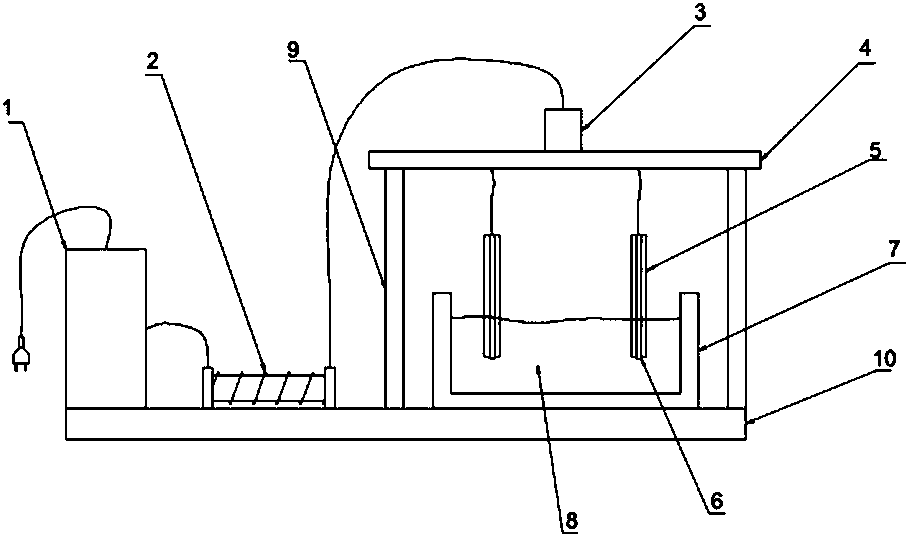
[0022] Such as figure 1 The self-cleaning composite graphite electrode electrolytic redox device shown includes a DC power supply system 1, the output end of the DC power supply system 1 is provided with a sliding rheostat 2, and the output end of the sliding rheostat 2 is provided with a cycle steering controller 3. A top plate 4 is provided at the bottom of the periodic steering transmission, an electrolytic electrode 5 is provided at the bottom of the top plate 4, a graphene cell 6 is embedded inside the electrolytic electrode 5, and an electrolytic cell 7 is provided at the bottom of the electrolytic electrode 5 , the electrolytic cell 7 is provided with an electrolyte 8, the two sides of the electrolytic cell 7 are provided with support rods 9, the bottom of the support rod 9 is provided with a bottom plate 10, and the DC power supply system 1 and the sliding rheostat 2 are made of copper The core wires are connected, the DC power supply system 1, the sliding rheostat 2 a...
Embodiment 2
[0027] The difference with embodiment 1 is:
[0028] After electrolytic treatment of fuel industry wastewater, the graphite electrode is taken out and placed in the electrolytic cell 7. At this time, the density of the electrolyte 8 is 1.24g / cm³, the conductivity is greater than 0.2S / m, the pH value is adjusted to 5, and the electrolysis electrode 5 The material is stainless steel, and then 10% sodium hydroxide solution is used to adjust the pH value of the electrolyte 8, and the control cycle is turned to the controller 3, and the cyclic operation of power-on-off-steering is carried out. The time ratio is 1:4, and the current density is 10A / ㎡ when electrified for electrolytic redox reaction;
[0029] After three hours of electrolysis, the graphite electrode was taken out, rinsed with deionized water, and the polymers on the front and back sides of the electrode were observed with a microscope. Turning on the electric operation promotes and improves the flow of charged partic...
Embodiment 3
[0031] The difference with embodiment 2 is:
[0032]After electrolytic treatment of fuel industry wastewater, the graphite electrode is taken out and placed in the electrolytic cell 7. At this time, the density of the electrolyte 8 is 1.3g / cm³, the conductivity is greater than 0.2S / m, the pH value is adjusted to 11, and the electrolysis electrode 5 The material is titanium steel, and then 20% sodium hydroxide solution is used to adjust the pH value of the electrolyte 8, the control cycle is turned to the controller 3, and the cycle operation of power-on-off-turn on-off is performed, and the turn cycle is 200 seconds, the off-time ratio is 1:5, and the current density is 200A / ㎡ when electrified for electrolytic redox reaction.
[0033] After four hours of electrolysis, the graphite electrode was taken out, rinsed with deionized water, and the polymers on the front and back sides of the electrode were observed with a microscope. Turning on the electric operation promotes and im...
PUM
| Property | Measurement | Unit |
|---|---|---|
| Density | aaaaa | aaaaa |
| Conductivity | aaaaa | aaaaa |
| Density | aaaaa | aaaaa |
Abstract
Description
Claims
Application Information
 Login to View More