This helps you quickly interpret patents by identifying the three key elements:
Problems solved by technology
Method used
Benefits of technology
Problems solved by technology
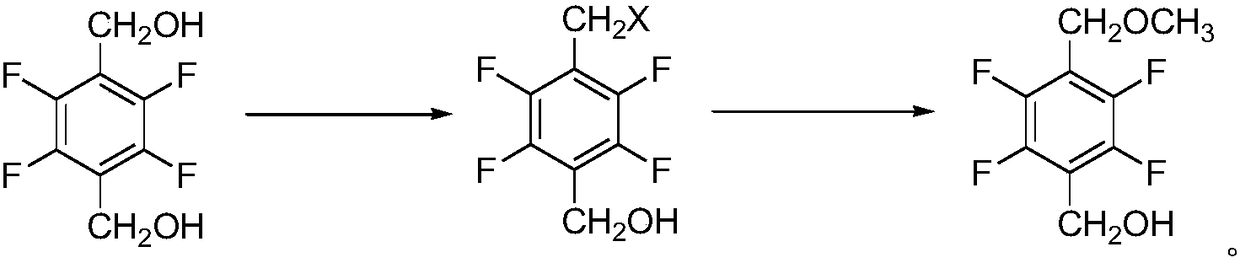
The disadvantage is that the chemical properties of the hydroxyl group in the raw material tetrafluoro-tere-phenylenedimethanol and the halogenated product 2,3,5,6-tetrafluoro-4-halomethyl benzyl alcohol are similar, and the halogenation reaction is carried out When the selectivity of the two is poor, it is easy to generate dihalogenated by-products, and further generate by-products 1,4-bis(methoxymethyl)-2,3,5, 6-tetrafluorobenzene, resulting in a decrease in reaction yield and an increase in synthesis cost
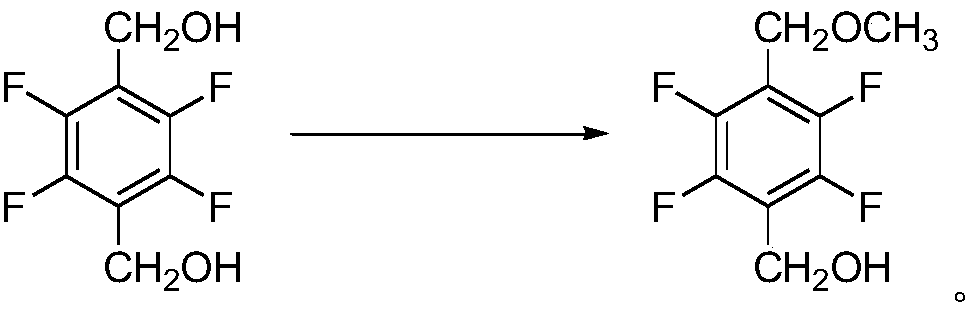
Main deficiency is that, in the reaction process, the chemical property of the hydroxyl in the raw material tetrafluoro-tere-phenylenedimethanol and the product 2,3,5,6-tetrafluoro-4-methoxymethyl benzyl alcohol is similar, causing reaction In the process, the selectivity is poor, and it is easy to generate by-product 1,4-bis(methoxymethyl)-2,3,5,6-tetrafluorobenzene. Usually, the content of this by-product is about 10%. Leading to a decrease in the reaction yield and an increase in the synthesis cost
[0013] At present, in the industrial production process of 2,3,5,6-tetrafluoro-4-methoxymethyl benzyl alcohol, there will be by-product 1,4-di(methoxymethyl)-2,3,5 , 6-Tetrafluorobenzene is produced. Depending on the process route and process conditions, the by-product usually accounts for 5-15%. Its application value has not been found so far, and it can only be incinerated as hazardous waste. Not only does it need Pay a lot of treatment costs, and may also produce secondary pollution in the process of incineration
Method used
the structure of the environmentally friendly knitted fabric provided by the present invention; figure 2 Flow chart of the yarn wrapping machine for environmentally friendly knitted fabrics and storage devices; image 3 Is the parameter map of the yarn covering machine
View more
Image
Smart Image Click on the blue labels to locate them in the text.
Viewing Examples
Smart Image
Click on the blue label to locate the original text in one second.
Reading with bidirectional positioning of images and text.
Smart Image
Examples
Experimental program
Comparison scheme
Effect test
Embodiment 1
[0048] Add 140 grams of compound (I), 420 grams of 70% sulfuric acidaqueous solution, and 1120 grams of propionic acid into a 2-liter reaction flask, stir and heat up to 140-145 ° C for 10 hours, stop the reaction, and cool down. The reaction solution was extracted with 700 grams of chloroform, the organic phases were combined, and the chloroform was removed by distillation under reduced pressure to obtain 159.5 grams of mixture (II) (HPLC detection: 2,3,5,6-tetrafluoro-4-methoxymethylbenzyl alcohol Propionate 35.5%, 2,3,5,6-Tetrafluorotere-xylylenedimethanol Dipropionate 20.2%, 2,3,5,6-Tetrafluorotere-xylylenedimethanol Monopropionate 16.8%, 2, 3,5,6-Tetrafluorotere-xylylenedimethanol 4.8%, 2,3,5,6-Tetrafluoro-4-methoxymethylbenzyl alcohol 11.8%, and 1,4-bis(methoxymethyl) -2,3,5,6-tetrafluorobenzene 9.1%), for the next reaction.
[0049] The resulting mixture (II) was added to a 2-liter reaction flask, 1250 grams of water and 370 grams of potassiumcarbonate were added, st...
Embodiment 2
[0052] Add 150 grams of compound (I), 600 grams of 60% sulfuric acidaqueous solution, and 900 grams of acetic acid into a 2-liter reaction flask, stir and heat up to 120-125° C. for 8 hours, stop the reaction, and cool down. The reaction solution was extracted with 960 grams of toluene, and the organic phases were combined to obtain 1125 grams of a toluene solution of the mixture (II) (HPLC detection: 2,3,5,6-tetrafluoro-4-methoxymethylbenzyl alcohol acetate 32.5 %, 2,3,5,6-Tetrafluorotere-xylylenedimethanol diacetate 22.4%, 2,3,5,6-Tetrafluorotere-xylylenedimethanol monoacetate 17.8%, 2,3,5, 6-tetrafluoro-tere-phenylenedimethanol 5.4%, 2,3,5,6-tetrafluoro-4-methoxymethylbenzyl alcohol 11.6% and 1,4-bis(methoxymethyl)-2,3 , 5,6-Tetrafluorobenzene 8.2%), for the next reaction.
[0053]Add the toluene solution of the obtained mixture (II) into a 2-liter reaction flask, add 480 grams of water and 84 grams of potassiumhydroxide, stir and heat up to 60-65° C. for 8 hours, stop t...
Embodiment 3
[0056] Add 160 grams of compound (I), 1280 grams of 80% sulfuric acid aqueous solution, and 480 grams of acetic acid into a 2-liter reaction flask, stir and heat up to 110-115° C. for 9 hours, stop the reaction, and cool down. The reaction solution was extracted with 350 grams of dichloroethane, and the organic phases were combined to obtain 525 grams of a dichloroethane solution of the mixture (II) (HPLC detection: 2,3,5,6-tetrafluoro-4-methoxymethyl Benzyl Alcohol Acetate 33.4%, 2,3,5,6-Tetrafluoro-tere-xylylene Dimethanol Diacetate 22.3%, 2,3,5,6-Tetrafluoro-Tetrafluoro-Tere-Phenyl Dimethanol Monoacetate 18.1%, 2,3,5,6-Tetrafluoro-tere-phenylenedimethanol 3.4%, 2,3,5,6-tetrafluoro-4-methoxymethylbenzyl alcohol 14.3% and 1,4-bis(methoxymethyl base)-2,3,5,6-tetrafluorobenzene 6.8%) for the next reaction.
[0057] Add the dichloroethane solution of the obtained mixture (II) into a 2-liter reaction flask, add 1000 grams of water and 240 grams of sodiumcarbonate, stir and rais...
the structure of the environmentally friendly knitted fabric provided by the present invention; figure 2 Flow chart of the yarn wrapping machine for environmentally friendly knitted fabrics and storage devices; image 3 Is the parameter map of the yarn covering machine
Login to View More
PUM
Login to View More
Abstract
The invention discloses a method for synthesizing 2,3,5,6-tetrafluoro-4-methoxymethyl benzyl alcohol through 1,4-di(methoxymethyl)-2,3,5,6-tetrafluorobenzene and belongs to the technical field of organic synthesis. The method comprises the following steps: taking the 1,4-di(methoxymethyl)-2,3,5,6-tetrafluorobenzene to react in a mixed solution composed of a sulfuric acid water solution and organiccarboxylic acid; carrying out ester group hydrolysis reaction on an obtained mixture under the action of inorganic alkali; carrying out methylation reaction of hydroxyl under the action of the inorganic alkali; finally, separating and purifying to obtain the 2,3,5,6-tetrafluoro-4-methoxymethyl benzyl alcohol and recycling the 1,4-di(methoxymethyl)-2,3,5,6-tetrafluorobenzene. According to the method provided by the invention, resource utilization of the low-value 1,4-di(methoxymethyl)-2,3,5,6-tetrafluorobenzene is realized; meanwhile, the method has the advantages of cheap and easy-to-obtain reaction reagents, moderate reaction conditions, simplicity in operation, high synthesis yield, good product quality and the like, and has very high social and economic value.
Description
technical field [0001] The invention belongs to the technical field of organic synthesis, in particular to a method for synthesizing 2,3,5,6-tetrafluorobenzene from 1,4-bis(methoxymethyl)-2,3,5,6-tetrafluorobenzene Fluoro-4-methoxymethylbenzyl alcohol method. Background technique [0002] 2,3,5,6-Tetrafluoro-4-methoxymethylbenzyl alcohol is a key intermediate in the synthesis of perfluthrin, metofluthrin and bifluethrin. Perfluthrin and Metofluthrin were developed by Sumitomo Chemical Industry Co., Ltd. Japan, and Chorfluthrin was developed by Jiangsu Yangnong Chemical Co., Ltd. All three are pyrethroids with low toxicity and high efficiency Insecticides have excellent knockdown and killing activities against mosquitoes, flies and other sanitary pests, and are currently widely used in the control of sanitary pests. [0003] There are currently bibliographically reported 2,3,5,6-tetrafluoro-4-methoxymethyl benzyl alcohol synthetic methods mainly contain the following: [0...
Claims
the structure of the environmentally friendly knitted fabric provided by the present invention; figure 2 Flow chart of the yarn wrapping machine for environmentally friendly knitted fabrics and storage devices; image 3 Is the parameter map of the yarn covering machine
Login to View More
Application Information
Patent Timeline
Application Date:The date an application was filed.
Publication Date:The date a patent or application was officially published.
First Publication Date:The earliest publication date of a patent with the same application number.
Issue Date:Publication date of the patent grant document.
PCT Entry Date:The Entry date of PCT National Phase.
Estimated Expiry Date:The statutory expiry date of a patent right according to the Patent Law, and it is the longest term of protection that the patent right can achieve without the termination of the patent right due to other reasons(Term extension factor has been taken into account ).
Invalid Date:Actual expiry date is based on effective date or publication date of legal transaction data of invalid patent.




 Login to View More
  Login to View More