Metal and nitrogen codoped ultrathin carbon nanosheet catalyst and preparation method and application thereof

A catalyst and co-doping technology, applied in structural parts, electrical components, battery electrodes, etc., can solve the problems of limiting the catalytic activity of oxygen reduction reaction and reducing the utilization rate of active sites, so as to achieve excellent catalytic performance, improve utilization rate, To achieve the effect of conduction

A catalyst and co-doping technology, applied in structural parts, electrical components, battery electrodes, etc., can solve the problems of limiting the catalytic activity of oxygen reduction reaction and reducing the utilization rate of active sites, so as to achieve excellent catalytic performance, improve utilization rate, To achieve the effect of conduction

CN109599569AActive Publication Date: 2019-04-09BEIJING UNIV OF CHEM TECH

Image

Smart Image Click on the blue labels to locate them in the text.
Viewing Examples
Smart Image
  • Metal and nitrogen codoped ultrathin carbon nanosheet catalyst and preparation method and application thereof
  • Metal and nitrogen codoped ultrathin carbon nanosheet catalyst and preparation method and application thereof
  • Metal and nitrogen codoped ultrathin carbon nanosheet catalyst and preparation method and application thereof

Examples

Experimental program
Comparison scheme
Effect test

Embodiment 1

[0034] Preparation of iron, nitrogen co-doped ultra-thin carbon nanosheet catalyst, the steps are as follows:

[0035] (1) Add 121 mg of Tris to 100 mL of deionized water to obtain 0.01 mol L -1 buffer solution, pH 7.4, add 100 mg tetracarboxyphenyl porphyrin iron, ultrasonic 30 min, stir until completely dissolved, add 10 g potassium chloride to the above solution, stir until completely dissolved.

[0036] (2) The solution was placed in a lyophilizer, frozen at -50 °C for 6 h, and then lyophilized in a vacuum environment for 48 h.

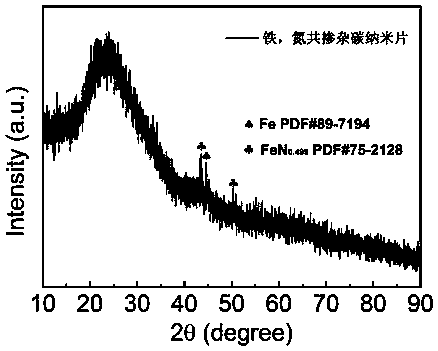
[0037] (3) The freeze-dried product was placed in a tube furnace for carbonization under an Ar atmosphere with a heating rate of 5 °C min -1 , the holding temperature was 800 °C, and the holding time was 2 h. After cooling to room temperature, it was washed with deionized water to remove potassium chloride.

[0038] (4) The product was placed in a tube furnace, in NH 3 Heat treatment was carried out under atmosphere at a heating rate of 5 °C mi...

Embodiment 2

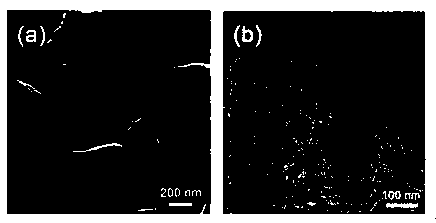
[0041] The preparation process of Example 1 is adopted, except that the inorganic salt used is replaced by potassium bromide or potassium sulfate. After freeze-drying, the mixture of inorganic salt and porphyrin iron still maintains a two-dimensional sheet structure, such as Figure 5 shown. It shows that the method has wide applicability for different inorganic salts.

Embodiment 3

[0043] Adopt the preparation process of embodiment 1, its difference is that the addition of potassium chloride is reduced to 5 g, and the catalyst specific surface area of ​​making is about 400 m 2 g -1 , the morphology basically maintains a sheet-like structure, and its SEM image is shown in Figure 6 , indicating that changing the amount of potassium chloride added will affect the pore structure on the basis of maintaining the sheet structure, thereby changing the specific surface area.

the structure of the environmentally friendly knitted fabric provided by the present invention; figure 2 Flow chart of the yarn wrapping machine for environmentally friendly knitted fabrics and storage devices; image 3 Is the parameter map of the yarn covering machine
Login to View More

PUM

PropertyMeasurementUnit
Thicknessaaaaaaaaaa
Specific surface areaaaaaaaaaaa
Thicknessaaaaaaaaaa
Login to View More

Abstract

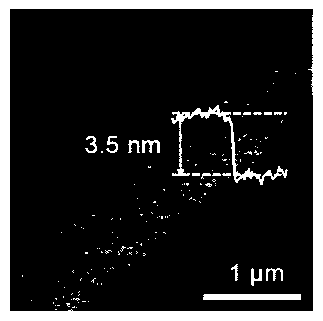
The invention relates to metal and nitrogen codoped ultrathin carbon nanosheet catalyst and a preparation method and application thereof. Freeze drying is carried out on mixture of meso-tetra(4-carboxyphenyl) porphyrin metal and soluble potassium salt by taking ice as a template. High temperature carbonization is carried out. Washing is carried out to remove potassium chloride, thereby obtaining an ultrathin nanosheet structure. Heat treatment is carried out under an atmosphere of ammonia gas, thereby obtaining the metal and nitrogen codoped ultrathin carbon nanosheet catalyst. Thickness of the catalyst is 3.5-10 nm. A specific surface area reaches 700 m<2>g<-1>. The catalyst has abundant micropores and mesoporous structures. Meta and nitrogen elements are uniformly distributed in a carbonnetwork. The catalyst has excellent oxygen reduction electrocatalytic activity, stability and methanol poisoning resistance and can be widely applied to fields such as a fuel cell and a metal-air cell. The method is simple and controllable. A preparation process is environment-friendly.

Description

technical field [0001] The invention belongs to the technical field of preparation of energy materials, especially electrochemical materials, and specifically relates to a metal and nitrogen co-doped ultra-thin carbon nanosheet catalyst and its preparation method and application. Background technique [0002] The oxygen reduction reaction is a key reaction that determines the performance of fuel cells and metal-air batteries. Its process is complex, its overpotential is high, and its kinetics is slow. It is necessary to use efficient catalysts to increase the reaction rate. The high cost and limited reserves of noble metal catalysts currently used limit their large-scale application. The development of non-noble metal catalysts is crucial to reduce costs and promote commercialization. Transition metal, nitrogen co-doped carbon materials (TM-N-C) are considered as a class of low-cost, high-performance oxygen reduction catalysts that are promising to replace noble metals. [...

Claims

the structure of the environmentally friendly knitted fabric provided by the present invention; figure 2 Flow chart of the yarn wrapping machine for environmentally friendly knitted fabrics and storage devices; image 3 Is the parameter map of the yarn covering machine
Login to View More

Application Information

Patent Timeline
09 Apr 2019
Publication
CN109599569A
IPC
H01M4/90; H01M4/88
CPC
H01M4/8825; H01M4/90; H01M4/9041; H01M4/9083; Y02E60/50
Inventors
王峰; 李寒煜