Polymer binder with high peel strength and application of polymer binder in secondary lithium battery
A polymer, high peeling technology, applied in the direction of secondary batteries, lithium batteries, battery electrodes, etc., can solve the problems of mechanical properties (poor elastic modulus, low solubility of organic solvents, electrode delamination or peeling, etc., to achieve excellent performance , Raw materials are readily available, and the effect of high elastic modulus
- Summary
- Abstract
- Description
- Claims
- Application Information
AI Technical Summary
Problems solved by technology
Method used
Image



Examples
Embodiment 1
[0044] Preparation of polymer binder A1:
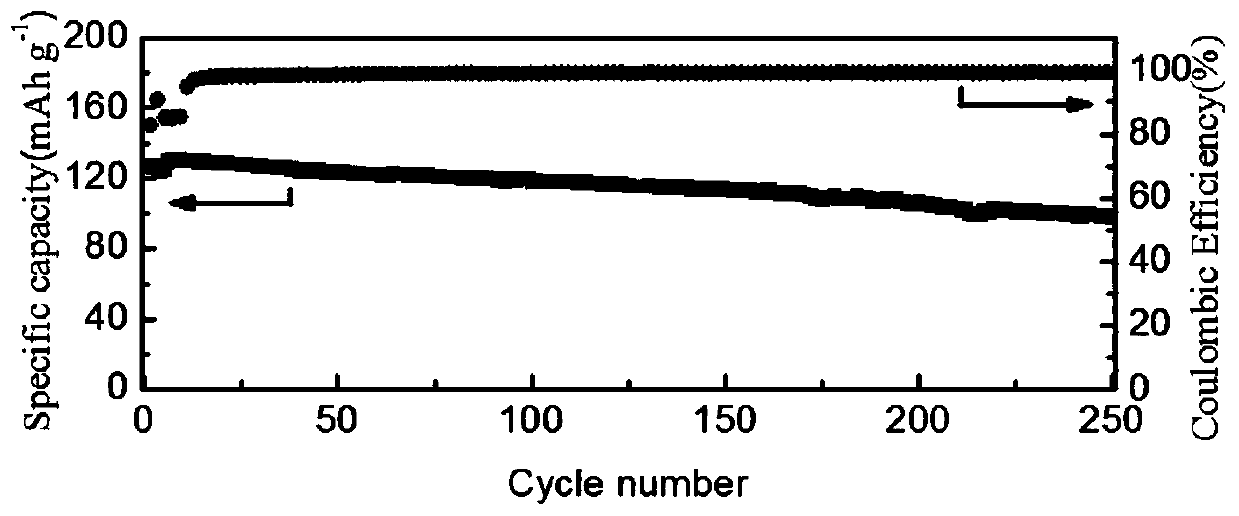
[0045] The cathode active material lithium nickel manganese oxide, Super P and binder A1 precursor [(Nu1 (m=44, accounting for 60% of the total mass of the polymer) and polyvinylene carbonate (40% of the total mass of the polymer)] were added to the mortar as a slurry at a mass ratio of 8:1:1, and NMP (accounting for 10% by mass of the slurry) was ground and stirred at 30° C. for 20 min to obtain a homogeneous slurry. Coat the above slurry evenly on the aluminum foil, dry it in a 60°C oven for 2 hours, punch it into a pole piece of a suitable size through a punching machine, continue to dry it in a 100°C oven for 24 hours, and put it in a glove box for later use.
[0046] The above-mentioned obtained electrode is used as a positive electrode, and graphite is assembled as a negative electrode to obtain a lithium nickel manganate / graphite full battery, and its long-term cycle performance at room temperature and peel strength are detec...
Embodiment 2
[0052] Preparation of polymer binder A2:
[0053] Nu2 (accounting for 10% of the total mass of the polymer) and polyvinylene carbonate (accounting for 90% of the total mass of the polymer) were dissolved in acetonitrile (accounting for 80% of the mass ratio of the slurry), and stirred and reacted for 2h at 100°C. A solution of polymer binder A2 was obtained.
[0054] High peel strength polymer binder based electrodes:
[0055] Grinding and stirring the acetonitrile solution of the positive electrode active material sulfur and graphite and the above-mentioned obtained polymer binder A2 in a mass ratio of 70:5:25 in a mortar to form a homogeneous slurry. The above slurry was uniformly coated on an aluminum foil, and dried in an oven at 60°C for 0.5h. The electrode pieces of appropriate size were formed by the machine, and then dried in an oven at 80°C for 12 hours.
[0056] The electrode obtained above is used as a positive electrode, and lithium is assembled as a negative ...
Embodiment 3
[0061] Preparation of polymer binder A3:
[0062] Structure Nu3 as (33% of the total mass of the polymer) and polyvinylene carbonate) (67% of the total mass of the polymer) were dissolved in tetrahydrofuran (80% of the mass ratio of the slurry), and the reaction was stirred at -10°C A solution of polymer binder A2 was prepared in 2 minutes.
[0063] High peel strength polymer binder based electrodes:
[0064] The ternary positive electrode material, acetylene black, and the tetrahydrofuran solution of the polymer binder A3 obtained above were ground and stirred in a mortar at a mass ratio of 6.5:1.8:1.7 to form a uniform slurry. The above slurry was uniformly coated on an aluminum foil, and dried in an oven at 60°C for 20 minutes. Electrodes of suitable size were blasted by a blasting machine, then dried in a vacuum oven at 60°C for 12 hours, and placed in a glove box for later use.
[0065] The above-mentioned obtained electrode is used as a positive electrode, and lithi...
PUM
| Property | Measurement | Unit |
|---|---|---|
| tensile strength | aaaaa | aaaaa |
| peel strength | aaaaa | aaaaa |
| current efficiency | aaaaa | aaaaa |
Abstract
Description
Claims
Application Information
 Login to View More
PatSnap Eureka turns technology decisions into work you can execute. Powered by our Innovation Knowledge Graph, it runs expert workflows across engineering, life sciences, materials and intellectual property. Get your review-ready output in minutes.


