

Trivalent cerium ion coupled graphite phase carbon nitride and copper nano-cluster ratiometric fluorescent probe as well as preparation method and application thereof
A graphite-phase carbon nitride and ratiometric fluorescent probe technology, applied in the field of fluorescent sensing, achieves the effects of low detection limit, improved sensitivity, and fast response speed
- Summary
- Abstract
- Description
- Claims
- Application Information
AI Technical Summary
Problems solved by technology
Method used
Image

Examples
Embodiment 1
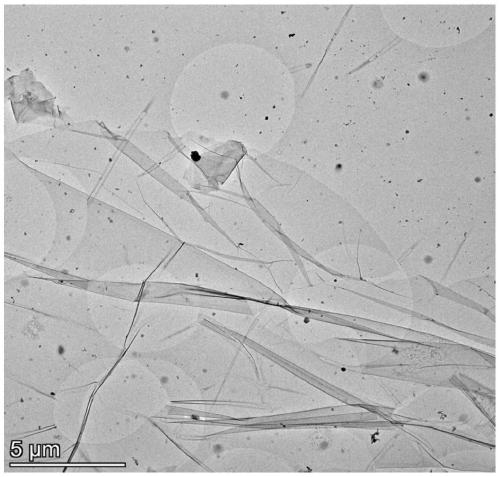
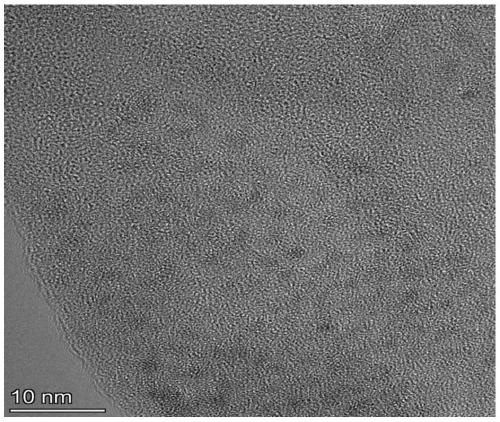
[0031] Preparation of graphite-phase carbon nitride: 8.0 g of melamine was spread and dispersed in the center of a porcelain boat, then placed in a tube furnace, heated to 600 °C at a rate of 3 °C / min, and kept at this temperature for 2 hours. After cooling to room temperature, the resulting pale yellow blocky solid was ground into a powder in an agate mortar. Weigh 100mg of powdered carbon nitride and disperse it in 100mL of deionized water. Under 300W power, it is ultrasonically stripped for 8h and left standing overnight. The supernatant was taken and centrifuged at 5000 rpm for 30 min to obtain graphite phase carbon nitride. Depend on figure 1 It can be seen that the prepared graphitic carbon nitride is flake-like.
[0032] Preparation of copper nanoclusters: 10 mL of glutathione (50 mg / mL) was added dropwise to 10 mL of CuSO 4 (10 mM) in a round-bottomed flask (50 mL) at 37° C. for 1 hour at 650 rpm to generate a milky white suspension. Then use NaOH (1M) solution to ...
PUM
| Property | Measurement | Unit |
|---|---|---|
| particle diameter | aaaaa | aaaaa |
Abstract
Description
Claims
Application Information
 Login to View More