
Method for synthesizing granular activated carbon catalyst while self-activating coconut shells under catalysis of calcium
A technology for synthesizing particles and self-activation, applied in metal/metal oxide/metal hydroxide catalysts, physical/chemical process catalysts, chemical instruments and methods, etc., can solve the problem of uneven dispersion of metal oxides, complicated preparation steps, Problems such as specific surface area and pore volume decrease
- Summary
- Abstract
- Description
- Claims
- Application Information
AI Technical Summary
Problems solved by technology
Method used
Image

Examples
Embodiment 1
[0026] Mix dry coconut shells with a particle size of 0.18mm~0.28mm and 0.5mol / L lanthanum nitrate solution at a solid-to-liquid ratio of 1g:1.5mL, vacuum impregnate for 25 hours, and vacuum dry; place Ca-coir in the middle of the tube furnace , close the inlet valve, and after the tube furnace is pumped to vacuum, close the outlet valve, raise the temperature to 800°C, control the pressure at 0.12~0.13MPa by adjusting the outlet valve, and activate the catalytic pyrolysis for 4 hours; feed nitrogen into the tube furnace (200mL / min), heated to 900°C and calcined under normal pressure for 2h to prepare a hierarchical porous carbon-based CaO catalyst. The specific surface area of the catalyst is 712.3m 2 / g, the total pore volume is 0.509cm 3 / g, the mesoporosity is 47.47%, and the average particle size of nano-CaO is 23.2nm.
Embodiment 2
[0028] Mix dry coconut shells with a particle size of 0.18mm~0.28mm and 0.5mol / L lanthanum nitrate solution at a solid-to-liquid ratio of 1g:1.5mL, vacuum impregnate for 24 hours, and vacuum dry; place Ca-coir in the middle of the tube furnace , close the inlet valve, and after the tube furnace is pumped to vacuum, close the outlet valve, raise the temperature to 800°C, control the pressure at 0.12~0.13MPa by adjusting the outlet valve, and activate the catalytic pyrolysis for 2 hours; feed nitrogen into the tube furnace (200mL / min), heated to 900°C and calcined under normal pressure for 2h to prepare a hierarchical porous carbon-based CaO catalyst.
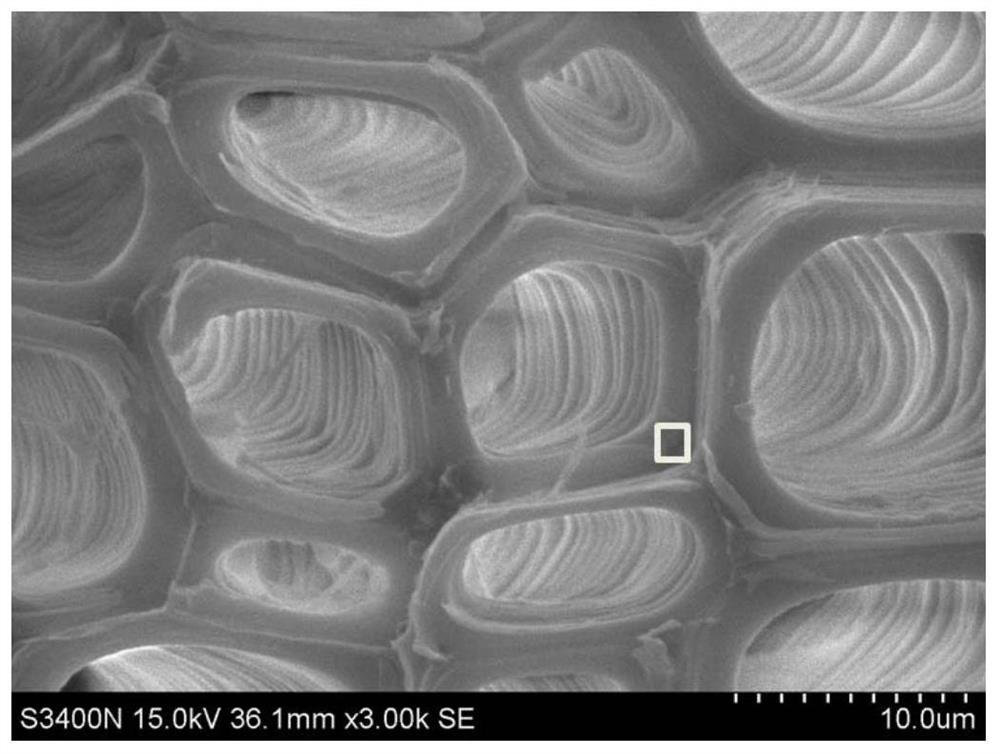
[0029] figure 1 After the Ca-coconut shell obtained in this implementation case is cut and processed, the scanning electron microscope-X-ray energy spectrum analysis diagram of the inner cell wall shows no obvious change in the inner cell wall, and the elemental analysis at the box is detected to contain 2.77wt% lanthanum element...
Embodiment 3
[0037] Mix dry coconut shells with a particle size of 0.18mm~0.28mm and 0.5mol / L lanthanum nitrate solution at a solid-to-liquid ratio of 1g:1.5mL, vacuum impregnate for 24 hours, and vacuum dry; place Ca-coir in the middle of the tube furnace , nitrogen gas (200mL / min) was introduced into the tube furnace, the temperature was raised to 800°C for 2 h, and the temperature was raised to 900°C for 2 h under normal pressure to prepare the carbon-based CaO catalyst. The specific surface area of the catalyst is 451.5m 2 / g, the total pore volume is 0.232cm 3 / g, the mesoporosity is 20.00%, and the average particle size of nano-CaO is 7.6nm.
PUM
| Property | Measurement | Unit |
|---|---|---|
| particle diameter | aaaaa | aaaaa |
| size | aaaaa | aaaaa |
| particle diameter | aaaaa | aaaaa |
Abstract
Description
Claims
Application Information
 Login to View More