
Perishable Garbage Rapid Degradation Method and Its Application
A rapid degradation and garbage technology, applied in the direction of microorganism-based methods, biochemical equipment and methods, immobilized on or in inorganic carriers, can solve the problems of non-reusable and difficult separation of microbial carriers, and achieve excellent microbial adsorption High efficiency, reduced preparation cost, and fast degradation
- Summary
- Abstract
- Description
- Claims
- Application Information
AI Technical Summary
Problems solved by technology
Method used
Image


Examples
Embodiment 1
[0068] Embodiment 1: A kind of quick-degrading bacterial agent for perishable garbage:
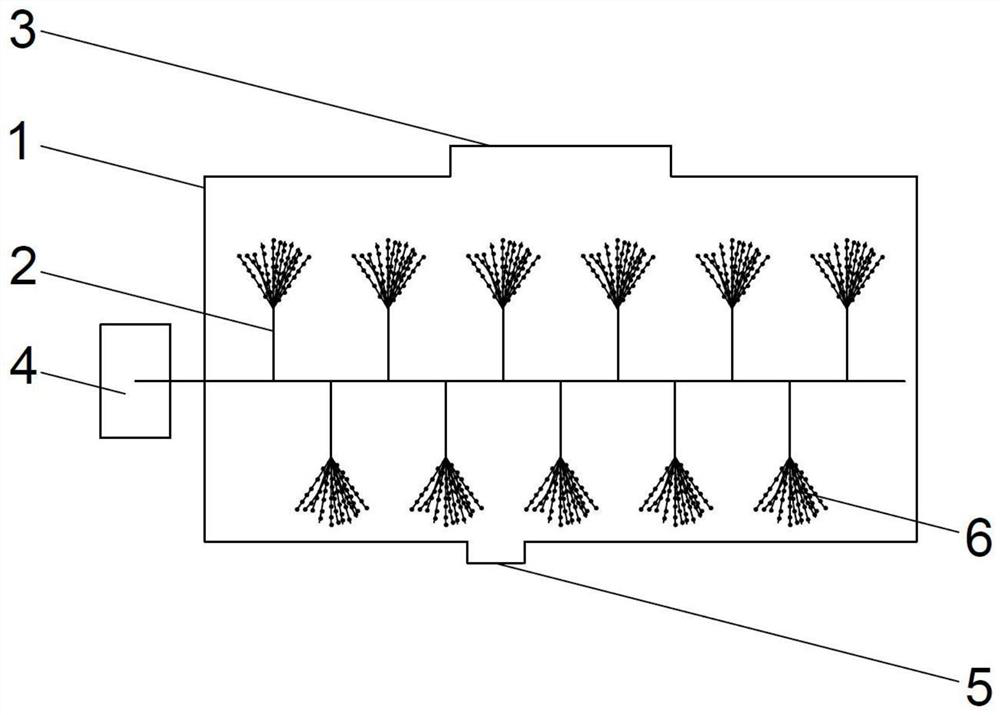
[0069] This embodiment first provides a reusable carrier, such as figure 1 As shown, its preparation steps specifically include:
[0070] 1) Basalt fiber (diameter 12μm) was soaked in 5% acetone solution at a frequency of 25KHz and a density of 0.3W / cm 2 Under the condition of ultrasonic cleaning for 6h, rinsed twice with deionized water, placed in 0.5mol / L hydrochloric acid solution, soaked at 35°C for 60min, taken out and rinsed to neutrality, dried at 40°C for 1 h, cut into 10cm length, and taken 15g basalt fiber, one end is tied into an umbrella shape;
[0071] 2) The ashes from the burning of Populus euphratica branches were heated at 550 °C for 2 hours, then dispersed in 0.2 molL sodium hydroxide solution according to the mass ratio of Populus euphratica ash and sodium hydroxide 1.3:1, and stirred at 120 r / min at 45 °C. The reaction was carried out for 6 hours. After filtration, t...
Embodiment 2
[0076] Embodiment 2: A kind of perishable garbage fast degrading bacterial agent:
[0077] This embodiment first provides a reusable carrier, the preparation steps of which specifically include:
[0078] 1) Basalt fiber (diameter 15μm) was soaked in 20% acetone solution at a frequency of 40KHz and a density of 0.6W / cm 2 Under the condition of ultrasonic cleaning for 4h, rinsed with deionized water for 4 times, placed in 1.0mol / L hydrochloric acid solution, soaked at 35℃ for 30min, taken out and rinsed to neutrality, dried at 60℃ for 1h, cut into 15cm length, and taken 10g basalt fiber, one end is tied into an umbrella shape;
[0079] 2) The ashes from the burning of Populus euphratica leaves were heated at 600°C for 2 hours, then dispersed in 0.1mol / L sodium hydroxide solution according to the mass ratio of Populus euphratica ash to sodium hydroxide of 1.5:1, at 60°C, covered with 600r / L Min stirring reaction for 2h, after filtration, the residue was washed with distilled wa...
Embodiment 3
[0084] Embodiment 3: A kind of perishable garbage fast degrading bacterial agent:
[0085] This embodiment first provides a reusable carrier, the preparation steps of which specifically include:
[0086] 1) Basalt fiber (diameter 15μm) was soaked in 10% acetone solution at a frequency of 32KHz and a density of 0.5W / cm 2 Under the condition of ultrasonic cleaning for 5h, rinsed twice with deionized water, placed in 0.8mol / L hydrochloric acid solution, soaked at 35℃ for 45min, taken out and rinsed to neutrality, dried at 45℃ for 2h, cut into 12cm length, and taken out. 15g basalt fiber, one end is tied into an umbrella shape;
[0087] 2) The ashes from the burning of Populus euphratica leaves were heated at 580°C for 2 hours, and then dispersed in 0.1mol / L sodium hydroxide solution according to the mass ratio of Populus euphratica ash and sodium hydroxide of 1.5:1. Min stirring and reacting for 3h, after filtration, the residue was washed with distilled water, the supernatant ...
PUM
| Property | Measurement | Unit |
|---|---|---|
| diameter | aaaaa | aaaaa |
| quality score | aaaaa | aaaaa |
Abstract
Description
Claims
Application Information
 Login to View More