Check patentability & draft patents in minutes with Patsnap Eureka AI!

Purine/pyrimidine nucleoside phosphorylase tandem expression engineering bacterium and application

A technology for pyrimidine nucleoside phosphorylase and pyrimidine nucleoside phosphorylase gene, which is applied to purine/pyrimidine nucleoside phosphorylase tandem expression engineering bacteria and application fields, and can solve the problem of low activity, unengineered application and low recovery rate And other issues

Inactive Publication Date: 2021-09-10
HENAN NORMAL UNIV
View PDF4 Cites 1 Cited by
  • Summary
  • Abstract
  • Description
  • Claims
  • Application Information

AI Technical Summary

Problems solved by technology

[0005] Phosphorylase has less content or lower activity in wild strains. A method for completing the conversion of pyrimidine or purine nucleosides in the prior art is to construct an overexpressed strain of a single enzyme and combine it with another protein expressed in the background of the engineering bacteria itself. One phosphorylase is completed, but it cannot be engineered due to the restriction of low-activity enzymes expressed in the background; the other method is to complete by coupling two engineered strains, but involves substrates and intermediate metabolites between strains transfer, and it is necessary to investigate the synergy of enzyme activity and strain ratio, the steps are cumbersome, the recovery rate is low, and the cost is high

Method used

the structure of the environmentally friendly knitted fabric provided by the present invention; figure 2 Flow chart of the yarn wrapping machine for environmentally friendly knitted fabrics and storage devices; image 3 Is the parameter map of the yarn covering machine
View more

Image

Smart Image Click on the blue labels to locate them in the text.
Viewing Examples
Smart Image
  • Purine/pyrimidine nucleoside phosphorylase tandem expression engineering bacterium and application
  • Purine/pyrimidine nucleoside phosphorylase tandem expression engineering bacterium and application
  • Purine/pyrimidine nucleoside phosphorylase tandem expression engineering bacterium and application

Examples

Experimental program
Comparison scheme
Effect test

Embodiment 1

[0021] Construction of Purine / Pyrimidine Nucleoside Phosphorylase Tandem High-expression Engineering Bacteria

[0022] Include the following steps:

[0023] Step S1: Extract the bacterial genome

[0024] Inoculate Escherichia coli in LB liquid medium and activate overnight at 37°C. The genome was extracted from Escherichia coli, and the steps were carried out according to the Ezup Column Bacterial Genome DNA Extraction Kit.

[0025] Step S2: Amplification of the target gene

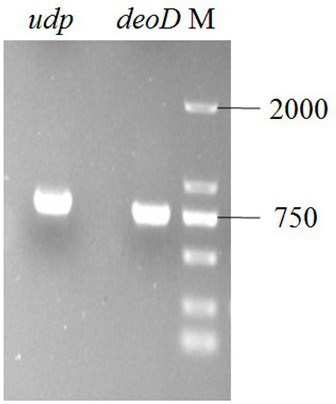
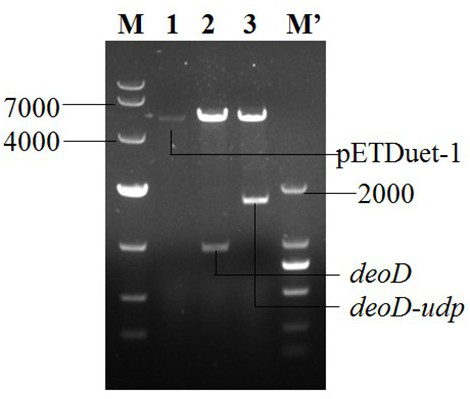
[0026] According to existing in Genbank deoD and udp Gene design primers, design restriction sites according to the map of the plasmid pMD18-T and the target plasmid, and use the extracted genome as a template to amplify the target fragment.

[0027] The 50 μL amplification system is: 0.5 μL of LA Taq enzyme, 5 μL of 10×PCR buffer, 8 μL of dNTP, 1 μL of gene DNA, 1 μL of each primer, ddH 2 O supplemented to 50 μL.

[0028] Amplification conditions were: pre-denaturation at 95 °C for 5 min, and th...

Embodiment 2

[0050] Protein

[0051] Specific steps are as follows:

[0052] Step S1: Induction of engineered bacteria

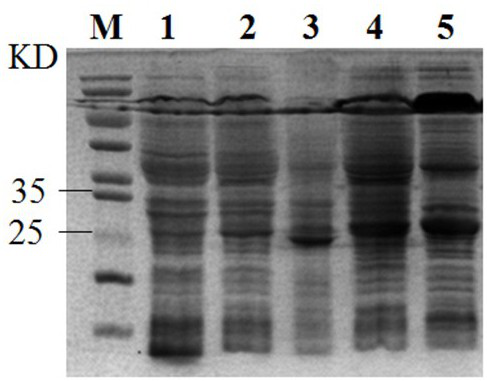
[0053] engineering bacteria E. coli ( deoD ) 、E. coli ( udp ), E. coli ( deoD-udp ) inoculated in LB (Amp + ) liquid, cultured at 37 ºC, inoculated with the original strain and the original strain containing no load at the same time as a control.

[0054] Inoculate LB or LB (Amp + ) liquid, cultured at 37 °C, when the bacterial liquid grows to the pre-logarithmic phase, add IPTG or lactose to a final concentration of 0.01-0.5 mM, and induce at 25-40 °C for 5-10 h.

[0055] Step S2: Preparation of crude enzyme solution

[0056] Centrifuge the induced bacterial solution with a 50 mL centrifuge tube at 6000 rpm for 5 min, discard the supernatant, collect the bacterial cells, and wash 2-3 times with 50 mM Tris-HCl buffer solution of pH 7.5.

[0057] Weigh 0.1 g of wet bacteria into a centrifuge tube, add 1 mL of Tris-HCl buffer to resuspend the bacteria, a...

Embodiment 3

[0061] Enzyme activity detection

[0062] Step S1: PNPase activity detection

[0063] The reaction system is as follows: 2.5 mL of reaction solution (20 mM inosine, 100 mM potassium dihydrogen phosphate, pH 7.0, 10 wt% crude enzyme solution), react at 60 °C for 10 min, add 2 mL of 1 M sodium hydroxide pre-cooled at 4 °C Stop the reaction.

[0064] The reaction results were detected by HPLC. The chromatographic conditions were as follows: Zorbax Eclipse XDB-C18 chromatographic column (4.6 mm×250 mm, 5 μm), and the mobile phase was KH 2 PO 4 Buffer (pH 4.0 50 mM): methanol=92:8, flow rate: 1.0 ml / min; column temperature: 20 ℃; detection wavelength: 259 nm; injection volume: 20 μL. Hypoxanthine standard solutions with concentration gradients of 5 mM, 10 mM, 15 mM, 20 mM, and 25 mM were prepared respectively, the peak areas corresponding to different concentrations were detected, and the linear regression equation between concentration and peak area was established. The enzyme...

the structure of the environmentally friendly knitted fabric provided by the present invention; figure 2 Flow chart of the yarn wrapping machine for environmentally friendly knitted fabrics and storage devices; image 3 Is the parameter map of the yarn covering machine
Login to View More

PUM

No PUM Login to View More

Abstract

The invention discloses a purine / pyrimidine nucleoside phosphorylase tandem expression engineering bacterium and application thereof. A purine / pyrimidine nucleoside phosphorylase gene is introduced into host escherichia coli for tandem expression to obtain the purine / pyrimidine nucleoside phosphorylase tandem expression engineering bacterium, and the purine / pyrimidine nucleoside phosphorylase tandem expression engineering bacterium is applied to a pilot plant test and large-scale green conversion of nucleoside analogues; anarabinoside drug is prepared by adopting the purine / pyrimidine nucleoside phosphorylase; a substrate is broad-spectrum; the substrate conversion rate is high; a product is easy to purify; the reaction condition is mild; the product component is relatively single, and by-products are few.

Description

technical field [0001] The invention belongs to the technical field of biomedical engineering, and specifically relates to a purine / pyrimidine nucleoside phosphorylase tandem expression engineering bacterium and its application. Background technique [0002] Purine nucleoside phosphorylase (PNPase) widely exists in eukaryotes and prokaryotes, and is one of the key enzymes in the purine salvage synthesis pathway, which can reversibly catalyze the generation of purine nucleoside (or deoxynucleoside) The phosphorylation reaction produces ribose (or deoxyribose)-1-phosphate and the corresponding purine base. Bacterial PNPase has a wide range of substrates and has been used to synthesize a series of nucleosides such as vidarabine, ribavirin, and 5-methyluridine. [0003] Uridine phosphorylase (UPase) belongs to pyrimidine phosphorylase, which can reversibly catalyze the formation of uracil from uridine. Has been used to synthesize 2´-fluridine, deoxyfluridine, etc., deoxyflurid...

Claims

the structure of the environmentally friendly knitted fabric provided by the present invention; figure 2 Flow chart of the yarn wrapping machine for environmentally friendly knitted fabrics and storage devices; image 3 Is the parameter map of the yarn covering machine
Login to View More

Application Information

Patent Timeline
no application Login to View More
Patent Type & Authority Applications(China)
IPC IPC(8): C12N1/21C12N15/70C12P19/38C12R1/19
CPCC12N9/1077C12N15/70C12Y204/02001C12Y204/02003C12P19/38
Inventor 王振宇张震刘玉雪王海磊刘国生
Owner HENAN NORMAL UNIV
Features
  • R&D
  • Intellectual Property
  • Life Sciences
  • Materials
  • Tech Scout
Why Patsnap Eureka
  • Unparalleled Data Quality
  • Higher Quality Content
  • 60% Fewer Hallucinations
Social media
Patsnap Eureka Blog
Learn More