
Super capacitor based on cobalt-based material
A supercapacitor, cobalt-based technology, used in the manufacture of hybrid capacitor electrodes and hybrid/electric double-layer capacitors, can solve the problems of high cost, complex process, and expensive graphene, and achieve improved conductivity, excellent cycle performance, Simple preparation method
- Summary
- Abstract
- Description
- Claims
- Application Information
AI Technical Summary
Problems solved by technology
Method used
Image

Examples
Embodiment 1
[0058] 1G CoCl 2 · 6h 2 O and 1.02G NA 2 MOO 4 The obtained homogeneous solution was transferred to the inner lined stainless steel high pressure reactor, and a clean foam is placed in a reactor in an oven in an oven at 120 ° C. Cobalt molybdate COMOO 4 Electrode material.
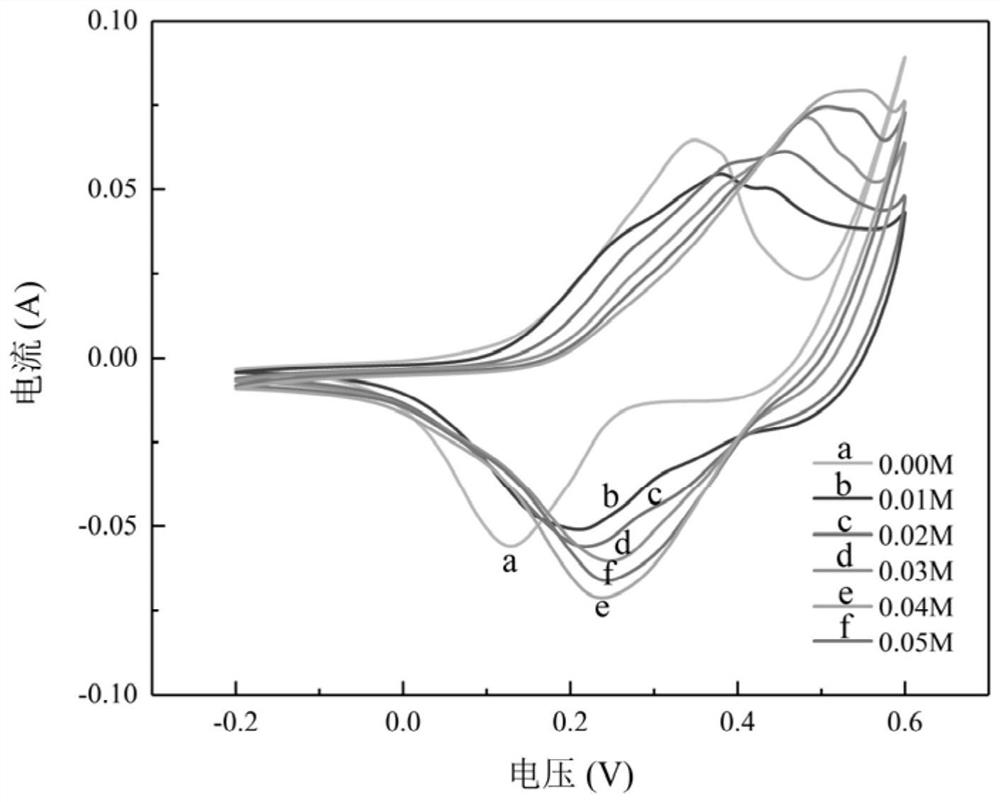
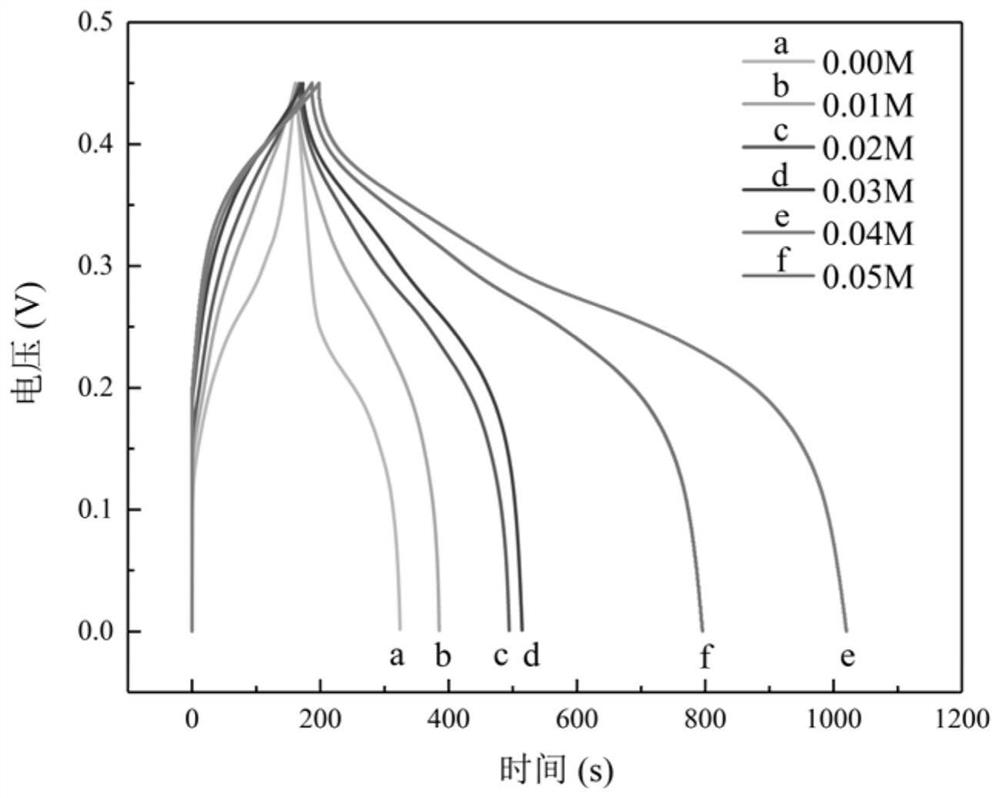
[0059] The standard three-electrode system is used, the PT electrode is used for electrodes, saturated glycine electrodes to reference electrodes, cobalt molybdate cobalt COMOO 4 The electrode material is a working electrode, and the addition of 0.01 mol / L, 0.02 mol / L, 0.03 mol / L, 0.04mol / L, and 0.05mol / L of K in the KOH electrolyte of 2 mol / L. 3 Fe (CN) 6 Circulating voltammetry (potential window is -0.2V to 0.6V, scan rate is 20mv S -1 ) And constant current charge and discharge curve (current density is 1A g -1 ) figure 1 with figure 2 .
[0060] From figure 2 It can be seen that add 0.04mol / L K 3 Fe (CN) 6 The specific capacitor is up to 1778F G -1 Never add K 3 Fe (CN) 6 Comparison capacitan...
Embodiment 2
[0062] Cocl of 1.05mmol 2 · 6h 2 O and 0.7mmol NA 3 V 4 O 8 The obtained homogeneous solution was dissolved in 50 ml of deionized water, and then the obtained homogeneous solution was transferred to the inner liner high-pressure reactor, and a clean foam nickel was put into the reactor, and the reaction kettle was placed in an oven at 130 ° C in an oven reaction for 3h. Cobalt Cobalt Co 3 V 2 O 8 Electrode material.
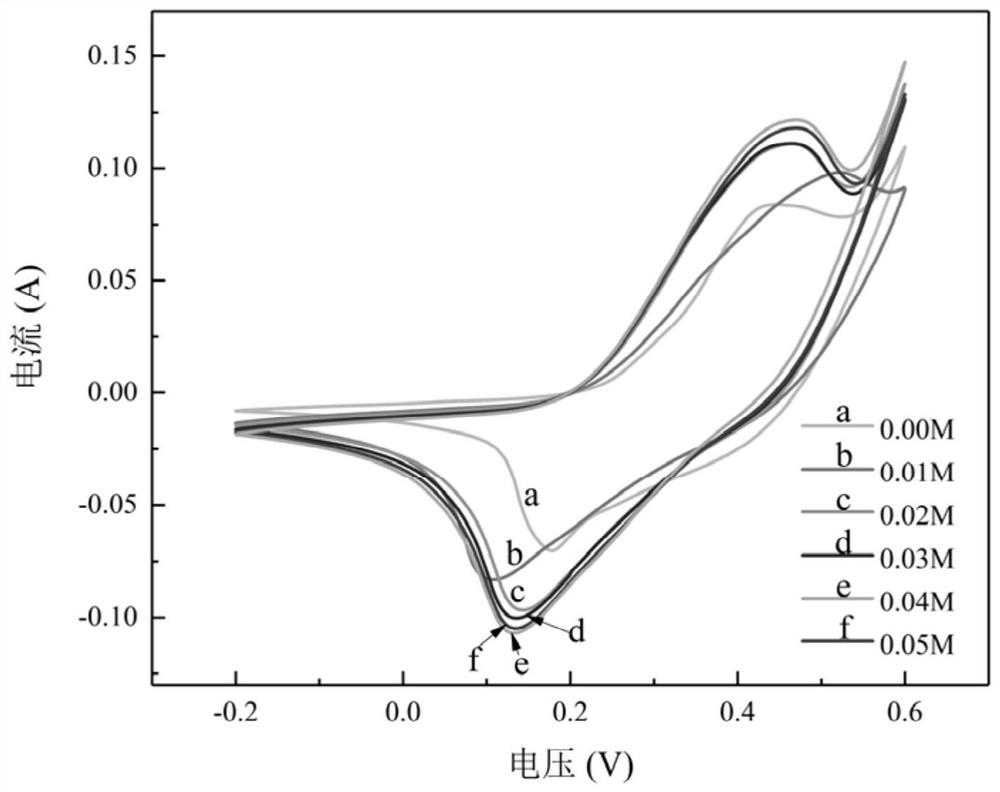
[0063] The standard three-electrode system is used, and the PT electrode is used for electrodes, saturated glycine electrodes for reference electrodes, cobalt vanadate CO 3 V 2 O 8 The electrode material is a working electrode, and the addition of 0.01 mol / L, 0.02 mol / L, 0.03 mol / L, 0.04mol / L, and 0.05mol / L of K in the KOH electrolyte of 2 mol / L. 3 Fe (CN) 6 Circulating voltammetry (potential window is -0.2V to 0.6V, scan rate is 20mv S -1 ) And constant current charge and discharge curve (current density is 1A g -1 ) image 3 with Figure 4 .
[0064] From...
Embodiment 3
[0066] 1g CoCl 2 · 6h 2 O Soluble in 20 ml of deionized water, placed on a magnetic stirrer, continuously stirred for 30 minutes to form a homogeneous solution. Will 0.3G NABH 4 And 0.06 g of NaOH was dissolved in 20 mL of deionized water, and then drip droplets were added dropwise to the above mixed solution, and a clean foam nickel was placed thereto, and then stirred for 3 hours to obtain a boron Cobalt COB electrode material.
[0067] The standard three-electrode system is used, the PT electrode is the counter electrode, the saturated glycine electrode is the reference electrode, the boride COB electrode material is a working electrode, and 0.01 mol / l, 0.02 mol, respectively, at 2 mol / L of KOH electrolyte, respectively. / L, 0.03mol / L, 0.04mol / L and 0.05mol / L of K 3 Fe (CN) 6 The circulating voltammetry (potential window is (-0.2V to 0.6V, the scan rate is 20mv s) -1 ) And constant current charge and discharge curve (current density is 1A g -1 ) Figure 5 with Image 6 .
...
PUM
 Login to View More
 Abstract
Description
Claims
Application Information
 Login to View More