
A thrombin-responsive dna nanomachine and its preparation method and application
A nanomachine, thrombin technology, applied in the field of nanomedicine, to achieve the effect of drug protection, uniform size, and improved enrichment ability
- Summary
- Abstract
- Description
- Claims
- Application Information
AI Technical Summary
Problems solved by technology
Method used
Image

Examples
Embodiment 1
[0049] The preparation method of the DNA nanomachine of embodiment 1 thrombin response
[0050] In this embodiment, the DNA nanomachine preparation method comprises the following steps:
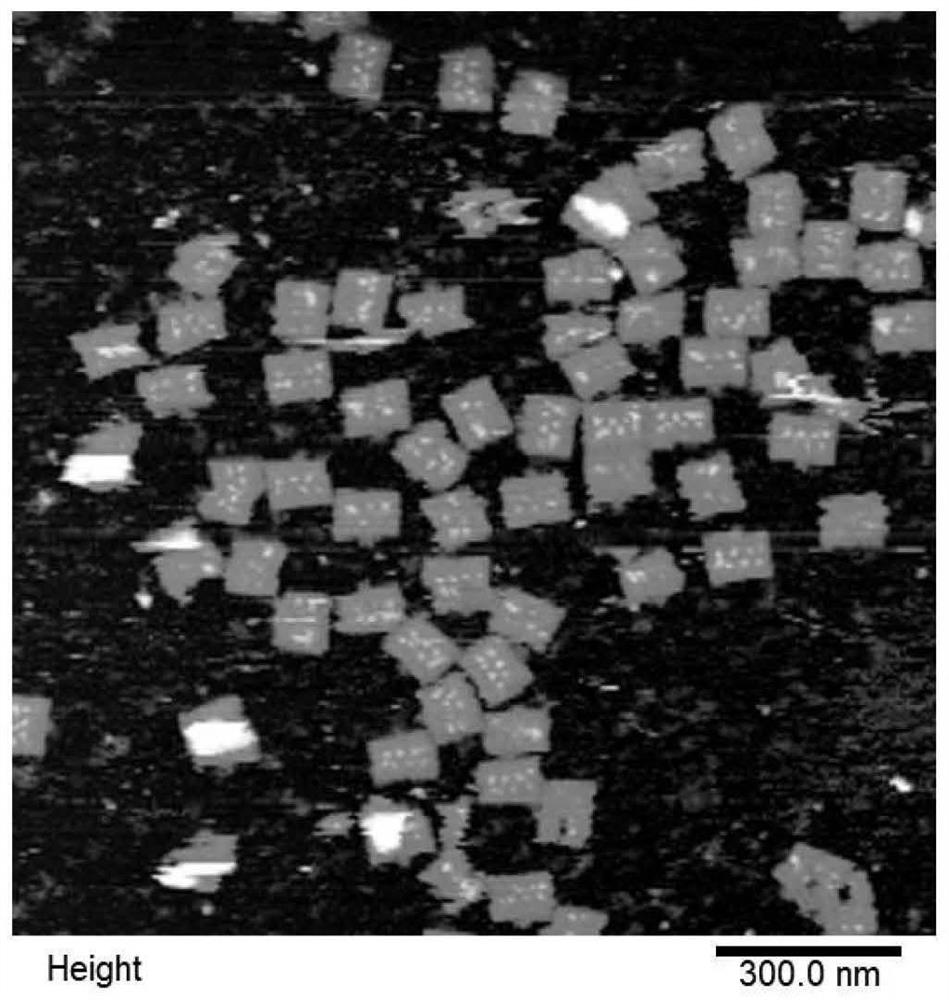
[0051] Step 1: Preparation of rectangular flat DNA nanostructures
[0052] The raw materials for preparation include: M13mp18 template strands shown in SEQ ID NO:1 and short DNA strands, the short DNA strands include: DNA staple strands with 156 sequences, 24 DNAs with sequences shown in SEQ ID NO:3-26 Capture strand, 12 kinds of DNA "lock" strands with sequences shown in SEQ ID NO:28-39, the above DNA strands were mixed in 1×TAE / Mg 2+ In the buffer, the total volume after mixing is 100 μL, the template strand concentration is 10 nM, the short DNA strands of each sequence are added in equal amounts and in excess, and the total concentration of short DNA strands is 80 nM;
[0053] Among them, the DNA staple strands of 156 sequences are selected from the "Supporting information" of the docume...
Embodiment 2
[0062] Example 2: Regulation of DNA nanomachines in response to thrombin environments in different concentration ranges
[0063]The DAN "lock" chain used in Example 1 is a sequence that is not completely complementary to the thrombin aptamer chain, and is a DAN "lock" chain that mismatches two bases. By modifying the DNA "lock" chain The number of matching bases can change its stability when it is complementary to the thrombin aptamer chain, thereby regulating the DNA nanomachine response to the thrombin concentration in different concentration ranges; it is confirmed by experiments that corresponding to Example 1, it is completely complementary and only The DAN "lock" chain with a mismatch of 1 base can also realize the response of DNA nanomachines to thrombin, and the mismatch of 1 base is the sixth in the repeated sequence 5'-AAAACACCAACC-3' in the "lock" chain A base is replaced by a T base; no mismatch base, that is, the sixth A base of the repeat sequence 5'-AAAACACCAACC...
experiment example 1
[0064] Experimental Example 1: Evaluation of Thrombus Targeting Effect of Tubular DNA Nanomachines
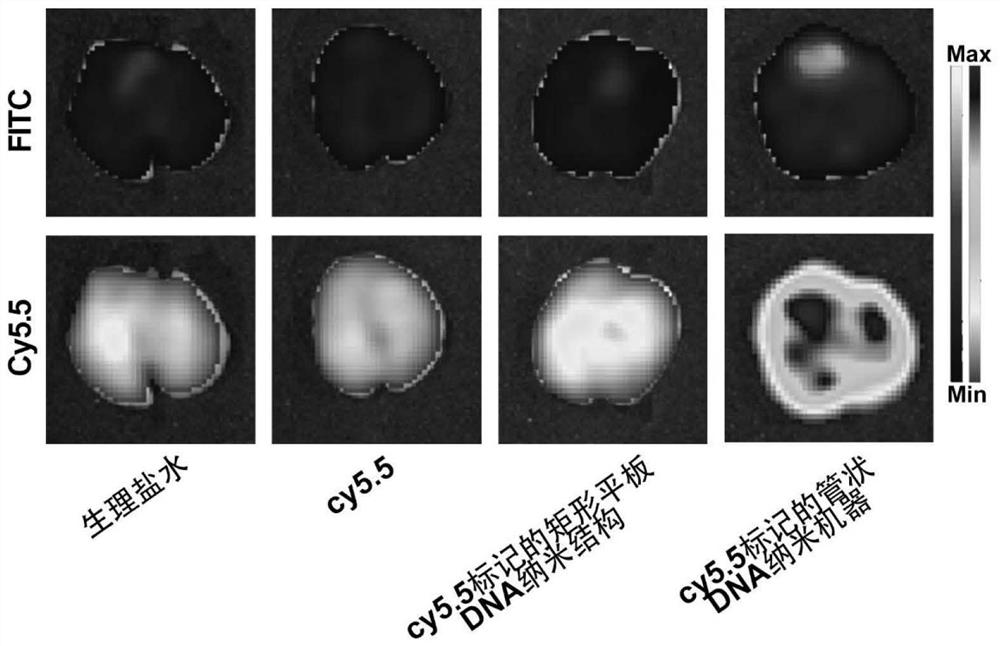
[0065] A certain dose of Cy5.5 fluorescent labeling, according to the tubular DNA nanomachines constructed under the condition of DNA "lock" strand mismatch of 2 bases as described in Example 1, was injected into C57 / BL6 mice through the tail vein After 20 min, the lung tissue was isolated and observed by IVIS in vivo fluorescence imaging to evaluate the thrombus targeting effect of the tubular DNA nanomachine. The result is as image 3 As shown, compared with the control group, that is, Cy5.5-labeled single-stranded DNA and fluorescently-labeled rectangular flat DNA nanostructures, the ratio of Cy5.5 / FITC fluorescence intensity in the tubular DNA nanomachine treatment group was higher than that in the rectangular flat DNA nanostructure treatment group. More than 2.1 times, it shows that the tubular DNA nanomachine provided by the present invention can protect the drug as a dr...
PUM
| Property | Measurement | Unit |
|---|---|---|
| diameter | aaaaa | aaaaa |
Abstract
Description
Claims
Application Information
 Login to View More