
Azole compound and medicinal use thereof
a technology of azole and compound, applied in the field of new azole compound, can solve the problems of publication not disclosing its usefulness as a ptp1b,
- Summary
- Abstract
- Description
- Claims
- Application Information
AI Technical Summary
Problems solved by technology
Method used
Image

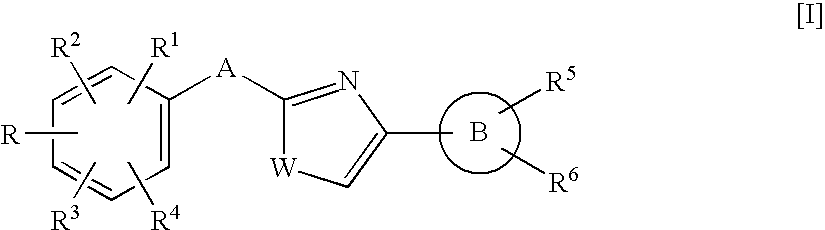
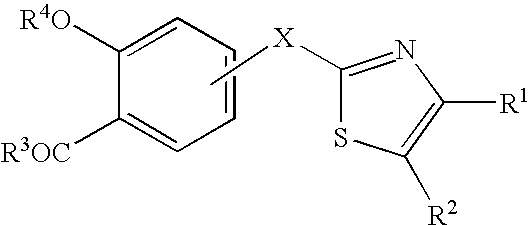
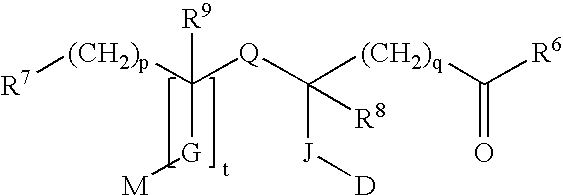
Examples
production example 1
4-cyclohexylbenzaldehyde
(1) 4-cyclohexylbenzyl Alcohol
Under a nitrogen stream, tetrahydrofuran (1.2 L, 15.0 v / w) was added to 4-cyclohexylbenzoic acid (80.0 g, 0.382 mol) and then isobutyl chlorocarbonate (52.0 ml, 0.401 mol) was added. Triethylamine (56.0 ml, 0.401 mol) was added to the reaction mixture with stirring under ice-cooling and the mixture was stirred at the same temperature for 30 min. The resulting precipitate was collected by filtration. To a suspension of sodium borohydride (58.0 g, 1.53 mol) in tetrahydrofuran (160 ml, 2.0 v / w) prepared in a different reaction vessel was carefully added the above-mentioned filtrate with stirring under ice-cooling under a nitrogen stream. After stirring at room temperature for 1.5 hr, distilled water (160 ml, 2.0 v / w) was added with stirring under ice-cooling. After stirring under ice-cooling for 20 min, 2N-hydrochloric acid (825 ml, 4.3 eq) was added. After stirring at room temperature for 30 min, the mixture was extracted with e...
example 1
4-(N-(4-(4-(N-(4-cyclohexylbenzyl)-N-methylamino)phenyl)-2-thiazolyl)-N-methylaminomethyl)benzoic acid
(1) 1-(4-methoxycarbonylbenzyl)-2-thiourea
Under an argon atmosphere, to a suspension of methyl 4-aminomethylbenzoate hydrochloride (170.0 g, 0.843 mol) in chloroform (850 ml, 5.0 v / w) were successively added 1,1′-thiocarbonyldiimidazole (purity 90%, 166.0 g, 0.843 mol) and triethylamine (123 ml, 0.885 mol). After stirring at room temperature for 3 hr, 28% aqueous ammonia (570 ml, 8.43 mol) and methanol (170 ml, 1.0 v / w) were added and the mixture was stirred overnight. n-Hexane (1700 ml, 10.0 v / w) and water (850 ml, 5.0 v / w) were successively added to the reaction mixture and the mixture was stirred at room temperature for 3 hrs. The precipitated crystals were collected by filtration, washed successively with n-hexane (500 ml) and water (500 ml) and dried in vacuo to give the title compound (172.5 g, yield 91.3%) as a colorless solid.
1H-NMR(300 MHz,DMSO-d6) δ 3.84(3H,s), 4.40(1H...
example 2
potassium 4-(N-(4-(4-(4-cyclohexylbenzyloxy)phenyl)-2-thiazolyl)-N-methylaminomethyl)benzoate
(1) 4-(4-cyclohexylbenzyloxy)acetophenone
Toluene (225 ml) and 48% hydrobromic acid (150 ml) were added to 4-cyclohexylbenzyl alcohol (74.9 g, 0.394 mol) and the mixture was stirred at 50° C. for 14 hr. After partitioning, the organic layer was washed successively with water (100 ml), saturated aqueous sodium hydrogen carbonate (100 ml), water (100 ml) and saturated brine, and dried over magnesium sulfate. After filtration and solvent evaporation, the residue was dried in vacuo to give a pale-yellow oil. The obtained oil was dissolved in N,N-dimethylformamide (500 ml) and 4-hydroxyacetophenone (50.3 g, 0.369 mol) and potassium carbonate (153 g, 1.11 mol) were added. The mixture was stirred at 45° C. for 70 min. After ice-cooling, water (750 ml) was added dropwise and the mixture was stirred at room temperature for 30 min. The precipitated crystals were collected by filtration, washed with ...
PUM
| Property | Measurement | Unit |
|---|---|---|
| Digital information | aaaaa | aaaaa |
| Temperature | aaaaa | aaaaa |
| Temperature | aaaaa | aaaaa |
Abstract
Description
Claims
Application Information
 Login to View More