
Multifunctional Nanoparticle Conjugates And Their Use
- Summary
- Abstract
- Description
- Claims
- Application Information
AI Technical Summary
Benefits of technology
Problems solved by technology
Method used
Image

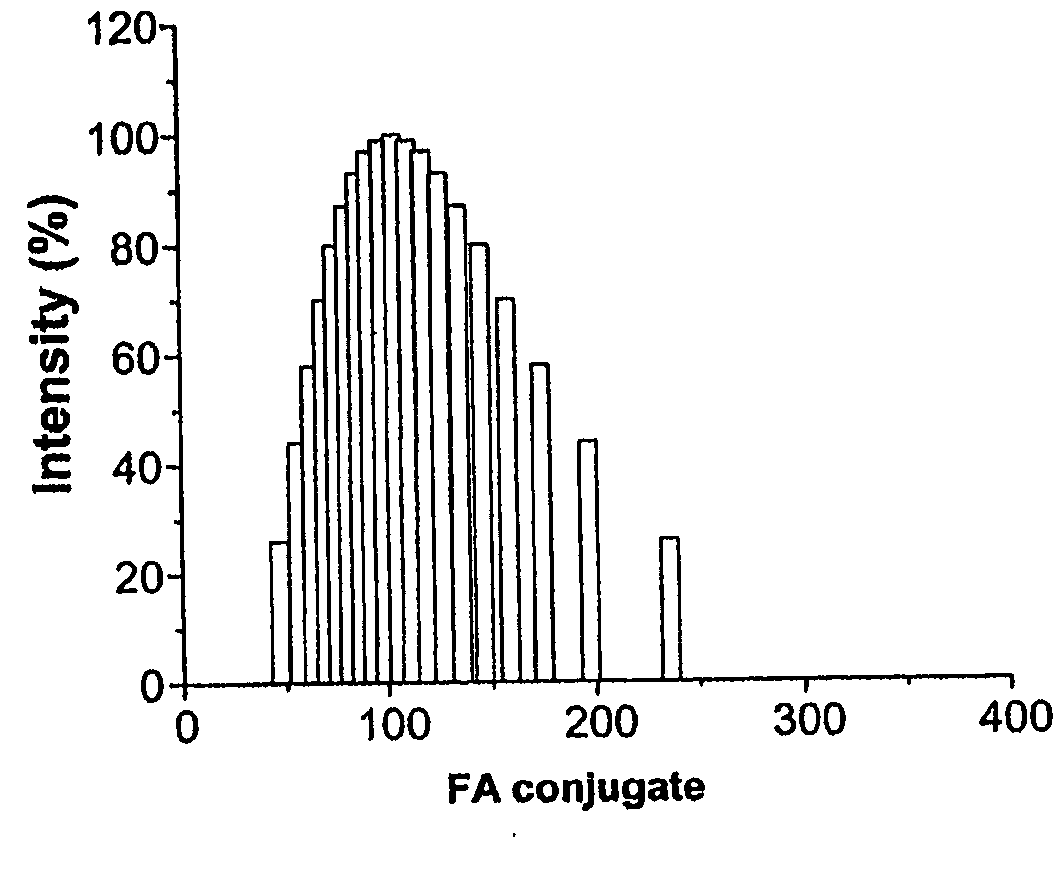
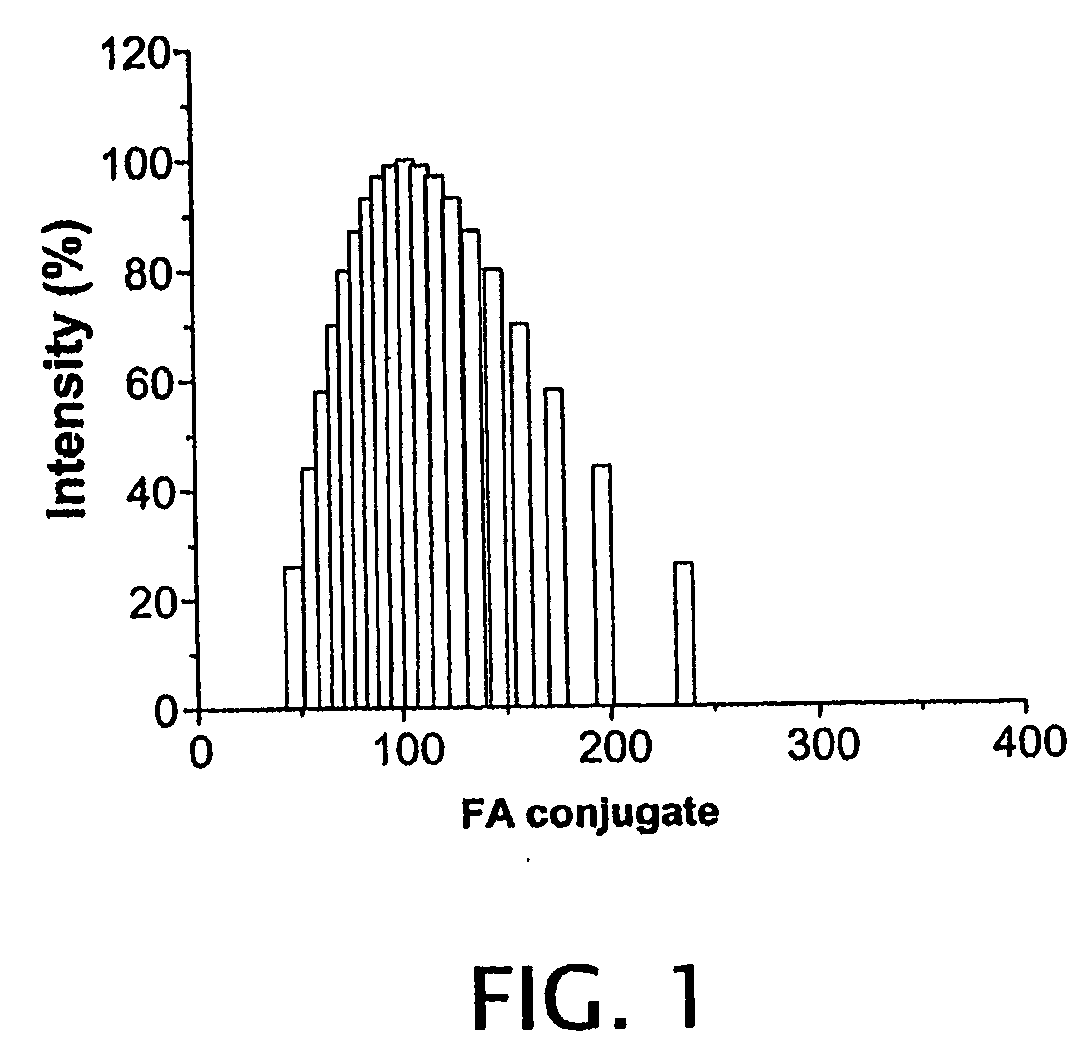
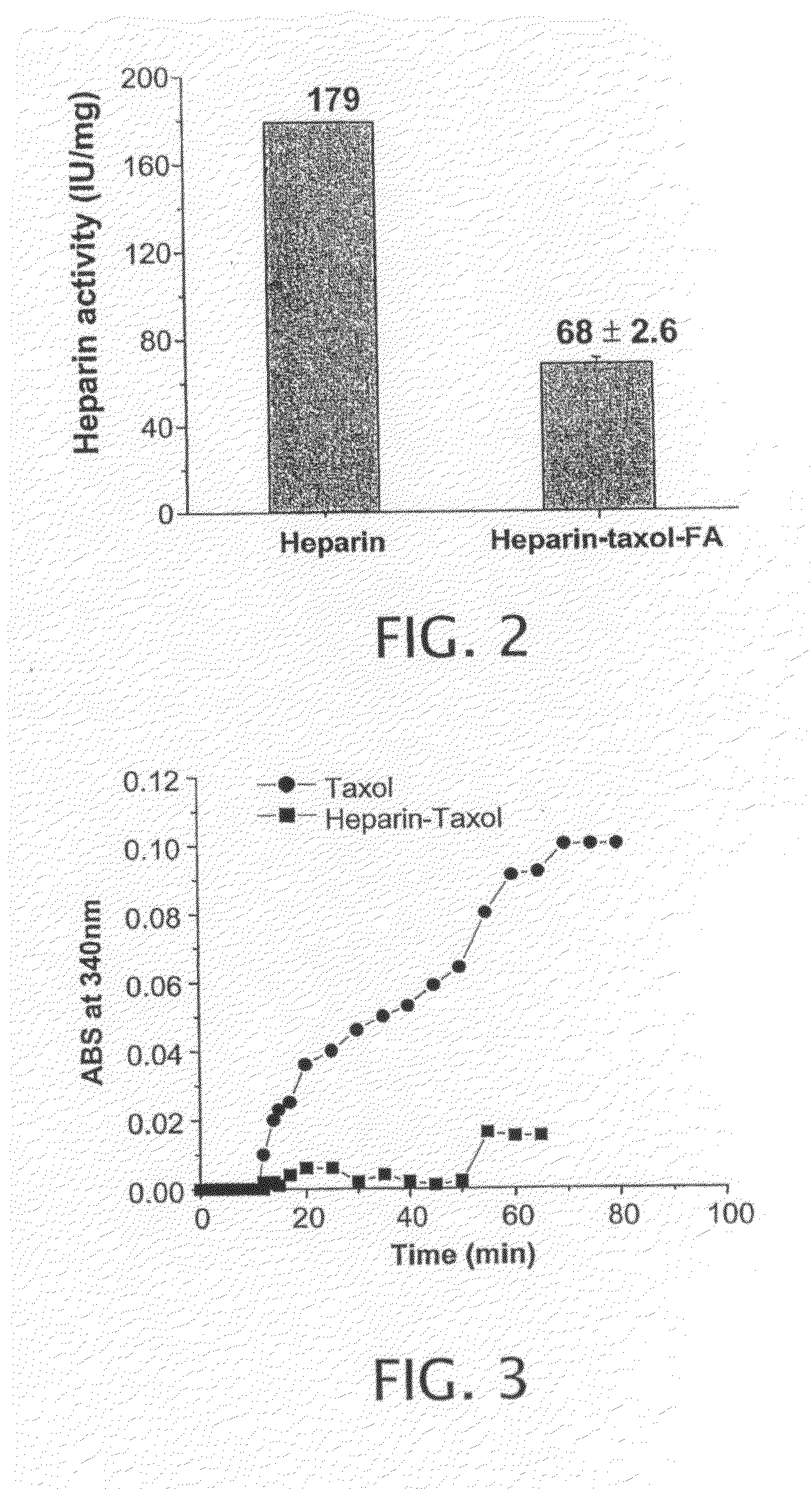
Examples
example 1
Synthesis of Conjugate Compounds
[0137]This example describes the synthesis of a Paclitaxel-Heparin-FA conjugate as illustrated in Scheme 1, below. Heparin (1 mmol) was activated using DCC (20 mmol) and NHS (22 mmol) in formamide at 4° C. overnight. Dicyclohexylurea (DCU) was removed by filtration and then heparin-NHS was obtained by recrystallization. The activated heparin-NHS (1 mmol) and aminated FA (20 mmol) were reacted at room temperature for 1 day. FA was aminated using conjugation with ethylene diamine. The unreacted aminated FA was removed by dialysis (molecular weight cut-off 2000). The final yellowish product was obtained by freeze-drying. The yield of conjugation was 95% (w / w). After dissolving the heparin-FA conjugate (1 mmol) in formamide, paclitaxel (30 mmol) and DCC (30 mmol) in DMSO were added. The mixture was reacted overnight at room temperature. After the reaction, recystallization and filtration were done to remove the unreacted DCC. For further purification, thi...
example 2
Characterization of Conjugate Compounds
[0138]This example describes the characterization of the Paclitaxel-Heparin-FA produced according to example 1. UV-vis absorption spectra were recorded on a Shimadzu UV-2401PC scanning spectrophotometer operating at a slit width of 1.0 nm. The content of paclitaxel conjugated to heparin-FA was estimated by LUV measurements based on a standard curve generated with known concentrations of paclitaxel in methanol (λ=228 nm). The IR spectra of Paclitaxel-Heparin-FA were acquired on a Fourier transform infrared spectroscopy (FT-IR) using a Perkin Elmer system 2000 spectrometer and the samples were analyzed as KBr pellets.
[0139]Synthesis of heparin-FA was confirmed by the presence of signals at δ6.75-8.77 ppm in the 1H-NMR spectrum of Heparin-FA and by an absorbance at λ=280 nm in the UV spectrum of the heparin-FA. Coupling of the paclitaxel to heparin-FA was achieved via a DCC mediated reaction of hydroxyl groups of paclitaxel and the carboxyl groups...
example 3
Characterization of Tubulin Binding Activity
[0143]This example describes the tubulin polymerization assay used to evaluate the disclosed compounds. The tubulin assembly reaction was performed in G-PEM buffer (1 mM GTP, 80 mM PIPES, 1 mM EGTA, 0.5 mM magnesium chloride; pH 6.8) at a tubulin (Cytoskeleton Inc., Boulder, Colo.) concentration of 1 mg / ml (10 μM) in the presence of drugs (10 μM). The instrument was zeroed with this solution at 4° C. Paclitaxel or heparin-Paclitaxel conjugates were then quickly mixed into the tubulin solution to a final concentration of 10 μM and the absorbance was continually monitored over an 80 min period. These samples were placed in quartz cuvettes and incubated at 32° C. Tubulin polymerization was observed by measuring the absorbance of the solution (340 nm).
[0144]With reference to FIG. 3, the ability of paclitaxel and Paclitaxel-Heparin-FA conjugate to induce microtubule assembly in vitro was determined at 10 μM paclitaxel or heparin-paclitaxel conj...
PUM
| Property | Measurement | Unit |
|---|---|---|
| Mass | aaaaa | aaaaa |
| Mass | aaaaa | aaaaa |
| Mass | aaaaa | aaaaa |
Abstract
Description
Claims
Application Information
 Login to View More