
Method for manufacturing soi substrate
a technology substrate, which is applied in the direction of basic electric elements, electrical apparatus, semiconductor devices, etc., can solve the problems of defective bonding, surface of silicon nitride film, defective bonding, etc., and achieve the effect of simplifying the process and suppressing the occurrence of defective bonding between the base substrate and the semiconductor substra
- Summary
- Abstract
- Description
- Claims
- Application Information
AI Technical Summary
Benefits of technology
Problems solved by technology
Method used
Image

Examples
embodiment mode 1
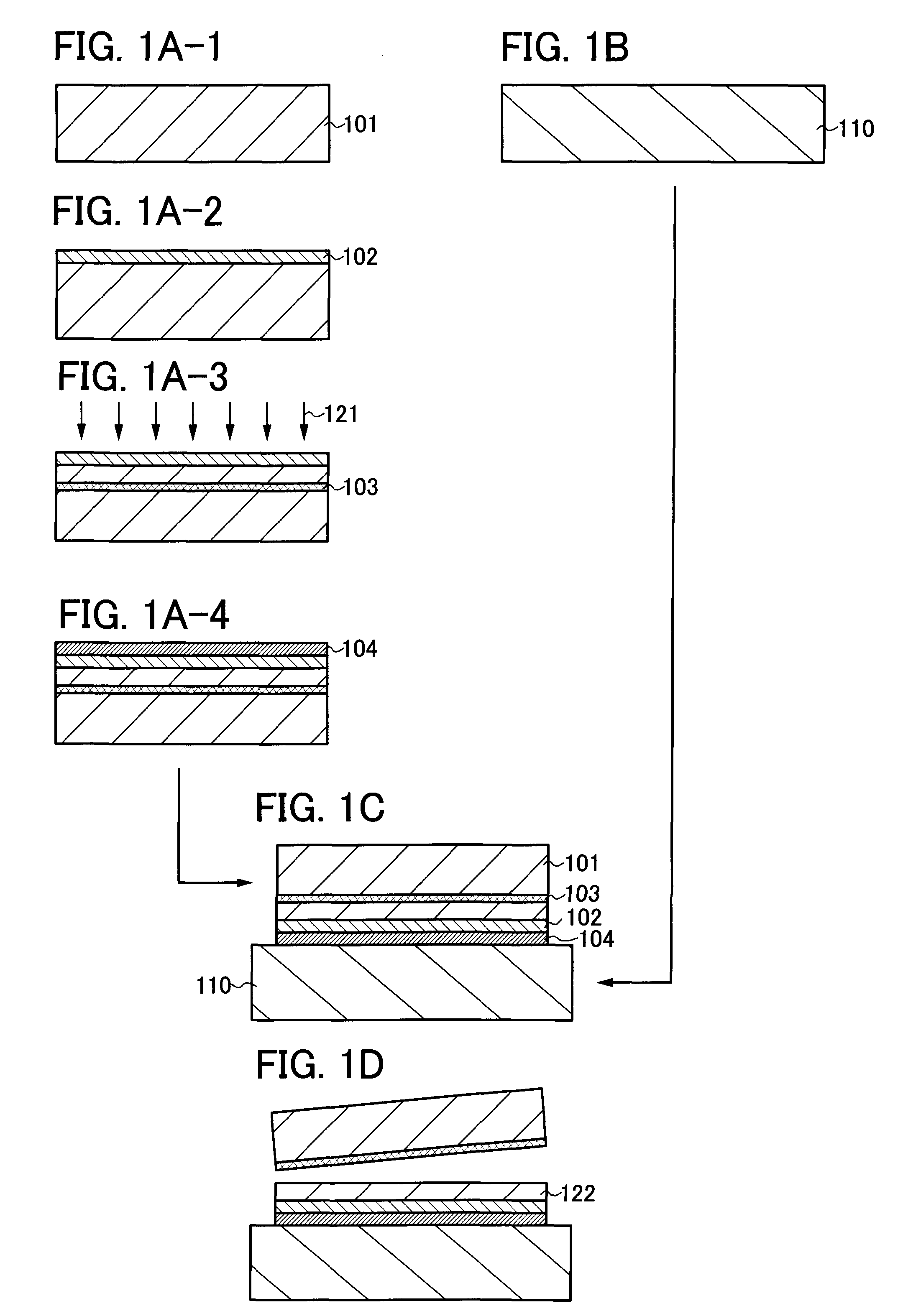
[0041]In this embodiment mode, an example of a method for manufacturing an SOI substrate of the present invention is described with reference to drawings.
[0042]First, a semiconductor substrate 101 is prepared (see FIG 1A-1).
[0043]As the semiconductor substrate 101, a commercially available semiconductor substrate can be used. For example, a single crystal silicon substrate, a single crystal germanium substrate, or a compound semiconductor substrate of gallium arsenide, indium phosphide, or the like can be used. Typical examples of commercially available silicon substrates are circular silicon substrates which are 5 inches (125 mm) in diameter, 6 inches (150 mm) in diameter, 8 inches (200 mm) in diameter, and 12 inches (300 mm) in diameter. Note that the shape is not limited to a circular shape, and a silicon substrate processed into a rectangular shape or the like can also be used.
[0044]Next, an insulating film 102 is formed over a surface of the semiconductor substrate 101 (see FIG...
embodiment mode 2
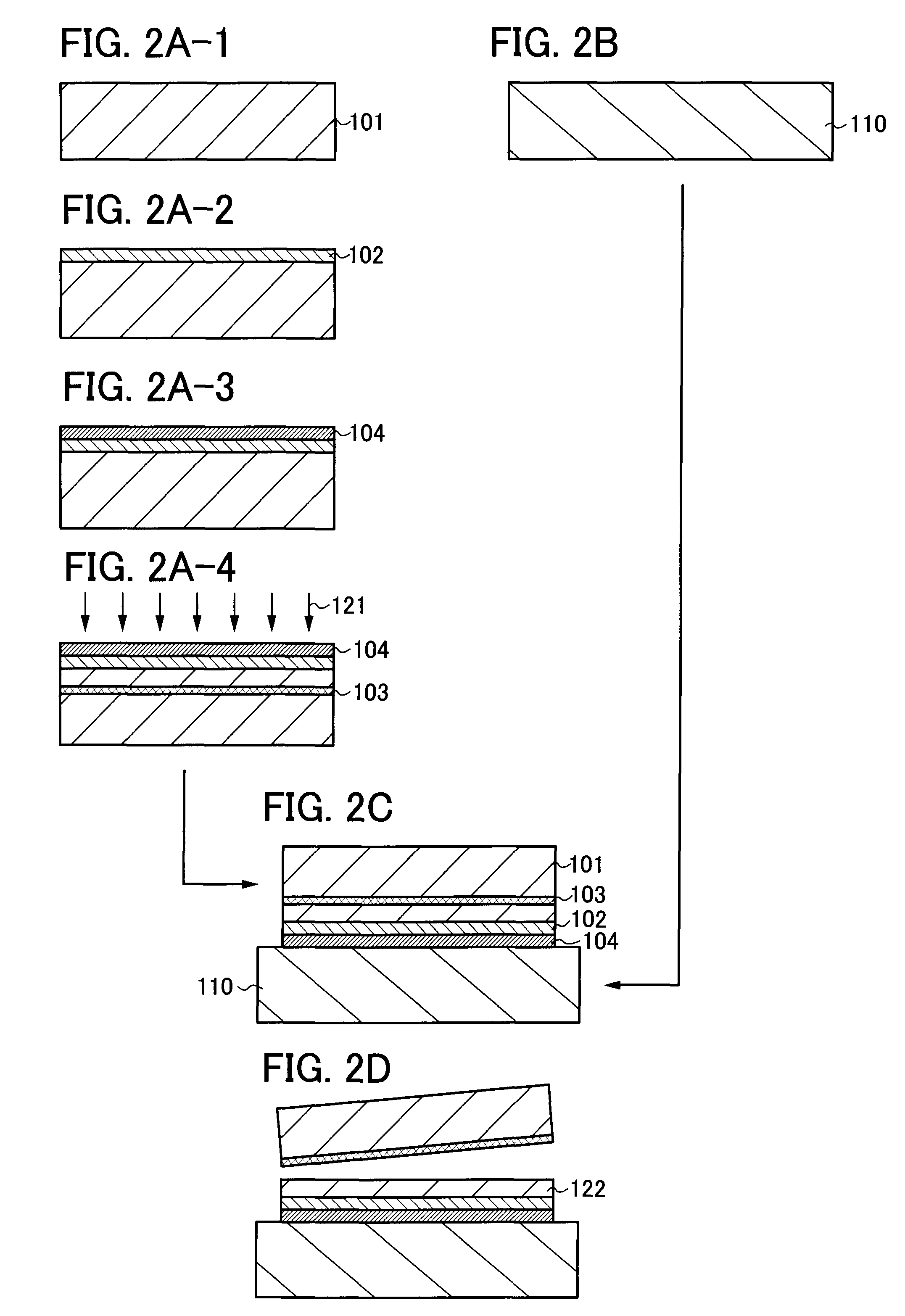
[0088]In this embodiment mode, a method for manufacturing an SOI substrate, which is different from that in the above-described embodiment mode, is described with reference to drawings. Specifically, a case is described in which a base substrate provided with a nitrogen-containing layer over its surface and a semiconductor substrate provided with an insulating film are bonded together.
[0089]First, a semiconductor substrate 101 is prepared (see FIG. 4A-1), and an insulating film 202 is formed over a surface of the semiconductor substrate 101 (see FIG. 4A-2).
[0090]In this embodiment mode, the insulating film 202 functions as a bonding layer to a base substrate. The insulating film 202 can be a silicon oxide film (SiOx) or a silicon oxynitride film (SiOxNy) (x>y) formed by a CVD method, a sputtering method, or the like. Alternatively, the insulating film 202 may be an insulating film (such as a silicon oxide film) formed by thermal oxidation of a surface of the semiconductor substrate ...
embodiment mode 3
[0108]In this embodiment mode, a method for manufacturing a semiconductor device using the SOI substrate manufactured in either one of the above-described embodiment modes is described.
[0109]First, as a method for manufacturing a semiconductor device, a method for manufacturing an n-channel thin film transistor and a p-channel thin film transistor is described with reference to FIGS. 5A to 5D and 6A to 6C. By combining a plurality of thin film transistors (TFTs), various types of semiconductor devices can be formed.
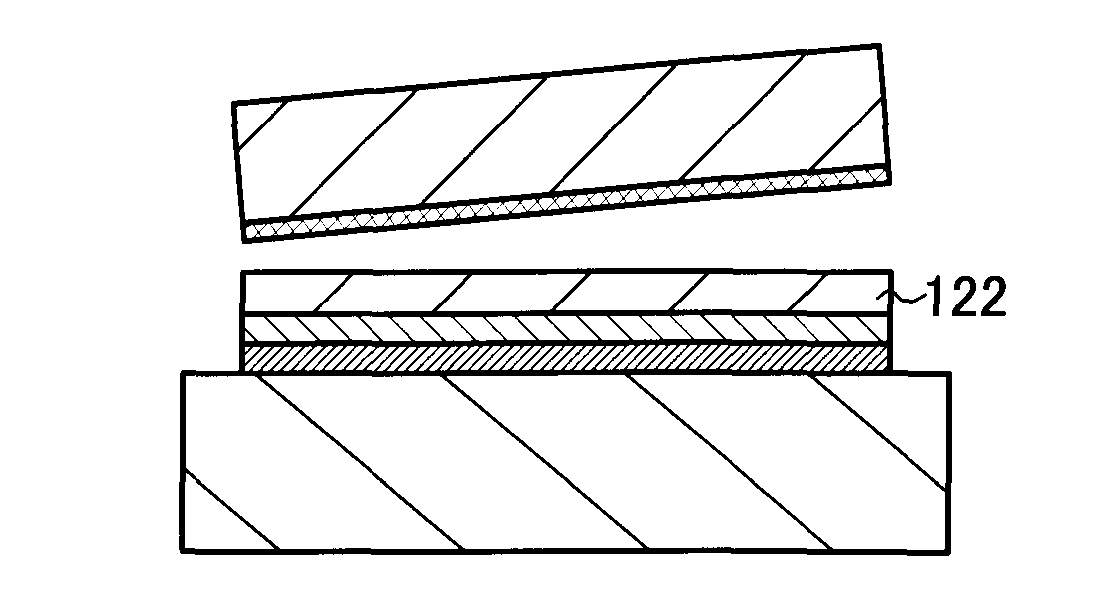
[0110]As an SOI substrate, the SOI substrate manufactured by the method of Embodiment Mode 1 is used here. FIG. 5A is a cross-sectional view of the SOI substrate manufactured by the method described with reference to FIGS. 1A-1 to 1A-4, 1B, 1C, and 1D.
[0111]By element isolation of the single crystal semiconductor layer 122 of the SOI substrate by etching, semiconductor layers 151 and 152 are formed as shown in FIG. 5B. The semiconductor layer 151 is used for forming an n-...
PUM
| Property | Measurement | Unit |
|---|---|---|
| temperature | aaaaa | aaaaa |
| surface roughness | aaaaa | aaaaa |
| diameter | aaaaa | aaaaa |
Abstract
Description
Claims
Application Information
 Login to View More