[0046]In contrast, the present invention provides methods and composition where no pre-growth of a microvascular
bed is necessary. Rather, the present invention promotes the formation of neovessel sprouts at the transplant-
host interface without needing time for growth or production of a
microvessel bed or prevascularized construct. Accordingly, one
advantage of the present invention is that the presence of the
population of SVF cells (either embedded in the
tissue transplant, or encapsulating the
tissue transplant) greatly enhances and accelerates the vascularization of the
tissue transplant after transplantation into the host recipient, without needing 7-10 days for the prior preparation of a prevascularized construct. Thus unlike the methods of the '838 patent, the present methods and compositions as disclosed herein are extremely useful
in real life organ and tissue donor situations in which time is of the essence, for example, where it is unpredictable when a subject will receive a
donor tissue, or where a subjects heath is at risk or when the viability of a donor organ is an issue, therefore time to cultivate a prevasculairzed construct is not possible. Also, unlike U.S. Pat. No. 7,052,829, were freshly isolated
microvessel constructs comprising
microvessel fragments are used, in some embodiments the methods and compositions exclude the presence of microvessel constructs.
[0047]Additionally, unlike the methods and compositions of the '829 patent, an additional
advantage of the present invention is that SVF cells can be used to promote revasculatization of a tissue (e.g., tissue transplant) or population of cells (e.g., cell transplant) by encapsulating (e.g., encasing) the tissue / cell population with the SVF cells. In some embodiments, the encapsulating population of SVF cells can be a single or multiple
cell layer which encapsulates the tissue or cell population, or in alternative embodiments in the presence (e.g., on the surface of, or embedded within) a three-dimensional matrix. In some embodiments, the encapsulating population of SVF cells can also be in the presence or absence of microvessel fragments, where in some embodiments, the microvessel fragments can be present on the surface of, or embedded within a three-dimensional matrix with the SVF cells, or in alternative embodiments, the microvessel fragments can be mixed among the population of cells to be transplanted, which is encapsulated with the encapsulating population of SVF cells.
[0048]Without wishing to be bound by a theory, the inventors demonstrate that both regulatory modulation of existing neovessels and incorporation of SVF cells leads to neovessel
sprouting and are the underlying mechanism for such new vessel invasiveness or
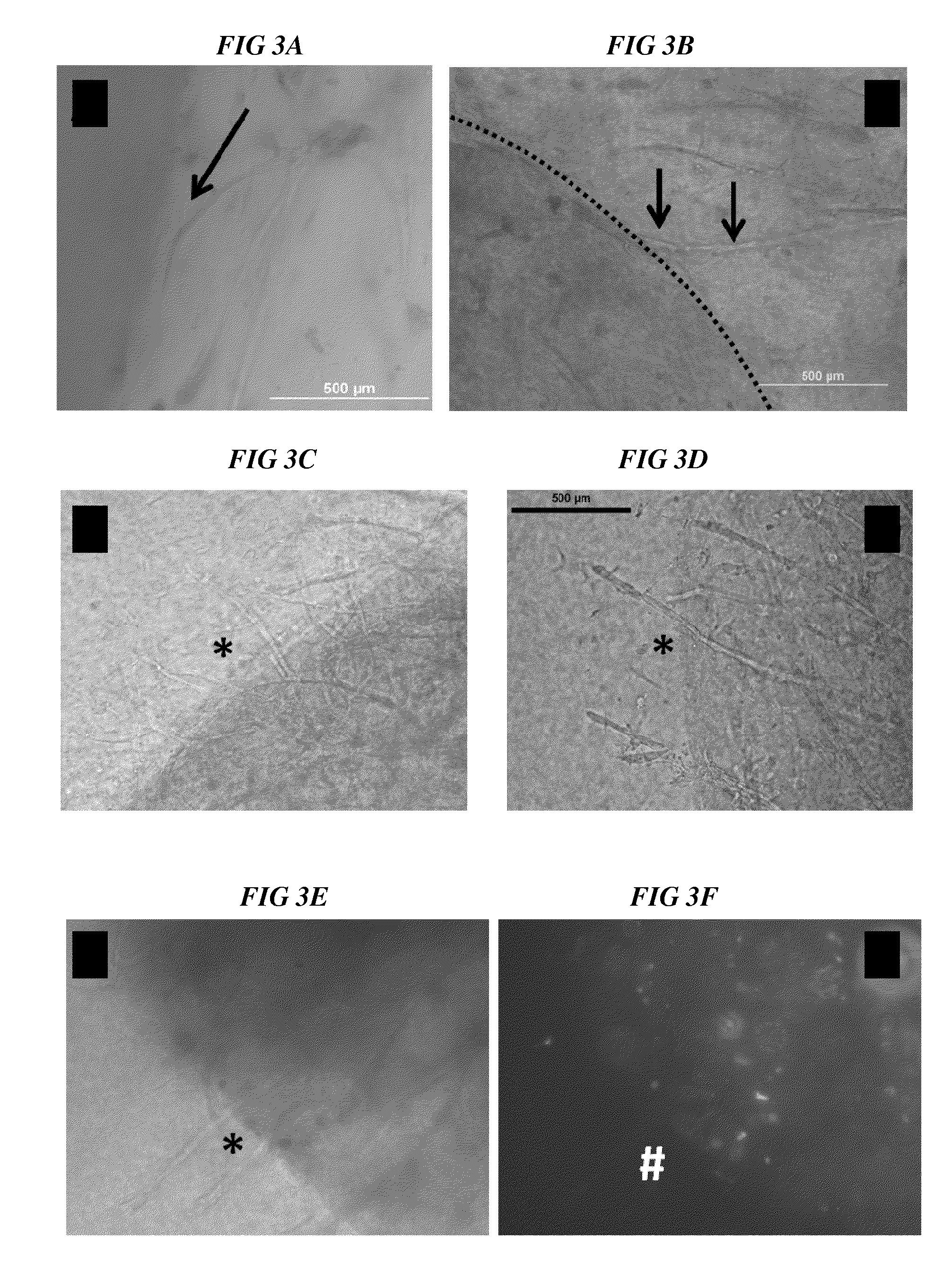
angiogenesis. Thus, the inventors herein clearly demonstrate that addition of SVF cells has a pro-angiogenic role. Further, collagen present at the interface between the
cell free periphery and the vascularized-cellular core remains is well-defined, demonstrating that the occurrence of matrix remodeling is a highly localized phenomenon. This is an important feature as it demonstrates that
neovascularization promoted by the presence of SVF cells is localized and does not provide uncontrolled vascular growth elsewhere in the body.
[0049]The absence of any conspicuous
pooling of cells at the interfacial surface also demonstrates a pro-angiogenic and regulatory role for the SVF cells rather than only matrix remodeling at the interface leading to a higher invasion of angiogenic sprouts into the surrounding matrix.
[0050]One aspect of the present invention provides methods and compositions comprising a population of SVF cells in combination (such as mixed in), within tissue cells or cells to be transplanted into a subject to form a transplant mixed with SVF cells. In such embodiments, a population of SVF cells can be combined with a population of cells to be transplanted in a three-dimensional matrix, such as a gel as disclosed herein. In some embodiments, the transplant mixed with SVF cells, (e.g., a
heterologous mixture of a population of SVF cells and a population of cells of interest to be transplanted) can include additional populations of cells. In some embodiments where the transplant mixed with SVF cells includes additional populations of cells, the additional cells do not include microvessel fragments. Alternatively, in some embodiments, where a
three dimensional matrix is not used, a transplant mixed with SVF cells can also include microvessel fragments.
[0051]In some embodiments, a transplant mixed with SVF cells is administered to a subject by injection, independent of whether the transplant mixed with SVF cells is present on the surface of, or embedded within a three-dimensional matrix. In some embodiments, a transplant mixed with SVF cells is administered to a subject by
surgical procedures commonly known by a skilled artisan.


 Login to View More
  Login to View More