Unlock instant, AI-driven research and patent intelligence for your innovation.

Surface modified silicon quantum dots

a surface modified, quantum dots technology, applied in the field of surface modified silicon quantum dots, can solve the problems of limiting the application of quantum dots, affecting the utilization rate of quantum dots, and inefficient particle collection, so as to facilitate nanoparticle formation and increase the vaporization of liquid silane aerosol droplets

Inactive Publication Date: 2018-08-30
NORTH DAKOTA STATE UNIV RES FOUND
View PDF0 Cites 4 Cited by
  • Summary
  • Abstract
  • Description
  • Claims
  • Application Information

AI Technical Summary

Benefits of technology

The technology described in this patent allows for the production of functionalized silicon nanoparticles, such as quantum dots, with control over their size and surface features. By controlling the chemistry of the starting materials and the reaction conditions, researchers have been able to create particles with hydrogen or hydroxyl groups attached to silicon atoms on the surface. These chemical hooks allow for very efficient coupling to a broad spectrum of reagents. This technology can be used to produce nanoparticles with control over their size and surface features, which can be useful in a variety of applications.

Problems solved by technology

However, despite the many benefits of using QDs in such product applications, the toxicity of many conventional quantum dot materials has hampered their utilization for such applications.
In addition, the difficulties of imbuing multifunctional properties to nonsilicon-based QDs and / or heterogeneity has raised concerns about their use in environmental tests and assays, e.g., detection of heavy metals, organic molecules, and other contaminants of commercial interest.
However, high decomposition temperatures of SiH4, difficulties associated with inefficient particle collection (particle adhesion to the reactor wall due to thermophoresis) and low yields limit this approach.

Method used

the structure of the environmentally friendly knitted fabric provided by the present invention; figure 2 Flow chart of the yarn wrapping machine for environmentally friendly knitted fabrics and storage devices; image 3 Is the parameter map of the yarn covering machine
View more

Image

Smart Image Click on the blue labels to locate them in the text.
Viewing Examples
Smart Image
  • Surface modified silicon quantum dots
  • Surface modified silicon quantum dots
  • Surface modified silicon quantum dots

Examples

Experimental program
Comparison scheme
Effect test

example 1

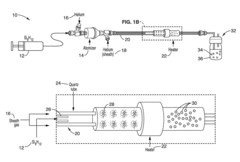
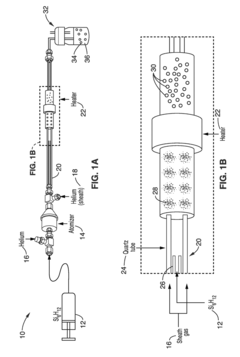
[0075]To demonstrate the gas phase pyrolysis synthesis, distillation and purification of Si-QDs, an apparatus shown in FIG. 1A and FIG. 1B was set up and tested. Neat Cyclohexasilane (Si6H12) was controllably injected (0.1 mL / h feed rate) using a syringe pump into an ultrasonic horn atomizer (Sonotek Inc, Milton, N.Y.) operating at 120 kHz. For efficient aerosol mist formation and transport to the reactor, Helium (He, 99.999%, Praxair) flowing at 50 sccm was introduced. An additional sheath gas of helium (He) flowing at 125 sccm was used to improve the vaporization of the mist and to carry the precursor to the hot-zone. The sheath gas surrounded the precursor at a distance of 2.5 cm ahead of the hot-zone. A 30 cm long fused silica tube with an outer diameter of 1.27 cm was used to form the reactor. Coil heaters of length 5 cm and inner diameter of 1.3 cm was slid over the fused silica tube to form the reactor. The length of the reactor (6 cm or 12 cm) was adjusted by using one or tw...

example 2

[0079]In order to characterize the size and structure of the as-synthesized Si-QDs that were produced, the silicon particles were evaluated with Raman spectroscopy and high-resolution transmission electron microscopic (HRTEM) analysis.

[0080]Dry as-synthesized Si-QDs collected on a glass frit were applied to glass slides and analyzed by Raman spectroscopy. Raman spectroscopic analysis was performed using a Horiba Jobin Yvon Labram Aramis confocal imaging system with a 532 nm Nd:YAG laser source. The dry as-synthesized and passivated (waxy solid) Si-QDs were applied to a glass substrate and Raman spectra were collected.

[0081]Deconvoluted spectra of Si peaks corresponding to Samples 1 and 2 that were obtained. The characteristic Si regions in the Raman spectra were deconvoluted to determine the contribution arising from amorphous and crystalline phases present in the samples.

[0082]The Raman spectra that were obtained showed bands centered at 460 and 490 cm−1. The broad band at 460 cm−1...

example 3

[0086]Further characterization of the chemical structures of the as-synthesized Si-QDs that were produced was conducted with Fourier transform infrared spectroscopy (FTIR). The types of Si-H bonds and the effects of hydrosilylation on the surfaces of the as-synthesized (dry powder) and passivated (waxy solid without solvent) Si-QDs were evaluated using FTIR.

[0087]During hydrosilylation, 1-dodecene reacts with the surface SiHx of Si-QDs to form stable Si-C covalent bonds. The FTIR spectra of the as-synthesized Si-QDs from Sample 1 demonstrated predominantly SiH3, SiH2 and SiH absorptions, while the hydrosilylated Si-QDs from Sample 1 depicted strong SiH (bulk and surface) features along with the bands corresponding to dodecane functionalities. The intensities of ═CH2 and C═C vibrations (at 3200, 1650, 900 and 800 cm−1) of hydrosilylated a-SiQDs were insignificant compared with the neat 1-dodecene.

[0088]The as-synthesized and passivated Si-QDs synthesized using the 10 cm hot-zone (Sam...

the structure of the environmentally friendly knitted fabric provided by the present invention; figure 2 Flow chart of the yarn wrapping machine for environmentally friendly knitted fabrics and storage devices; image 3 Is the parameter map of the yarn covering machine
Login to View More

PUM

PropertyMeasurementUnit
droplet diametersaaaaaaaaaa
sizeaaaaaaaaaa
Login to View More

Abstract

Methods for producing surface functionalized silicon nanoparticles like Si-QDs using a continuous gas-phase synthesis by direct pyrolysis of aerosolized higher order liquid silanes like cyclohexasilane (Si6H12) or cyclopentasilane (Si5H10) to produce nanoscale particles are provided. The methods permit control over the particle characteristics i.e., crystallinity, core-shell, size and surface chemistry of Si nanostructures and allow the tuning of the band gap (absorption) and manipulation of photo responsive properties. A wide variety of modifications can be performed using the hydrogen (H) or hydroxyl (OH) groups attached to silicon atoms on the particle surface. The coupling of different molecules or complexes directly to the silicon atoms of the particles allows the engineering of desirable optical, chemical or biological activity to the particles or can act as linkers to agglomerate particles or form porous films.

Description

CROSS-REFERENCE TO RELATED APPLICATIONS[0001]This application is a 35 U.S.C. § 111(a) continuation of PCT international application number PCT / US2016 / 047904 filed on Aug. 19, 2016, incorporated herein by reference in its entirety, which claims priority to, and the benefit of, U.S. provisional patent application Ser. No. 62 / 207,846 filed on Aug. 20, 2015, incorporated herein by reference in its entirety. Priority is claimed to each of the foregoing applications.[0002]The above-referenced PCT international application was published as PCT International Publication No. WO 2017 / 062105 on Apr. 13, 2017 and republished on Jun. 1, 2017, which publications are incorporated herein by reference in their entireties.STATEMENT REGARDING FEDERALLY SPONSORED RESEARCH OR DEVELOPMENT[0003]This invention was made with Government support under grant number DE-FC36-08G088160 awarded by the Department of Energy and under grant number N00014-15-1-0065 awarded by the Office of Naval Research. The Governme...

Claims

the structure of the environmentally friendly knitted fabric provided by the present invention; figure 2 Flow chart of the yarn wrapping machine for environmentally friendly knitted fabrics and storage devices; image 3 Is the parameter map of the yarn covering machine
Login to View More

Application Information

Patent Timeline
no application Login to View More
Patent Type & Authority Applications(United States)
IPC IPC(8): C09K11/59C09K11/02C01B33/021
CPCC09K11/59C09K11/02C01B33/021C09K11/025
Inventor BOUDJOUK, PHILIPSRINIVASAN, GURUVENKETANDERSON, KENNETHHOEY, JUSTINSAILER, ROBERT A.
Owner NORTH DAKOTA STATE UNIV RES FOUND