Polyactic Acid and Lignin Composite Thermoplastic for 3D Printing
a technology of polyactic acid and lignin, applied in the field of composite thermoplastic materials, can solve the problems of unsatisfactory industrial scale processes, high cost and toxic solvents, and many polymer pairs are thermodynamically incompatible, etc., to achieve biodegradable properties, improve properties, and reduce material cost
- Summary
- Abstract
- Description
- Claims
- Application Information
AI Technical Summary
Benefits of technology
Problems solved by technology
Method used
Image

Examples
example 1
[0069]In preliminary solubility testing, a solubility of 2-grams of dried lignin powder in mixtures of acetone in water was similar to the results of switchgrass lignin and pine lignin solubility in acetone in water mixtures.
example 2
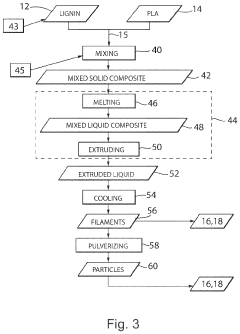
[0070]Purified lignin derived by the organosolv process described above with respect to FIG. 2, was compared to lignin produced by kraft process (pulping with sodium sulfite and sodium hydroxide) and soda process (pulping in sodium hydroxide solution). It was found that recovery of lignin using the kraft process and soda process was limited. The organosolv-based lignin produced pure and ungraded lignin with a narrow molecular weight distribution.
[0071]Attempts to blend kraft lignin in polylactic acid did not succeed beyond 5 wt % kraft lignin (lignin derived from the kraft process) loading in polylactic acid because of kraft lignin's immiscibility with polylactic acid and lack of flowability making it difficult to extrude into small diameter filaments at a higher weight percent.
example 3
[0072]In an acetone fractionation technique, one gram of dried purified lignin was mixed with 10 mL of 60% (v / v) acetone in water in a first step the mixture was stirred for 10 minutes. The first undissolved solid (INS) was collected without any rinsing and dried in an oven at 110° C. Then the first filtrate was diluted to 40% (v / v) acetone in water by adding water to form the second undissolved solid (PREC) in a second step. The PREC solid was filtered and dried in the oven at 110° C. PREC. The second filtrate was collected and the soluble solid (SOL) was obtained in a third step.
[0073]Purified lignin derived from wheat straw versus maple wood were compared using the acetone fractionation technique. The yields of organosolv-based lignin from wheat straw in this fractionation technique were 10% insoluble fraction (INS) in the first step, 70% insoluble fraction (PREC) in the second step, and 20% soluble fraction (SOL) in the third step. The yields of organosolv-based lignin from mapl...
PUM
| Property | Measurement | Unit |
|---|---|---|
| Percent by mass | aaaaa | aaaaa |
| Percent by mass | aaaaa | aaaaa |
| Percent by mass | aaaaa | aaaaa |
Abstract
Description
Claims
Application Information
 Login to View More