

Catalyst that can be used in hydrotreatment, comprising metals of groups VIII and VIB, and preparation with acetic acid and dialkyl succinate C1-C4
a catalyst and hydrotreatment technology, applied in the field of catalysts, can solve the problems of not always allowing to sufficiently increase the performance of catalysts, and the catalysts do not have the activity to meet the new environmental standards, so as to improve the catalytic performance and improve the catalytic activity
- Summary
- Abstract
- Description
- Claims
- Application Information
AI Technical Summary
Benefits of technology
Problems solved by technology
Method used
Image

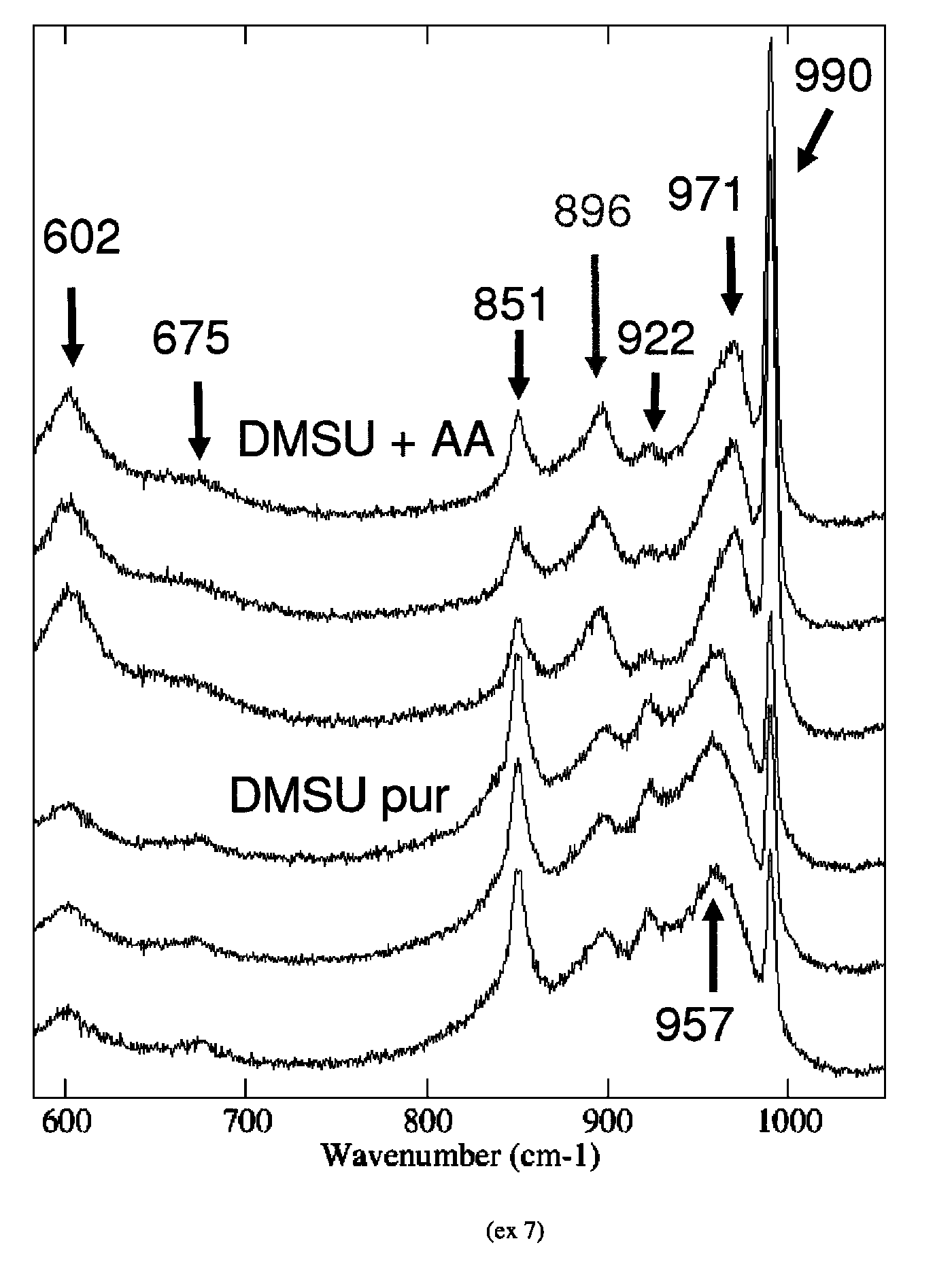
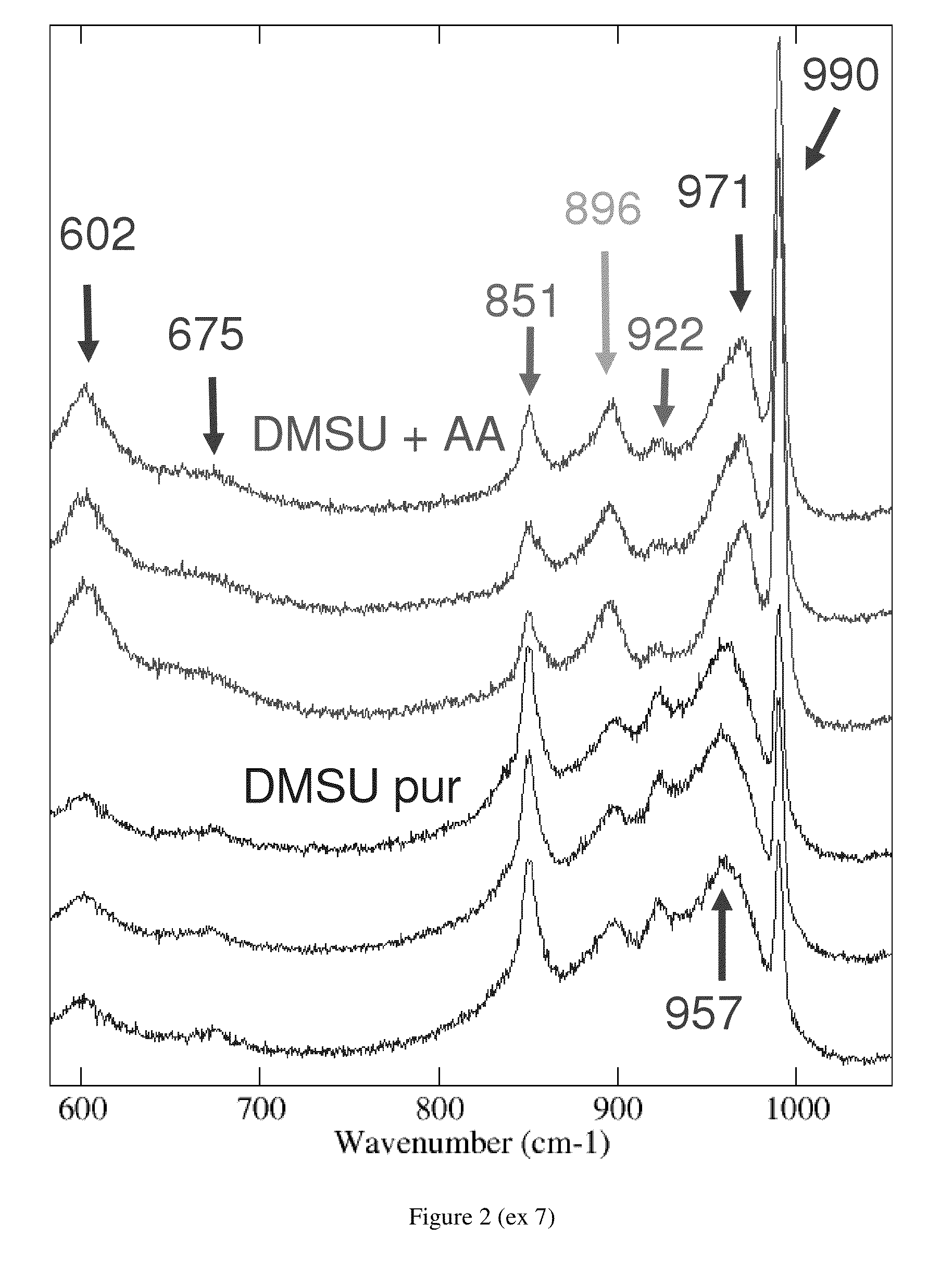
Examples
example 1
Preparation of Calcined Catalyst C1A (NiMoP / Alumina), Dried Catalyst C1E (NiMoP / Alumina) with Citric Acid (CA) and Polyethylene Glycol (PEG) Added, (C1A and C1E are not in Accordance with the Invention), and of Dried Catalysts C1B and C1F (NiMoP / Alumina) with Acetic Acid and Dimethyl Succinate Added (in Accordance with the Invention)
[0115]A matrix consisting of ultrafine tabular boehmite or alumina gel, marketed by Condea Chemie GmbH, is used. This gel is mixed with an aqueous solution containing 66% nitric acid (7 wt. % acid per gram of dry gel), then kneaded for 15 minutes. After kneading, the dough obtained is passed through a die with 1.6-mm diameter cylindrical orifices. The extrudates are then dried over night at 120° C., and then calcined at 600° C. for 2 hours under humid air containing 50 kg water per kg of dry air. Support extrudates having a specific surface area of 300 m2 / g are thus obtained. X-ray diffraction analysis shows that the support only consists of cubic gamma ...
example 2
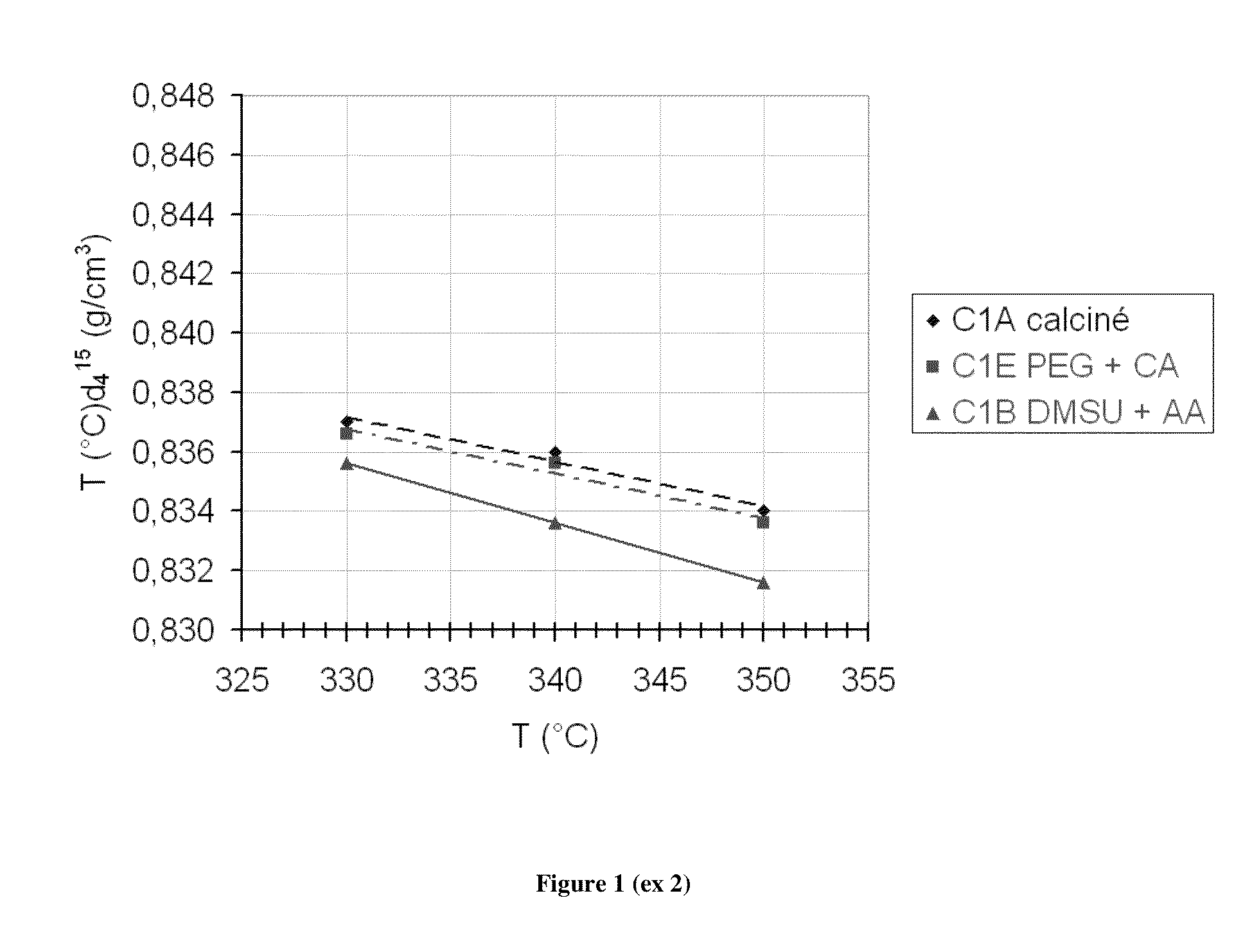
Evaluation of Catalysts CIA (NiMoP / Alumina) (not in Accordance), C1E (not in Accordance), C1B (in Accordance) for Distillation Diesel Fuel Hydrotreatment
[0121]Sulfurization of the catalyst (30 cm3 catalyst in extrudate form mixed with 10 cm3 SiC of grain size 0.8 mm) is carried out at 50 bars, at an hourly space velocity of 2 h−1, with an inlet H2 / HC ratio (volume flow rate) of 400 Std l / l. The sulfurization feed (diesel fuel with 2% DMDS Evolution from the Arkéma Company added) is fed into the reactor under H2 when the latter reaches 150° C. After one hour at 150° C., the temperature is increased with a 25° C. / hour ramp up to 220° C., then with a 12° C. / hour ramp until a 350° C. plateau is reached, which is kept for 12 hours.
[0122]After sulfurization, the temperature is lowered to 330° C. and the test feed is injected. The catalytic test is carried out at a total pressure of 50 bars, on a waste hydrogen basis, with an hourly space velocity of 2 h−1, with an inlet H2 / HC ratio of 400...
example 3
Evaluation of Catalysts C1A (NiMoP / Alumina) (not in Accordance), C1F (in Accordance) in Vacuum Distillate Hydrodenitrogenation for an Application of Hydrocracking Pre-Treatment Type
[0131]The main characteristics of the vacuum distillate used are given hereafter:
[0132]
Density at 20° C.:0.9365Sulfur:2.92 wt. %Total nitrogen:1400 ppm weightSimulated distillation:IP:361° C.10%:430° C.50%:492° C.90%:567° C.EP:598° C.
[0133]The test is carried out in an isotherm pilot reactor provided with a traversed fixed bed, the fluids circulating upwards. After in-situ sulfurization at 350° C. in the plant under pressure by means of a straight-run diesel fuel to which 2 wt. % dimethyldisulfide have been added, the hydrotreatment test is conducted under the following operating conditions:[0134]Total pressure: 12 MPa[0135]Catalyst volume: 40 cm3 [0136]Temperature: 380° C.[0137]Hydrogen flow rate: 40 l / h[0138]Feed flow rate: 40 cm3 / h.
[0139]The catalytic performances of the catalysts tested are given in t...
PUM
| Property | Measurement | Unit |
|---|---|---|
| temperature | aaaaa | aaaaa |
| molar ratio | aaaaa | aaaaa |
| molar ratio | aaaaa | aaaaa |
Abstract
Description
Claims
Application Information
 Login to View More