Check patentability & draft patents in minutes with Patsnap Eureka AI!

Phosphorus-containing compound and curing epoxy resin composition containing same

a technology of phosphorus-containing compounds and curing epoxy resins, which is applied in the field of phosphorus-containing compounds, can solve the problems of reducing physical properties, adversely affecting the curing of epoxy resins, and limited use of bromine-containing flame retardants, so as to reduce the dielectric constant of epoxy resins, impart flame retardancy, and excellent reactivity

Active Publication Date: 2017-08-22
ADEKA CORP
View PDF17 Cites 2 Cited by
  • Summary
  • Abstract
  • Description
  • Claims
  • Application Information

AI Technical Summary

Benefits of technology

The phosphorus-containing compound effectively imparts flame retardancy and reduces the dielectric constant of the epoxy resin while maintaining the physical properties of the cured product, offering a safer and more environmentally friendly alternative.

Problems solved by technology

Use of a bromine-containing flame retardant, which provides good flame retardancy, has been being limited on account of generation of toxic hydrogen halide gas (hydrogen bromide) on combustion.
However, these additives for imparting flame retardancy are disadvantageous in that their flame retardant effect is insufficient or they adversely affect curing of the epoxy resin or are accompanied by reduction of physical properties, such as a glass transition temperature, of a cured product.
Adding a sufficient amount of the flame retardant to realize satisfactory flame retardation causes reduction in glass transition temperature, and reduction in amount of the flame retardant to be added in an attempt to increase the glass transition temperature results in insufficient flame retardancy.
The proposal has turned out to be impractical because incorporating the phosphoric ester compound into an epoxy resin makes the resin hygroscopic or makes part of the resin take on a three-dimensional structure, which increases the viscosity and thereby greatly reduces the workability of the resin composition.

Method used

the structure of the environmentally friendly knitted fabric provided by the present invention; figure 2 Flow chart of the yarn wrapping machine for environmentally friendly knitted fabrics and storage devices; image 3 Is the parameter map of the yarn covering machine
View more

Image

Smart Image Click on the blue labels to locate them in the text.
Viewing Examples
Smart Image
  • Phosphorus-containing compound and curing epoxy resin composition containing same
  • Phosphorus-containing compound and curing epoxy resin composition containing same
  • Phosphorus-containing compound and curing epoxy resin composition containing same

Examples

Experimental program
Comparison scheme
Effect test

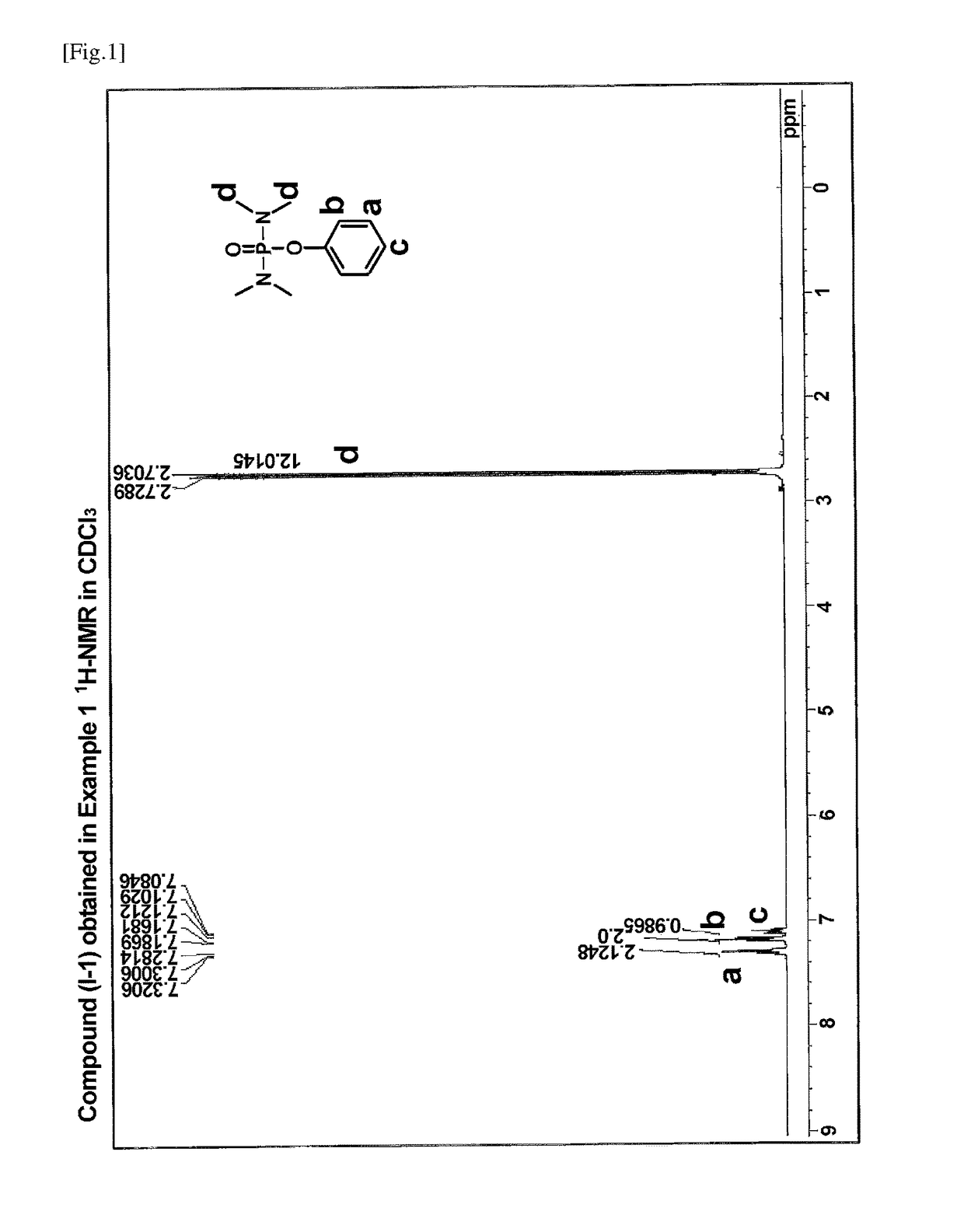
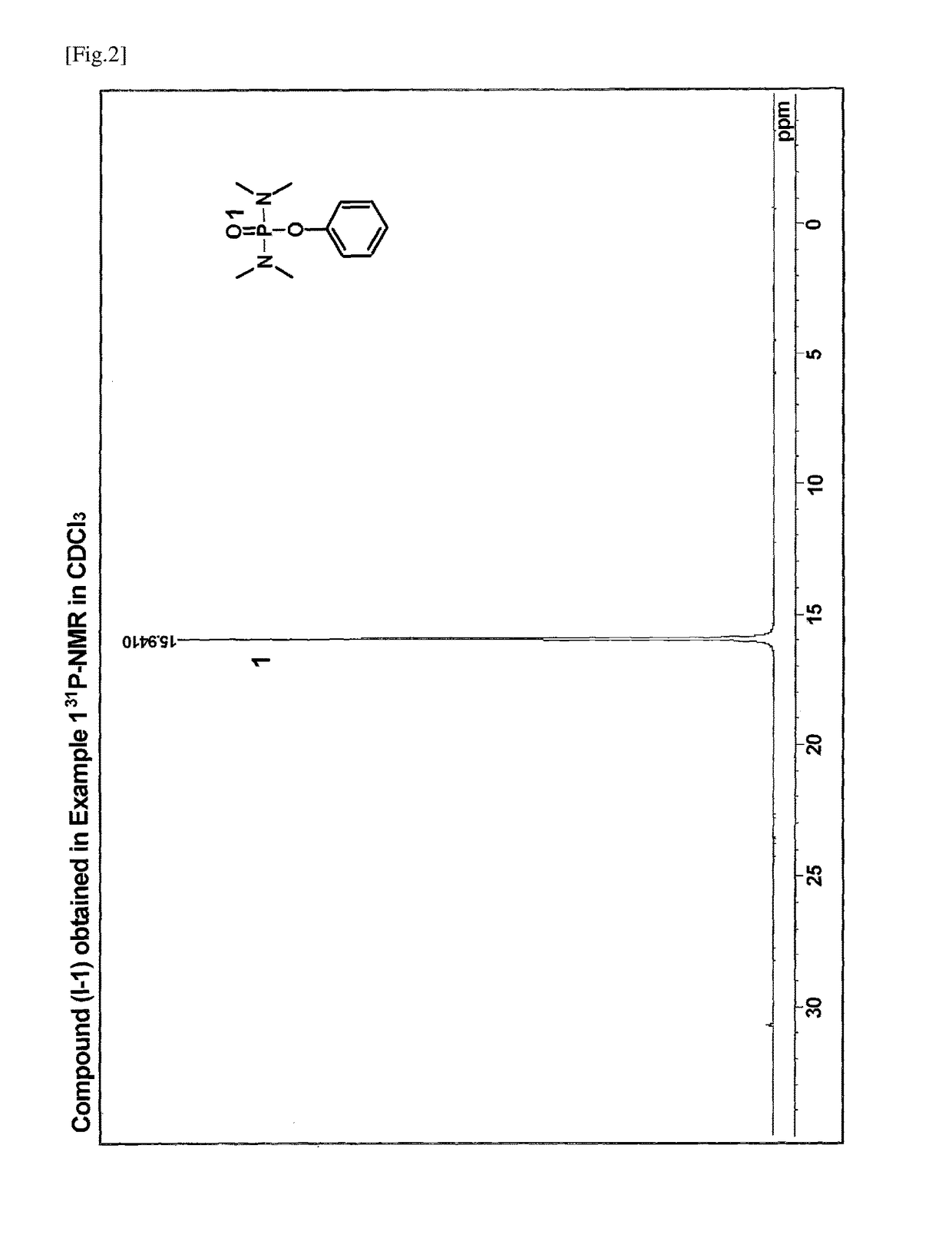
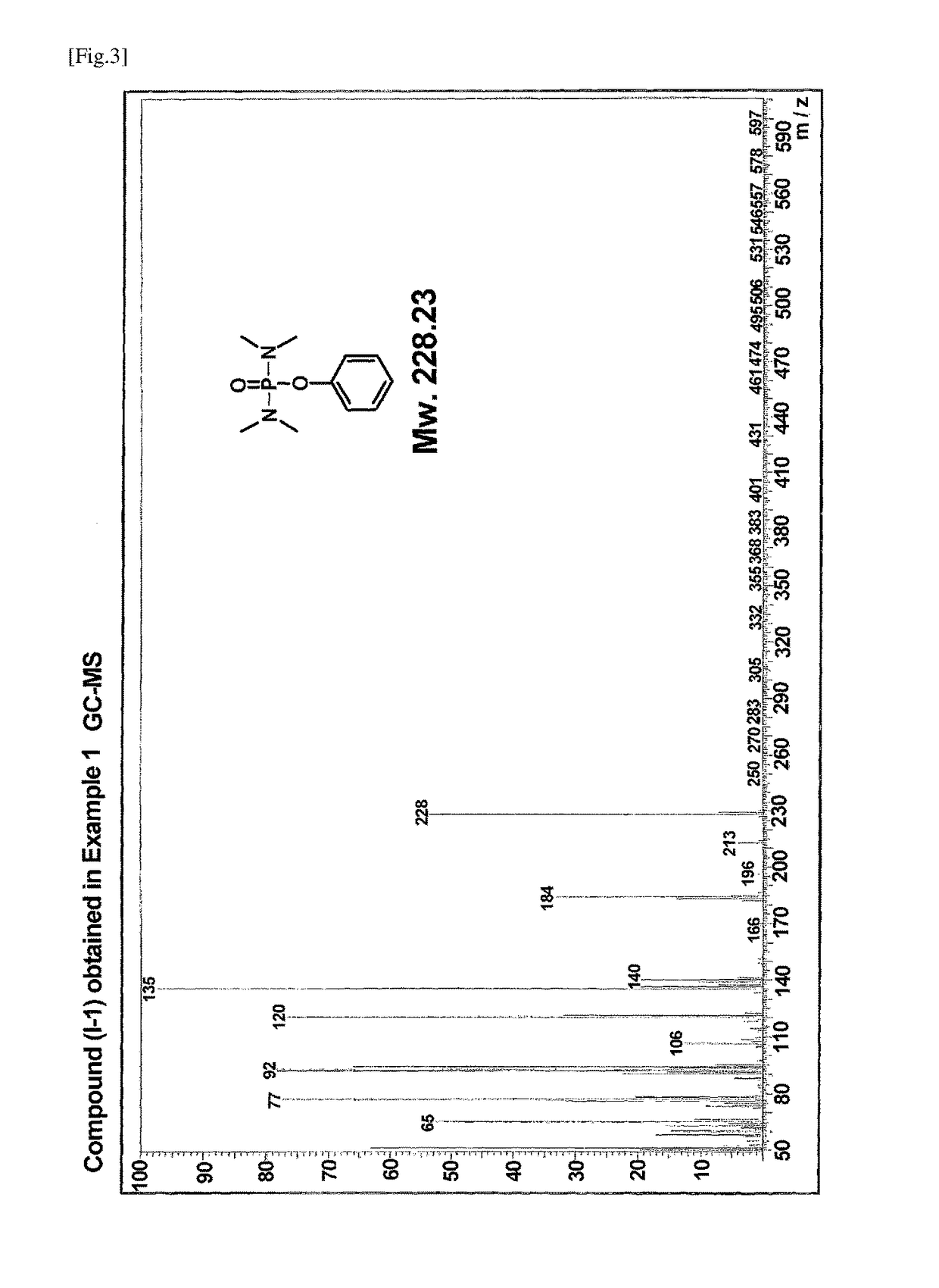
example 1

Synthesis of Phosphorus-Containing Compound [I-1]

[0068]A 100 ml three-necked flask equipped with a rotor, a reflux tube, and a rubber septum was charged with 0.1 g (1 mmol) of 4-dimethylaminopyridine (DMAP). After thoroughly drying and purging with nitrogen, the flask was charged with 0.9 g (10 mmol) of phenol and 10 ml of ultra-dehydrated tetrahydrofuran using a syringe. To the mixture was added dropwise 2.0 g (12 mmol) of bis(dimethylamino)phosphoryl chloride using a syringe taking care so that the reaction temperature did not exceed 30° C. After completion of the addition, the reaction system was stirred for 10 minutes. To the reaction solution were added 1.2 g (12 mmol) of triethylamine using a syringe taking care not to let the reaction temperature exceed 40° C., followed by stirring overnight. To the reaction mixture were added 5 ml of a saturated ammonium chloride aqueous solution and 5 ml of water, followed by stirring well. The solution was transferred to a separatory funne...

example 2

Synthesis of Phosphorus-Containing Compound [I-2]

[0069]A 100 ml three-necked flask equipped with a rotor, a reflux tube, and a rubber septum was thoroughly dried, purged with nitrogen, and charged with 9.5 g (21 mmol) of an ethylamine tetrahydrofuran solution, 2.1 g (21 mmol) of triethylamine, and 5 ml of ultra-dehydrated tetrahydrofuran while cooling in a salt-ice-water bath. After stirring the mixture for 5 minutes, 2.1 g (10 mmol) of phenyl dichlorophosphate was added thereto dropwise using a syringe taking care not to let the reaction temperature exceed 0° C. After completion of the addition, the reaction system was stirred for 1 hour. The salt-ice-water bath was removed, and the reaction system was stirred at room temperature overnight. To the reaction solution were added 5 ml of a saturated ammonium chloride aqueous solution and 5 ml of water, followed by stirring well. The solution was transferred to a separatory funnel, extracted 3 times with 10 ml portions of ethyl acetate ...

example 3

Synthesis of Phosphorus-Containing Compound [I-3]

[0070]A 100 ml three-necked flask equipped with a rotor, a reflux tube, and a rubber septum was thoroughly dried, purged with nitrogen, and charged with 9.0 g (21 mmol) of a methylamine tetrahydrofuran solution, 2.1 g (21 mmol) of triethylamine, and 5 ml of ultra-dehydrated tetrahydrofuran while cooling in a salt-ice-water bath. After stirring the mixture for 5 minutes, 2.1 g (10 mmol) of phenyl dichlorophosphate were added thereto dropwise using a syringe taking care not to let the reaction temperature exceed 0° C. After completion of the addition, the reaction system was stirred for 1 hour. The salt-ice-water bath was removed, and the reaction system was stirred at room temperature overnight. To the reaction mixture was added 10 ml of acetone, followed by stirring well, and followed by separation into solid and filtrate by filtration. To the solid was added another 10 ml portion of acetone, followed by stirring well, and followed by...

the structure of the environmentally friendly knitted fabric provided by the present invention; figure 2 Flow chart of the yarn wrapping machine for environmentally friendly knitted fabrics and storage devices; image 3 Is the parameter map of the yarn covering machine
Login to View More

PUM

PropertyMeasurementUnit
temperatureaaaaaaaaaa
Login to View More

Abstract

Provided is a novel phosphorus-containing compound represented by general formula (I). The compound has reactivity with a glycidyl group and is therefore capable of providing a curing epoxy resin composition that is expected to achieve flame retardation and reduction of dielectric constant.wherein m is a number of 1 to 10; R1, R2, R3, and R4 are each hydrogen, alkyl, or aryl; R5 is alkyl, alkanediyl, alkanetriyl, alkanetetrayl, or an aromatic group; X is oxygen or sulfur; Y is oxygen, sulfur, or ═NR′; and R′ is hydrogen, alkyl, or aryl.

Description

TECHNICAL FIELD[0001]This invention relates to a phosphorus-containing compound, particularly a reactive phosphorus-containing compound that can be combined with an epoxy compound to provide a curing epoxy resin composition expected to achieve flame retardation, reduction of dielectric constant, and the like.BACKGROUND ART[0002]The recent increase in concern with a global environmental problem and safety of the human body has boosted the demand for less hazard and more safety, as well as flame retardancy, of electric / electronic products. That is, reduction of harmful gas and smoke generation has been demanded.[0003]Use of a bromine-containing flame retardant, which provides good flame retardancy, has been being limited on account of generation of toxic hydrogen halide gas (hydrogen bromide) on combustion. Therefore, studies have been directed to compositions containing an ordinary epoxy resin and a halogen-free flame retardant, such as a nitrogen compound, a phosphorus compound, or ...

Claims

the structure of the environmentally friendly knitted fabric provided by the present invention; figure 2 Flow chart of the yarn wrapping machine for environmentally friendly knitted fabrics and storage devices; image 3 Is the parameter map of the yarn covering machine
Login to View More

Application Information

Patent Timeline
no application Login to View More
Patent Type & Authority Patents(United States)
IPC IPC(8): C07F9/24C08G59/40C07F9/22C08G59/44C08G59/14
CPCC07F9/242C07F9/224C07F9/2404C07F9/2458C08G59/1488C08G59/4071C08G59/446C07F9/24C08G59/40
Inventor ENDO, TAKESHIMATSUMOTO, KOZOTAMASO, KEN-ICHIOGAWA, RYO
Owner ADEKA CORP
Features
  • R&D
  • Intellectual Property
  • Life Sciences
  • Materials
  • Tech Scout
Why Patsnap Eureka
  • Unparalleled Data Quality
  • Higher Quality Content
  • 60% Fewer Hallucinations
Social media
Patsnap Eureka Blog
Learn More