AI technical title is built by Patsnap AI team. It summarizes the technical point description of the patent document.
A synthetic method and compound technology, applied in chemical instruments and methods, preparation of organic compounds, organic chemistry, etc., can solve problems such as low yield, achieve high reaction yield, simple treatment, and mild reaction conditions
Inactive Publication Date: 2013-01-30
EAST CHINA NORMAL UNIV
View PDF1 Cites 1 Cited by
Summary
Abstract
Description
Claims
Application Information
AI Technical Summary
This helps you quickly interpret patents by identifying the three key elements:
Problems solved by technology
Method used
Benefits of technology
Problems solved by technology
When preparing (7-methoxy-1-naphthyl) acetonitrile (4) in this method, used poisonous allyl methacrylate as dehydrogenation agent and the high temperature above 200 ℃, not only can produce a large amount of environmental Pollution and energy consumption, and in the actual operation process, it is found that the yield of this step reaction is extremely low
Method used
the structure of the environmentally friendly knitted fabric provided by the present invention; figure 2 Flow chart of the yarn wrapping machine for environmentally friendly knitted fabrics and storage devices; image 3 Is the parameter map of the yarn covering machine
View more
Image
Smart Image Click on the blue labels to locate them in the text.
Viewing Examples
Smart Image
Click on the blue label to locate the original text in one second.
Reading with bidirectional positioning of images and text.
Smart Image
Examples
Experimental program
Comparison scheme
Effect test
Embodiment 1
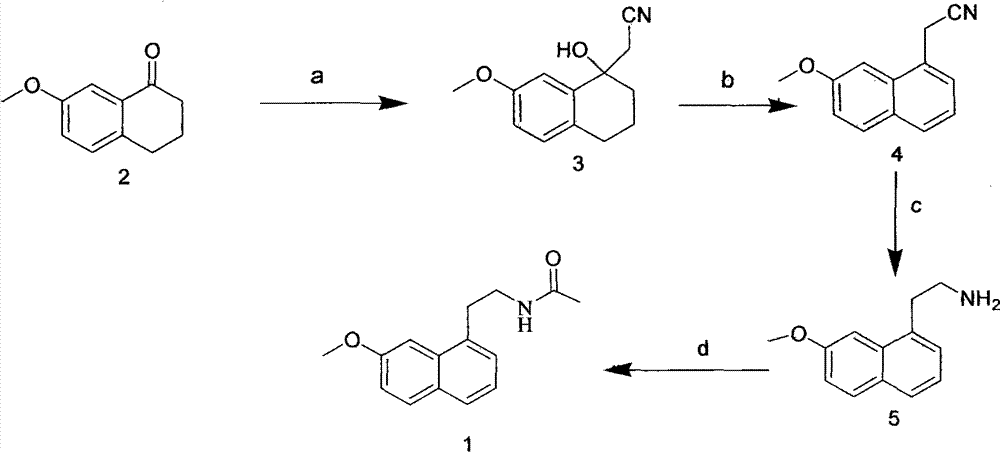
[0030] A, the preparation of 1-hydroxy-7-methoxy-1,2,3,4-tetrahydro-1-naphthyl acetonitrile (3)
[0031] Add acetonitrile (15.6ml, 300mmol) into anhydroustetrahydrofuran (500ml), cool to -78°C, slowly add n-decyllithium (120ml, 2.5M, 300mmol) dropwise, stir for 1h after dropping, keep at -78°C, Add 7-methoxy-1-tetralone (2) (35.2g, 199.7mmol) in tetrahydrofuran (250ml) dropwise, stir for 2h after dropping, add saturated ammoniumchloride solution (100ml) dropwise to quench the reaction, Return to room temperature, add 200ml ethyl acetate to the reaction solution, separate the layers, dry the organic layer with anhydroussodiumsulfate, filter to remove the desiccant, and concentrate under reduced pressure to obtain the target compound (3), with a yield of 95%.
[0043] A, the preparation of 1-hydroxy-7-methoxy-1,2,3,4-tetrahydro-1-naphthyl acetonitrile (3)
[0044] Add acetonitrile (12.5ml, 239.6mmol) into anhydrous tetrahydrofuran (500ml), cool to -78°C, slowly add n-decyllithium (95.9ml, 2.5M, 239.6mmol) dropwise, stir for 1h after dropping, keep- 78°C, add 7-methoxy-1-tetralone (2) (35.2g, 199.7mmol) in tetrahydrofuran solution (250ml) dropwise, stir for 2h after dropping, add saturated ammoniumchloride solution (100ml) dropwise to quench Extinguish the reaction, return to room temperature, add 200ml ethyl acetate to the reaction solution, separate the layers, dry the organic layer with anhydrous sodiumsulfate, filter to remove the desiccant, and concentrate under reduced pressure to obtain the target compound (3), with a yield of 90%.
[0045] B, the preparation of (7-methoxy-1-naphthyl) acetonitrile (4)
[0046] 1-Hydroxy-7-methoxy-1,2,3,4-tetrahydro-1-naphthylacetonitrile (3) (20.0g, 98.4mmol) was added to toluene (150ml), di...
the structure of the environmentally friendly knitted fabric provided by the present invention; figure 2 Flow chart of the yarn wrapping machine for environmentally friendly knitted fabrics and storage devices; image 3 Is the parameter map of the yarn covering machine
Login to View More
PUM
Login to View More
Abstract
The invention relates to a synthetic method for agomelatine. The method comprises the following steps: reacting 7-methoxy-1-tetralone (2) serving as a raw material with acetonitrile under the action of n-butyl lithium to obtain 1-hydroxy-7-methoxy-1,2,3,4-tetralin-1-naphthyl acetonitrile (3); then uniformly mixing the compound (3) and acetic acidsolvent or toluene, adding dichloro dicyano benzoquinone into the mixture for reacting at the temperature of between 50 and 150 DEG C for 4 to 20 hours to obtain a compound (4); adding the compound (4) into uniformly mixed solution of lithiumaluminum hydride and tetrahydrofuran for reacting at the temperature of between 0 and 60 DEG C for 5 to 24 hours to obtain (7-methoxy-1-naphthyl) ethylamine (5); and finally uniformly mixing the compound (5) and triethylamine or naphthyridine, and adding acetylchloride into the mixture for reacting at the temperature of between 0 and 25 DEG C for 1 to 5 hours to obtain the agomelatine (1). The synthetic method for the agomelatine of the invention has the advantages of high yield, low cost, high controllability, simple processing after the reaction and environment protection and is suitable for industrial production of the melatoninantidepressant.
Description
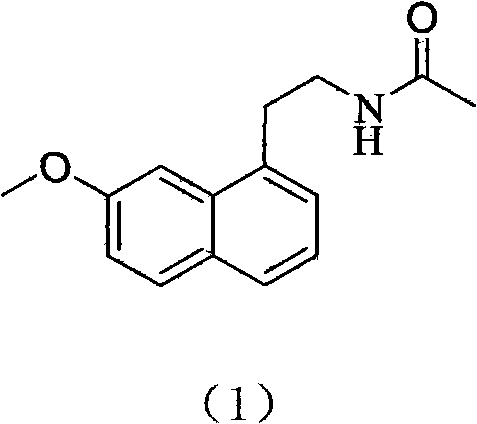
technical field [0001] The invention relates to a synthesis method of agomelatine, which belongs to the technical field of chemical and medical synthesis. Background technique [0002] Agomelatine, chemical name N-[2-(7-methoxy-1-naphthyl)ethyl]acetamide, trade name Valdoxan, is a melatoninagonist developed by the French Servier company , both antagonizing 5HT 2c Receptor action, it is the first melatoninantidepressant, can effectively treat depression. Its structural formula is as shown in (1): [0003] [0004] The synthetic method reported in patent EP0447285: 7-methoxyl-1-tetralone (2) and ethyl bromoacetate undergo Reformatsky reaction, and sulfurdehydrogenation aromatizes to obtain 7-methoxyl-1-naphthylacetic acidEthyl ester, and then through hydrolysis, acyl chloride, ammoniation, dehydrationelimination, reduction, acetylation to prepare agomelatine (1), the reaction is as long as 8 steps. The steps are numerous, the total yield is low, and the multi-step ...
Claims
the structure of the environmentally friendly knitted fabric provided by the present invention; figure 2 Flow chart of the yarn wrapping machine for environmentally friendly knitted fabrics and storage devices; image 3 Is the parameter map of the yarn covering machine
Login to View More
Application Information
Patent Timeline
Application Date:The date an application was filed.
Publication Date:The date a patent or application was officially published.
First Publication Date:The earliest publication date of a patent with the same application number.
Issue Date:Publication date of the patent grant document.
PCT Entry Date:The Entry date of PCT National Phase.
Estimated Expiry Date:The statutory expiry date of a patent right according to the Patent Law, and it is the longest term of protection that the patent right can achieve without the termination of the patent right due to other reasons(Term extension factor has been taken into account ).
Invalid Date:Actual expiry date is based on effective date or publication date of legal transaction data of invalid patent.


 Login to View More
  Login to View More