
Cloning of beta-1,4-endo-glucanase gene and preparation of recombinase
A technology of endoglucanase and glucanase, which is applied in a field, can solve problems such as research that has not been reported, and achieve the effects of large-scale industrial production, high catalytic activity and thermal stability
- Summary
- Abstract
- Description
- Claims
- Application Information
AI Technical Summary
Problems solved by technology
Method used
Image

Examples
Embodiment 1A
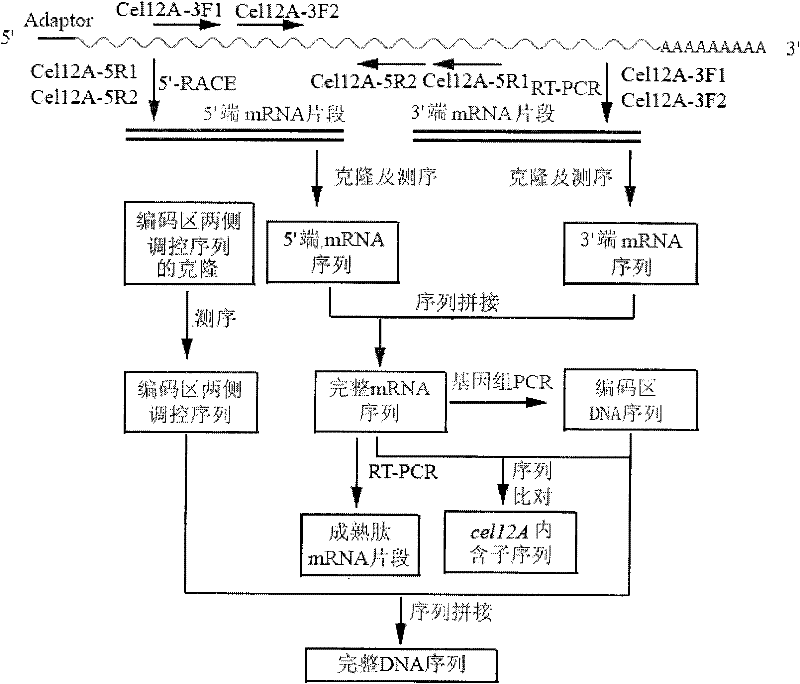
[0038] Cloning of Example 1 Aus cel12A 3' end mRNA sequence
[0039] The first strand of cDNA was synthesized by reverse transcription with Oligo dT-Adaptor Primer as primers; the first round of PCR was performed with M13 Primer M4 and Cel12A-3F1 as primers, and the reaction conditions were: 94°C for 2 min, 30 cycles (94°C 30s, 52°C for 30s, 72°C for 90s), 72°C for 10min; use M13 Primer M4 and Cel12A-3F2 as primers for the second round of PCR, and the reaction conditions are: 94°C for 2min, 30 cycles (94°C for 30s, 52°C 30s, 72°C 90s), 72°C 10min. The two rounds of PCR products were analyzed by 1% agarose gel electrophoresis, the target band was recovered and ligated with pUCm-T (pUCm-T-cel12A3′), transformed into JM109, and then sent to Shanghai Sangon for sequencing.
Embodiment 2A
[0040] Cloning of embodiment 2 Aus cel12A 5' end mRNA sequence
[0041] The first round of PCR was performed using the Outer Primer and Cel12A-5R1 of the 5′-Full RACE Kit as primers. The reaction conditions were: 94°C for 3min, 30 cycles (94°C for 30s, 55°C for 30s, 72°C for 60s), 72°C 10 min; the second round of PCR was performed using Inner Primer and Cel12A-5R2 as primers, and the reaction conditions were: 94°C for 3 min, 30 cycles (94°C for 30s, 55°C for 30s, 72°C for 60s), and 72°C for 10 min. The two rounds of PCR products were analyzed by 1% agarose gel electrophoresis, and the target band was recovered and ligated with pUCm-T (pUCm-T-cel12A5′), transformed into JM109, and then sent to Shanghai Sangon for sequencing.
Embodiment 3A
[0042] Example 3 Cloning of Aus cel12A 5' end promoter sequence
[0043] Using the processed A.usamii E001 genomic DNA as a template, the first round of PCR used T-PrimerF and Cel12A-5R1 as primers, and the reaction conditions were: 94°C for 4min, 30 cycles (94°C for 30s, 55°C for 30s, 72°C 60s), 72°C for 10min; the second round of PCR uses T-PrimerF and Cel12A-5R2 as primers, and the reaction conditions are: 94°C, 4min, 30 cycles (94°C for 30s, 55°C for 30s, 72°C for 60s), 72°C 10min. The two rounds of PCR products were analyzed by 1% agarose gel electrophoresis, the target band was recovered by tapping the gel and ligated with pUCm-T (pUCm-T-cel12AP), transformed into JM109, and sent to Shanghai Sangon for sequencing.
PUM
 Login to View More
 Abstract
Description
Claims
Application Information
 Login to View More