

Method for modifying styrene-butadiene-styrene (SBS) block copolymer
A technology of styrene block and butadiene, which is applied in the field of modification of styrene-butadiene-styrene block copolymer, can solve problems such as easy degradation, low grafting rate, complicated process, etc., and achieve high performance The effect of raising the glass transition temperature
- Summary
- Abstract
- Description
- Claims
- Application Information
AI Technical Summary
Problems solved by technology
Method used
Image



Examples
Embodiment 1
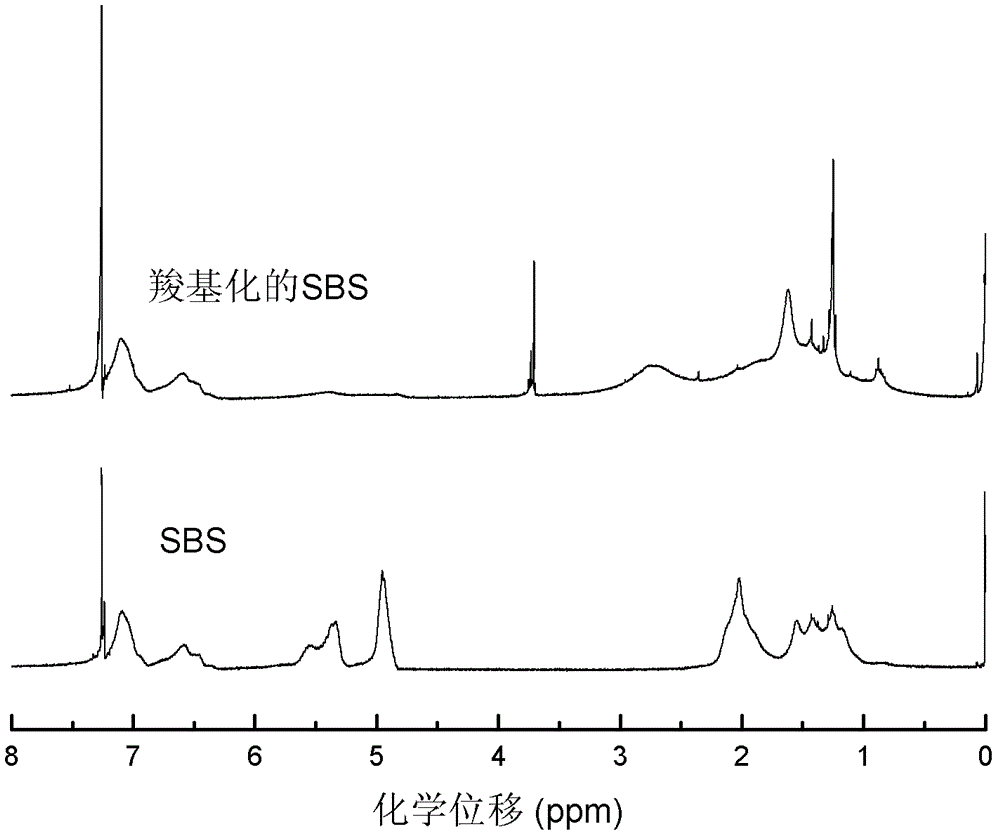
[0031] Dissolve 1.32g of SBS and 8.73g of 3-mercaptopropionic acid in 60mL of dioxane, and stir evenly at 25°C; then add 0.13g of azobisisobutyronitrile and disperse evenly, heat up to 60°C and react for 24 Hour. After precipitation, suction filtration and drying, carboxylated SBS was obtained. figure 1 It is the proton nuclear magnetic resonance spectrum of the SBS of gained carboxylation, as can be seen from the hydrogen nuclear magnetic resonance spectrum, butadiene 1 in the carboxylated SBS, 5.37ppm place hydrogen atom on the cis double bond of the 4 structure, 1, the trans double bond of the 4 structure The hydrogen atom at the upper methyl group, the hydrogen atom at 5.54ppm of the 1,2 double bonded methine, the 4.92ppm of the 1,2 double bonded methylene, and the chemical shift of the hydrogen atom at 4.98ppm are completely disappeared relative to SBS, and sulfur is produced at the same time There are 2.72ppm and 3.71ppm methylene signals on both sides of the atom, so i...
Embodiment 2
[0033] Dissolve 1g of SBS and 24.79g of mercaptopropyltriethoxysilane in 48mL of dioxane, stir well at 25°C; then add 0.17g of azobisisobutyronitrile and disperse evenly, heat up to 60°C Reaction 24h. After precipitation, suction filtration and drying, triethoxy-functionalized SBS was obtained. The triethoxy-functionalized SBS can undergo sol-gel reaction by itself or with tetraethyl orthosilicate, and the mesoporous silica material can be obtained after removing the polymer through high-temperature degradation. image 3 It is the hydrogen nuclear magnetic resonance spectrum of the obtained product. From the hydrogen nuclear magnetic resonance spectrum, it can be seen that the hydrogen atom at 5.37ppm on the cis double bond of the butadiene 1,4 structure in the triethoxy functionalized SBS, and the trans double bond of the 1,4 structure The hydrogen atom at the methyl group on the bond, the hydrogen atom at 5.54ppm of the 1,2 double bonded methine, the 4.92ppm of the 1,2 doub...
Embodiment 3
[0035]Dissolve 2.10g of SBS and 17.53g of mercaptoethanol in 90mL of dioxane, and stir evenly at 25°C; then add 0.17g of azobisisobutyronitrile and disperse evenly, heat up to 60°C for 24h. After precipitation, suction filtration and drying, hydroxylated SBS was obtained. The conversion rate of this reaction is 100%. Compared with SBS, the presence of a large number of hydroxyl groups increases the polarity of SBS, thereby enhancing the compatibility of SBS with polar polymers and oligomers. Figure 4 It is the proton nuclear magnetic resonance spectrum of the SBS of gained hydroxylation, as can be seen from the hydrogen nuclear magnetic resonance spectrum, butadiene 1 in the hydroxylated SBS, the hydrogen atom at 5.37ppm on the cis double bond of the 4 structure, 1, the trans double bond of the 4 structure The hydrogen atom at the upper methyl group, the hydrogen atom at 5.54ppm of the 1,2 double bonded methine, the 4.92ppm of the 1,2 double bonded methylene, and the chemical...
PUM
| Property | Measurement | Unit |
|---|---|---|
| glass transition temperature | aaaaa | aaaaa |
Abstract
Description
Claims
Application Information
 Login to View More