
Curcumenol derivatives resisting influenza A(H1N1) virus
A technology of influenza virus and curcumol, which is applied in the field of medicine, can solve the problems of poor water solubility, etc., and achieve the effects of stable quality, easy large-scale industrial production, and high purity of drugs
- Summary
- Abstract
- Description
- Claims
- Application Information
AI Technical Summary
Problems solved by technology
Method used
Image

Examples
Embodiment 1
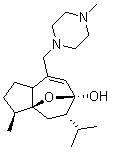
[0041] Example 1 : Compound of the present invention ( 1 ) preparation
[0042] Preparation of intermediates:
[0043] Will m- CPBA (17.2g, 1mol) was dissolved in dichloromethane (100ml), added to a solution of curcumol (11.8g, 0.05mol) in dichloromethane (100ml) at 0°C, and kept stirring at 0°C for 2 hours. After the reaction, the reaction liquid was extracted three times with NaOH (2 mol / l) solution, the organic phases were combined, extracted with water until neutral, and dried over anhydrous sodium sulfate. The solution was concentrated and evaporated to dryness, and the crude product was purified by silica gel column chromatography (cyclohexane:ethyl acetate=50:1~10:1) to obtain 11.95 g of white waxy solid 10,14-epoxycurcumol, yield 95% .
[0044] 10,14-epoxycurcumol (10.08g, 0.04mol) was dissolved in acetonitrile (600ml), and lithium perchlorate trihydrate (6.4g, 0.04mol) and diethylamine (20ml) were added at room temperature. The resulting mixture was heated t...
Embodiment 2
[0049] Example 2 : Compound of the present invention ( 2 ) preparation
[0050] The preparation of intermediate: the same Example 1 The preparation method of intermediates.
[0051] target compound ( 2 ) preparation:
[0052] Dissolve (1S, 4S, 5S, 7S, 8R)-5,8-epoxy-9,10-ene-14-chloroguaiacol (27mg, 0.1mmol) in DMF (2ml), add acetic acid Sodium (12.3 mg, 0.15 mmol). The resulting mixture was reacted at 70°C for 3.5 hours. The reaction solution was concentrated and evaporated to dryness, and the resulting crude product was purified by PTLC (cyclohexane:ethyl acetate=3:1, eluted with ethyl acetate) to obtain colorless oily compounds (1S, 4S, 5S, 7S, 8R)-5, 8 -Epoxy-9,10-ene-8-hydroxy-14-guaiacol acetate ( 2 ) 21.2mg, yield 72%. The spectral data of the compound are as follows: MS(ESI) m / z : 317.0 [M+Na] + ; 1 H-NMR (300 MHz, CDCl 3 ) δ (ppm): 1.96 (1H, dd, J =8.8, 16.4Hz, H-1), 1.87 (1H, m, H-2a), 1.56 (1H, m, H-2b), 1.87 (1H, m, H-3a), 1.56 (1H, m, H-3b), 1.8...
Embodiment 3
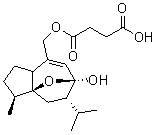
[0054] Example 3 : Compound of the present invention ( 3 ) preparation
[0055] The preparation of intermediate: the same Example 1The preparation method of intermediate (1S, 4S, 5S, 7S, 8R)-5, 8-epoxy-9, 10-ene-8, 14-guaiacol.
[0056] target compound ( 3 ) preparation:
[0057] Dissolve (1S, 4S, 5S, 7S, 8R)-5,8-epoxy-9,10-ene-8,14-guaiarediol (25.2mg, 0.1mmol) in dry pyridine (4ml) , succinic anhydride (15mg, 0.15mmol), DMAP (2.5mg, 0.02mmol) were added. The resulting mixture was reacted at 70°C for 2 hours. The reaction solution was concentrated and evaporated to dryness, and the resulting crude product was purified by PTLC (cyclohexane:ethyl acetate=2:1, eluted with ethyl acetate) to obtain colorless oily compounds (1S, 4S, 5S, 7S, 8R)-5, 8 -Epoxy-9,10-ene-8-hydroxy-14-guaiacol succinate ( 3 ) 24.6mg, yield 71%. The spectral data of the compound are as follows: MS(ESI) m / z : 361.2 [M+Na] + ; 1 H-NMR (300 MHz, CDCl 3 ) δ (ppm): 1.95 (1H, dd, J =8.8, 16.3H...
PUM
 Login to View More
 Abstract
Description
Claims
Application Information
 Login to View More