Check patentability & draft patents in minutes with Patsnap Eureka AI!

Preparation method of 1,5-dinitronaphthalene and 1,8-dinitronaphthalene

A dinitronaphthalene and nitrogen dioxide technology, applied in the field of synthesis of 1,5-dinitronaphthalene and 1,8-dinitronaphthalene, can solve poor safety performance, low atom economy and environmental pollution Serious problems, to achieve the effect of increasing yield and selectivity, improving atom utilization, and reducing environmental pollution

Inactive Publication Date: 2012-12-19
ANHUI HUAIHUA
View PDF4 Cites 2 Cited by
  • Summary
  • Abstract
  • Description
  • Claims
  • Application Information

AI Technical Summary

Problems solved by technology

[0005] With the development of environmental economy, the shortcomings of the above methods are becoming more and more manifested, mainly as follows: (1) the atom economy is not high; (2) the reaction selectivity is poor, a large amount of organic by-product waste is formed, and the environmental pollution is serious; ( 3) High energy consumption, a large amount of acid gas and strong inorganic waste acid need to be treated; (4) Strong acid environment is highly corrosive to equipment, and equipment investment costs are high; (5) Strong acid environment is prone to oxidation side reactions, rapid heat release, and safety performance Difference
In view of the increasing demand for dinitronaphthalene, with the development of environmental economy, the traditional production method of dinitronaphthalene is not sustainable and must be replaced by a more environmentally friendly method

Method used

the structure of the environmentally friendly knitted fabric provided by the present invention; figure 2 Flow chart of the yarn wrapping machine for environmentally friendly knitted fabrics and storage devices; image 3 Is the parameter map of the yarn covering machine
View more

Image

Smart Image Click on the blue labels to locate them in the text.
Viewing Examples
Smart Image
  • Preparation method of 1,5-dinitronaphthalene and 1,8-dinitronaphthalene
  • Preparation method of 1,5-dinitronaphthalene and 1,8-dinitronaphthalene
  • Preparation method of 1,5-dinitronaphthalene and 1,8-dinitronaphthalene

Examples

Experimental program
Comparison scheme
Effect test

Embodiment 1

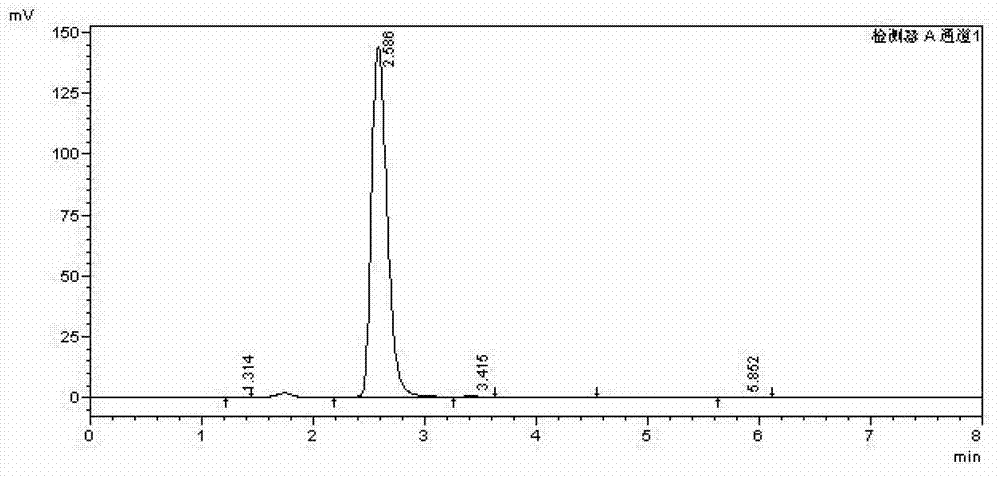
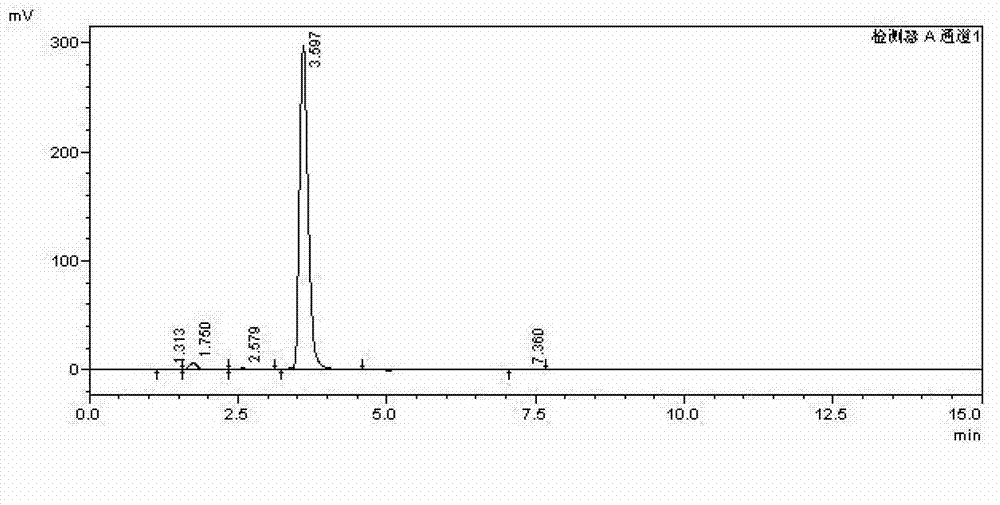
[0021] In a 50 mL three-necked flask, add 0.128 g of naphthalene, 5.0 mL of acetonitrile, 0.100 g of HZSM-11, 2.0 mL of nitrogen dioxide, stir magnetically in an oxygen atmosphere, and react at room temperature for 12 hours. After the reaction time has elapsed, the reaction is terminated with deionized water. The mixture was filtered through a glass funnel to remove the catalyst. The filtrate was rotary evaporated in vacuo to obtain a crude product, which was washed three times with 5% aqueous sodium bicarbonate solution, and then washed with distilled water until the crude product was neutral. Nitrobenzene was used as internal standard for HPLC analysis, and the content of each isomer component of nitration products was calculated by internal standard method. The mass of 1,5-dinitronaphthalene and 1,8-dinitronaphthalene is 0.160g, and the yield is 73.0%, of which the mass of 1,5-dinitronaphthalene is 0.109g, and the mass fraction is 68.1%; 1 , The mass of 8-dinitronaphthale...

Embodiment 2

[0024] In a 50 mL three-necked flask, add 0.128 g of naphthalene, 5.0 mL of acetonitrile, 0.100 g of Hβ-500, and 2.0 mL of nitrogen dioxide, stir magnetically in an oxygen atmosphere, and react at room temperature for 12 hours. After the reaction time has elapsed, the reaction is terminated with deionized water. The mixture was filtered through a glass funnel to remove the catalyst. The filtrate was rotary evaporated in vacuo to obtain a crude product, which was washed three times with 5% aqueous sodium bicarbonate solution, and then washed with distilled water until the crude product was neutral. After drying, carry out HPLC analysis with nitrobenzene as the internal standard, and calculate the content of each isomer component of the nitration product with the internal standard method. The mass of 1,5-dinitronaphthalene and 1,8-dinitronaphthalene is 0.177g, and the yield is 81.4%, of which the mass of 1,5-dinitronaphthalene is 0.131g, and the mass fraction is 74.0%; 1 , The...

Embodiment 3

[0027] In a 50 mL three-necked flask, add 0.128 g of naphthalene, 5.0 mL of acetonitrile, 0.200 g of HY, and 2.0 mL of nitrogen dioxide, stir magnetically in an oxygen atmosphere, and react at room temperature for 12 hours. After the reaction time has elapsed, the reaction is terminated with deionized water. The mixture was filtered through a glass funnel to remove the catalyst. The filtrate was rotary evaporated in vacuo to obtain a crude product, which was washed three times with 5% aqueous sodium bicarbonate solution, and then washed with distilled water until the crude product was neutral. After drying, carry out HPLC analysis with nitrobenzene as internal standard, and calculate the content of each isomer component after nitration of naphthalene with internal standard method. The mass of 1,5-dinitronaphthalene and 1,8-dinitronaphthalene is 0.139g, and the yield is 63.8%. Among them, the mass of 1,5-dinitronaphthalene is 0.096g, and the mass fraction is 69.1%; the mass o...

the structure of the environmentally friendly knitted fabric provided by the present invention; figure 2 Flow chart of the yarn wrapping machine for environmentally friendly knitted fabrics and storage devices; image 3 Is the parameter map of the yarn covering machine
Login to View More

PUM

No PUM Login to View More

Abstract

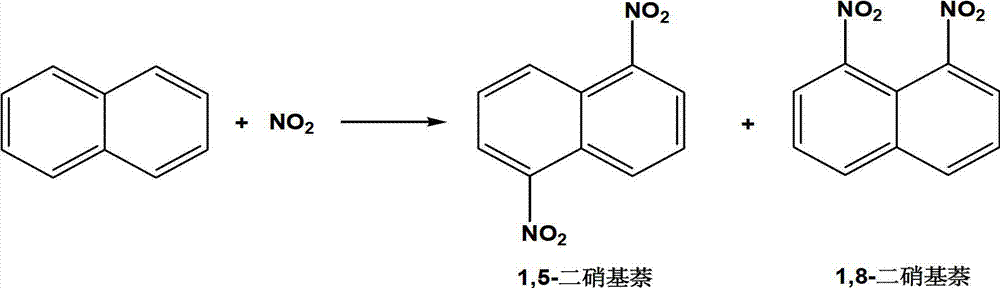
The invention relates to a preparation method of 1,5-dinitronaphthalene and 1,8-dinitronaphthalene. The preparation method comprises the steps of: dissolving naphthalene into an organic solvent to prepare a solution; and reacting the solution with nitrogen dioxide in a catalyst and an oxygen atmosphere. Dinitronaphthalene is prepared by using nitrogen dioxide as a nitration agent, instead of nitric acid and sulfuric acid, and the naphthalene as a basic material, and thus the preparation method is a non-acidic cleaning method, and is mild in reaction conditions, good in selectivity, and high in atom efficiency and the environment is clean.

Description

technical field [0001] The present invention relates to the synthesis of 1,5-dinitronaphthalene and 1,8-dinitronaphthalene. Background technique [0002] 1,5-Dinitronaphthalene and 1,8-Dinitronaphthalene are important chemical intermediates, which are widely used in the preparation of dyes, pigments and high-energy materials. 1,5-Dinitronaphthalene is also the precursor of 1,5-naphthalene diisocyanate, 1,5-naphthalene diisocyanate has a higher melting point, and the polyurethane synthesized from it has high hardness, good resilience and heat resistance Good performance, excellent dynamic performance, good wear resistance, etc., can be used in workplaces where ordinary polyurethane cannot meet the requirements or is prematurely damaged, such as high temperature and oily environments, so it is mostly used as a raw material for the synthesis of advanced polyurethane. 1,8-Dinitronaphthalene is also the precursor of 1,8-diaminonaphthalene, which is mainly used in the production ...

Claims

the structure of the environmentally friendly knitted fabric provided by the present invention; figure 2 Flow chart of the yarn wrapping machine for environmentally friendly knitted fabrics and storage devices; image 3 Is the parameter map of the yarn covering machine
Login to View More

Application Information

Patent Timeline
no application Login to View More
IPC IPC(8): C07C201/08C07C205/06
Inventor 彭新华韩松汪浩才苏传好朱志峰
Owner ANHUI HUAIHUA
Features
  • R&D
  • Intellectual Property
  • Life Sciences
  • Materials
  • Tech Scout
Why Patsnap Eureka
  • Unparalleled Data Quality
  • Higher Quality Content
  • 60% Fewer Hallucinations
Social media
Patsnap Eureka Blog
Learn More