
Self-adaptive optical fiber coupler or collimator control system capable of bilaterally receiving and transmitting laser beams
A fiber coupling and control system technology, applied in the direction of lasers, phonon exciters, laser components, etc., can solve the problems of inconvenient use of liquid crystal phase controllers, lack of synchronous coupling of laser beams, and low control accuracy, and achieve favorable Array integration, high control precision, and the effect of improving the resonance frequency
Patent Information
- Authority / Receiving Office
- CN · China
- Current Assignee / Owner
- Publication Date
- 2013-09-18
Smart Images
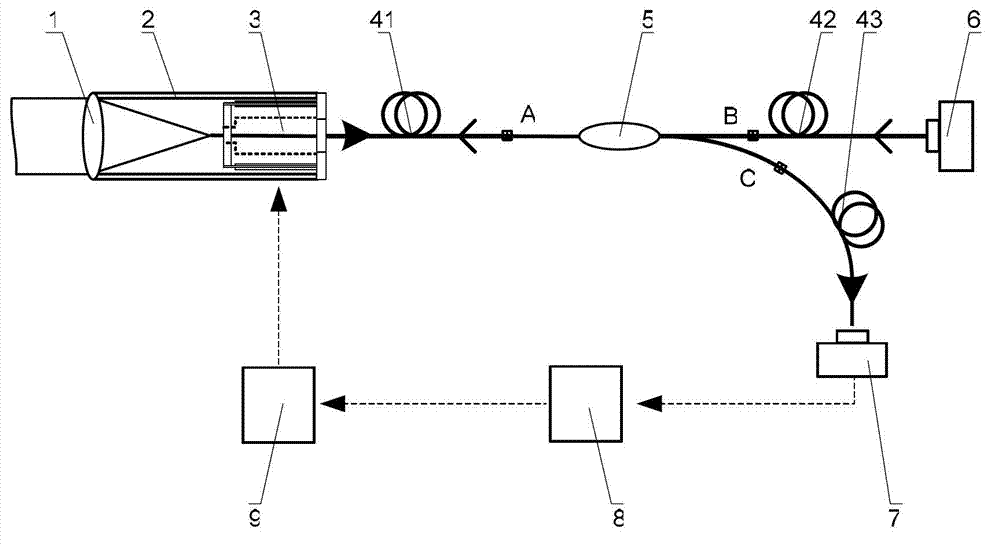
Figure 1 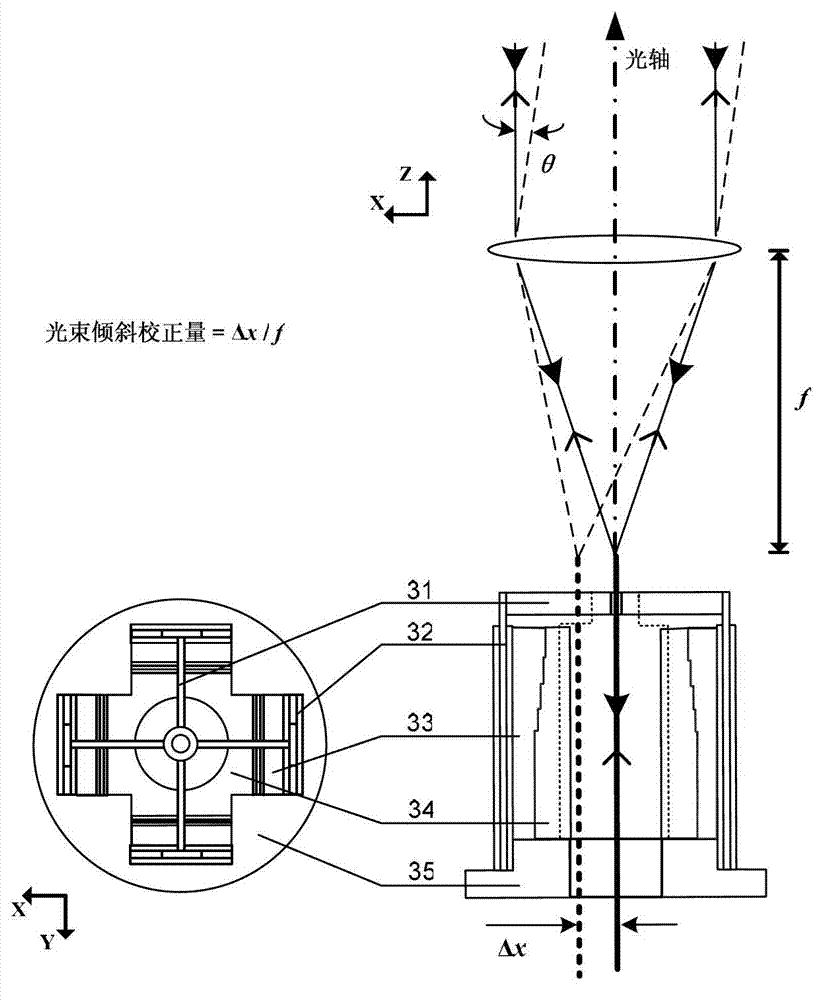
Figure 2
Abstract
Description
technical field
[0001] The invention relates to an adaptive optical fiber coupling or collimator control system for two-way transmission and reception of laser beams, which can be used in optical fiber-based space laser application fields such as free space laser communication, laser atmospheric transmission, laser precision positioning, and laser radar. Background technique
[0002] In the fiber-based space laser system, how to improve the space light coupling efficiency and reduce the signal-to-noise ratio is one of the key technical problems to be solved. In fact, due to atmospheric turbulence effects, mechanical platform vibration, and thermal distortion, the laser beam reaching the receiving end will produce an angle error, which greatly affects the fiber coupling efficiency. At the same time, factors such as atmospheric turbulence effects, mechanical platform vibration, and thermal distortion will also cause angle errors in the emitted laser beam, which affects the acc...
Examples
Embodiment
[0023] according to figure 1 , figure 2 Based on the structure, an adaptive fiber coupling or collimator control system for bidirectional transmission and reception of laser beams is designed. Based on the mode-field matching theory, the fiber coupling efficiency reaches a maximum of 81.45% when the coupling parameter β=1.13 (P.Winzer, and W.Leeb, "Fiber coupling efficiency for random light and its applications to ladar," Optics Letters23,986- 988 (1998)). Wherein, the coupling parameter is directly proportional to the aperture of the coupling or collimating lens 1 and the fiber mode field radius, and is inversely proportional to the focal length of the coupling or collimating lens and the laser wavelength. Accordingly, in the embodiment of the present invention, the first optical fiber 41, the second optical fiber 42 and the third optical fiber 43 adopt single-mode polarization-maintaining optical fibers, the fiber mode field radius is 5 μm, and the wavelength of the trans...