

Method for reducing content of glycidyl ester in edible oil by using adsorbent
A technology of glycidyl ester and edible oil, which is applied in the direction of edible oil/fat, application, food science, etc., can solve the problems of difficulty in controlling the quality consistency of raw materials, low removal rate of glycidyl ester, and complicated implementation, etc., to achieve Convenient for industrial production, no solvent residue, easy to operate
- Summary
- Abstract
- Description
- Claims
- Application Information
AI Technical Summary
Problems solved by technology
Method used
Image

Examples
Embodiment 1
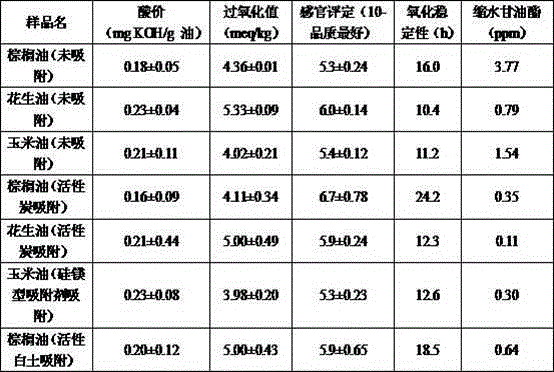
[0023] In a 100mL beaker, add 20g of palm oil, and at the same time add 2% of the weight of palm oil special activated carbon for edible oil, then use a constant temperature oil bath to quickly raise the temperature to 100°C, and react for 30min under rapid stirring at a speed of 10rpm. After the reaction was completed, it was filtered at 100°C to obtain a light yellow transparent liquid. The oxidative stability of the oil after adsorption is better than that before adsorption. Other indicators such as acid value and peroxide value are in line with national standards. After adsorption by special activated carbon for edible oil, the content of glycidyl ester in palm oil has increased from 3.7ppm It is reduced to about 0.3ppm, and the removal rate is above 92%. The specific experimental data are shown in Table 1.
[0024] Table 1
[0025]
Embodiment 2
[0027] In a 100mL beaker, add 20g of peanut oil, and at the same time add 5% of the weight of peanut oil special activated carbon for cooking oil, then use a constant temperature oil bath to quickly heat up to 100°C, and react for 60min under rapid stirring at a speed of 15rpm. After the reaction was completed, it was filtered at 100°C to obtain a yellow transparent liquid. The oxidative stability of the oil after adsorption is better than that before adsorption, and other indicators such as acid value and peroxide value are in line with national standards. After adsorption by special activated carbon for edible oil, the content of glycidyl ester in peanut oil is reduced from about 0.8ppm It is reduced to about 0.1ppm, and the removal rate is above 86%. The specific experimental data are shown in Table 1.
Embodiment 3
[0029] In a 100mL beaker, add 20g of corn oil, and at the same time add 10% of the weight of the corn oil as a silicon-magnesium-type adsorbent, then use a constant temperature oil bath to rapidly raise the temperature to 80°C, and react for 90min under rapid stirring at a speed of 20rpm. After the reaction was completed, it was filtered at 80°C to obtain a light yellow transparent liquid. The oxidative stability of the oil after adsorption is better than that before adsorption. Other indicators such as acid value and peroxide value are in line with national standards. About ppm is reduced to about 0.3ppm, and the removal rate is above 80%. The specific experimental data are shown in Table 1.
PUM
 Login to View More
 Abstract
Description
Claims
Application Information
 Login to View More