Ferroferric oxide nanoparticles as well as preparation method and application thereof in inhibiting proliferation of Salmonella

A technology of ferric oxide and nanoparticles, applied in the direction of iron oxide/hydroxide, application, nanotechnology, etc., can solve the problem of unreported and proven bactericidal effect, high cost of Salmonella purification, and increased drug resistance of chickens, etc. problem, achieve the effect of reducing Salmonella infection, low cost of use, and reducing pathological changes

A technology of ferric oxide and nanoparticles, applied in the direction of iron oxide/hydroxide, application, nanotechnology, etc., can solve the problem of unreported and proven bactericidal effect, high cost of Salmonella purification, and increased drug resistance of chickens, etc. problem, achieve the effect of reducing Salmonella infection, low cost of use, and reducing pathological changes

CN109095510AInactive Publication Date: 2018-12-28JIANGSU INST OF POULTRY SCI

Image

Smart Image Click on the blue labels to locate them in the text.
Viewing Examples
Smart Image
  • Ferroferric oxide nanoparticles as well as preparation method and application thereof in inhibiting proliferation of Salmonella
  • Ferroferric oxide nanoparticles as well as preparation method and application thereof in inhibiting proliferation of Salmonella
  • Ferroferric oxide nanoparticles as well as preparation method and application thereof in inhibiting proliferation of Salmonella

Examples

Experimental program
Comparison scheme
Effect test

Embodiment 1

[0026] A preparation method of iron ferric oxide nanoparticles comprises the following steps:

[0027] (1) Dissolve 0.8g ferric ferric oxide in 40mL of ethylene glycol solution (mass fraction is 60%), then add 3.5g sodium acetate, add to the hydrothermal reaction kettle after fully stirring, feed nitrogen, React at a temperature of 160°C for 12 hours to generate a precipitated product;

[0028] (2) Cool the precipitated product to room temperature, carry out ultrasonic dispersion after mechanical stirring, the frequency of ultrasonic is 40khz, and the time of ultrasonic dispersion is 4min;

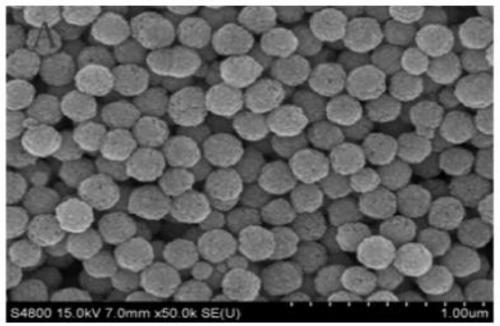
[0029] (3) The dispersed product was cross-washed with distilled water and ethanol until the pH of the supernatant was 6.8. After vacuum drying, ferric oxide nanoparticles were obtained, and the average diameter of the ferric oxide nanoparticles was 250nm.

Embodiment 2

[0031] A preparation method of iron ferric oxide nanoparticles comprises the following steps:

[0032] (1) Dissolve 0.82g ferric ferric oxide in 45mL of ethylene glycol solution (mass fraction is 60%), then add 3.6g sodium acetate, add to the hydrothermal reaction kettle after fully stirring, feed nitrogen, React at a temperature of 180°C for 8 hours to generate a precipitated product;

[0033] (2) Cool the precipitated product to room temperature, carry out ultrasonic dispersion after mechanical stirring, the frequency of ultrasonic wave is 40khz, and the time of ultrasonic dispersion is 5min;

[0034] (3) The dispersed product was cross-washed with distilled water and ethanol until the pH of the supernatant was 7.0, and vacuum-dried to obtain ferric oxide nanoparticles with an average diameter of 200 nm.

Embodiment 3

[0036] A preparation method of iron ferric oxide nanoparticles comprises the following steps:

[0037] (1) 0.85g of ferric oxide is dissolved in 50mL of ethylene glycol solution (mass fraction is 60%), then add 4.0g of sodium acetate, add to the hydrothermal reaction kettle after fully stirring, feed nitrogen, React at a temperature of 200°C for 6 hours to generate a precipitated product;

[0038] (2) Cool the precipitated product to room temperature, carry out ultrasonic dispersion after mechanical stirring, the frequency of ultrasonic is 40khz, and the time of ultrasonic dispersion is 6min;

[0039] (3) The dispersed product was cross-washed with distilled water and ethanol until the pH of the supernatant was 6.8, and vacuum-dried to obtain ferric oxide nanoparticles with an average diameter of 300nm.

the structure of the environmentally friendly knitted fabric provided by the present invention; figure 2 Flow chart of the yarn wrapping machine for environmentally friendly knitted fabrics and storage devices; image 3 Is the parameter map of the yarn covering machine
Login to View More

PUM

PropertyMeasurementUnit
diameteraaaaaaaaaa
diameteraaaaaaaaaa
diameteraaaaaaaaaa
Login to View More

Abstract

The invention discloses ferroferric oxide nanoparticles as well as a preparation method and the application of the ferroferric oxide nanoparticles in inhibiting proliferation of Salmonella. The ferroferric oxide nanoparticles are added to a feed for resisting Salmonella infection in poultry. According to the invention, the ferroferric oxide nanoparticles are used for resisting the Salmonella infection of the poultry for the first time; the ferroferric oxide nanoparticles are added in the feed during the brooding period, so that the bacteria loading amount of the Salmonella in broiler bodies infected with the Salmonella can be significantly reduced, and the ferroferric oxide nanoparticles have favorable effects on liver tissues, do not produce side effects and have lower use cost, and further are convenient in use and simple in production process. According to the ferroferric oxide nanoparticles and the preparation method and the application of the ferroferric oxide nanoparticles in inhibiting the proliferation of the Salmonella, a new way for treating the Salmonella is opened, and a new research idea for the development of medicines resisting the Salmonella is further provided.

Description

technical field [0001] The invention relates to the application of a nanozyme, in particular to a nanometer particle of ferric oxide, a preparation method thereof and an application in inhibiting the value-added of Salmonella. Background technique [0002] Nanozyme particles are a new type of nanomaterial that has emerged in the past two years. It has the advantages of low preparation cost, simple method and easy storage. It has been proven to have excellent antibacterial activity, and it is difficult to induce bacterial resistance compared with existing antibiotics. Drug resistance, mainly because the killing effect of nanomaterials is multifaceted, it is difficult for bacteria to develop targeted drug resistance, and nanozymes can effectively inhibit the proliferation of various bacteria when used in low doses without reducing the cell itself. activity, high biosafety and environmental friendliness. As the structural domain of various signaling substances in the body's im...

Claims

the structure of the environmentally friendly knitted fabric provided by the present invention; figure 2 Flow chart of the yarn wrapping machine for environmentally friendly knitted fabrics and storage devices; image 3 Is the parameter map of the yarn covering machine
Login to View More

Application Information

Patent Timeline
28 Dec 2018
Publication
CN109095510A
IPC
C01G49/08; B82Y40/00; A23K50/75; A23K20/20; A61K9/16; A61K33/26; A61P31/04
CPC
A23K20/30; A23K50/75; A61K9/16; A61K33/26; A61P31/04; B82Y40/00; C01G49/08; C01P2004/03
Inventors
施寿荣; 沈一茹