Tobacco protein kinase gene NtCIPK1 as well as cloning method and application thereof
What is AI technical title?
AI technical title is built by Patsnap AI team. It summarizes the technical point description of the patent document.
A technology of protein kinase gene and cloning method, applied in the field of tobacco protein kinase gene NtCIPK1 and its cloning
Inactive Publication Date: 2019-02-15
YUNNAN ACAD OF TOBACCO AGRI SCI
View PDF5 Cites 4 Cited by
Summary
Abstract
Description
Claims
Application Information
AI Technical Summary
This helps you quickly interpret patents by identifying the three key elements:
Problems solved by technology
Method used
Benefits of technology
Problems solved by technology
There is no report about the CIPKs protein gene in tobacco, and the cloned tobacco CIPK Genes, it is of great significance to understand the regulation of CIPKs on tobacco potassium content, and then to cultivate high-quality tobacco leaves
Method used
the structure of the environmentally friendly knitted fabric provided by the present invention; figure 2 Flow chart of the yarn wrapping machine for environmentally friendly knitted fabrics and storage devices; image 3 Is the parameter map of the yarn covering machine
View more
Image
Smart Image Click on the blue labels to locate them in the text.
Viewing Examples
Smart Image
Click on the blue label to locate the original text in one second.
Reading with bidirectional positioning of images and text.
Smart Image
Examples
Experimental program
Comparison scheme
Effect test
Embodiment 1
[0076] Tobacco protein kinase gene NtCIPK1 Clone of
[0077] A. According to Arabidopsis AtCIPK1 The protein sequence of the gene (EFH61473.1) searched NCBI database to get the homologous gene in tobacco NtCIPK1 Sequence, use this sequence to design gene cloning primers:
[0080] B. Extract RNA from tobacco root tissue and reverse transcription to obtain the first strand cDNA;
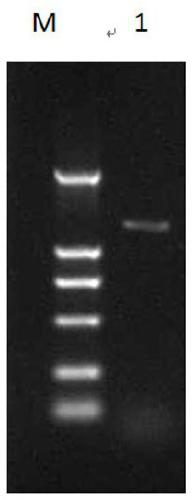
[0081] C. Using the first-strand cDNA obtained by reverse transcription as a template, PCR amplification was carried out with primers NtCIPK1F / NtCIPK1R, and the PCR products were separated by agarosegel electrophoresis and then recovered and purified ( figure 1 );
[0082] D. Connect the purified product to the carrier. The connection system and process are as follows: 4μL of purified product, 1μL of salt solution, 1μL of PCR®-BluntⅡ-TOPO (Invitrogen), mix well, 25℃, water bat...
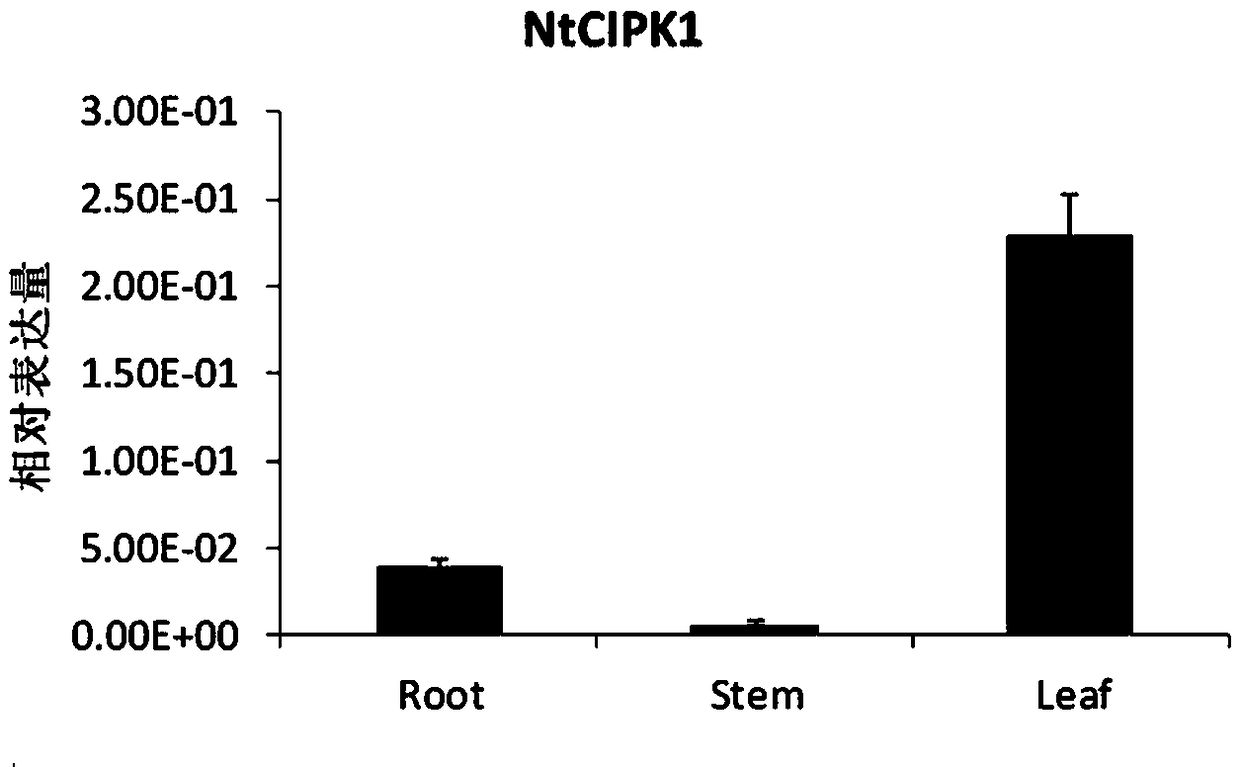
[0085] A. To plant and cultivate tobacco Yunyan 87, extract RNA from roots, stems and leaves during the vigorous period, and reverse transcription to obtain the first strand cDNA.
[0089] Tobacco Actin gene was used as internal control, Actin-F: CTGAGGTCCTTTTCCAACCA and Actin-RTACCCGGGAACATGGTAGAG. Fluorescence quantitative PCR was performed using cDNA of roots, stems and leaves as templates. The reaction was performed on RocheLightCycler 480 using LightCycler 480 SYBR Green I master. The 20 µL system contained 10 µL LightCycler 480 SYBR Green I master (2×), and the forward and reverse primers were 1 µL each (10 µmol / L), cDNA 1 µL (reverse transcription product diluted 4 times), 7 µL sterilized distilled water. The reaction procedure is as follows: pre-denatura...
Embodiment 3
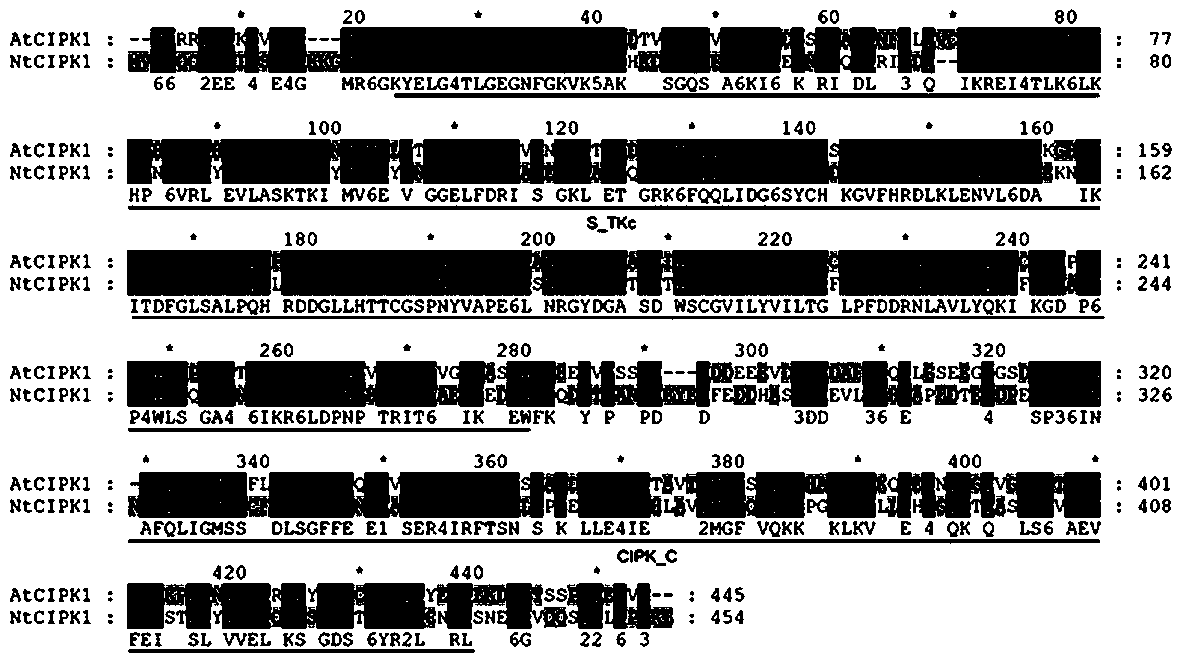
[0091] tobacco NtCIPK1 Analysis of Conserved Domains of Gene Coded Proteins
[0092] The NtCIPK1 protein was compared with the Arabidopsis AtCIPK1 protein in multiple sequence ( image 3 ). NtCIPK1 has CIPK protein conserved domains, such as transmembrane serine / threonineprotein kinase domain S_TKc, C-terminal regulatory domain CIPK_c, and NtCIPK1 protein has high homology with Arabidopsis AtCIPK1 protein.
the structure of the environmentally friendly knitted fabric provided by the present invention; figure 2 Flow chart of the yarn wrapping machine for environmentally friendly knitted fabrics and storage devices; image 3 Is the parameter map of the yarn covering machine
Login to View More
PUM
Login to View More
Abstract
The invention discloses a tobacco proteinkinasegene NtCIPK1 as well as a cloning method and application thereof. The nucleotide sequence of the tobacco proteinkinasegene NtCIPK1 is as shown in SEQID NO:1. The amino acid sequence of an encoded protein is as shown in SEQ ID NO:2. The cloning method comprises the following steps: synthesizing tobacco leaf cDNA; extracting total RNA of a tobaccoleaf and carrying out inverse transcription to obtain a first chain cDNA; carrying out PCR amplification on the NtCIPK1 gene; and carrying out PCR amplification by taking the cDNA of the tobacco leafas a template according to a NtCIPK1 gene sequence design primer, recovering and purifying a PCR amplification product, and sequencing the product. The application is as follows: the tobacco protein kinase gene NtCIPK1 is applied to obtaining a transgenic tobacco plant for regulating potassium content of tobacco. The cloned NtCIPK1 gene is identified functionally by means of a CRISPR / CAS9 technique. The cloned identification of the tobacco protein kinase gene NtCIPK1 provides a novel gene target for regulating the potassium content of tobacco.
Description
Technical field [0001] The invention belongs to the technical field of genetic engineering, and specifically relates to a tobacco protein kinase gene NtCIPK1 And its cloning method and application. Background technique [0002] Ca 2+ Known as the second messenger in eukaryotic signal transduction, Ca 2+ Signal transduction is one of the important ways for plants to transmit information to the body after receiving external stress. There are three main types of receiving Ca in plants 2+ Signal receptors: calmodulin (CaM), calcium-dependent protein kinases (CDPKs) and calmodulin B-like protein family (CBL). CIPK (CBL-interacting protein kinase) protein is a plant-specific Ser / Thr protein kinase and belongs to the plant SnRK3 protein kinase subfamily. CIPKs are CBL-specific target protein kinases. The network system formed by the interaction of CBL-CIPKs receives a series of plant responses to external abiotic stress stimuli. For example, drought, high salt, ABA, etc. The structur...
Claims
the structure of the environmentally friendly knitted fabric provided by the present invention; figure 2 Flow chart of the yarn wrapping machine for environmentally friendly knitted fabrics and storage devices; image 3 Is the parameter map of the yarn covering machine
Login to View More
Application Information
Patent Timeline
Application Date:The date an application was filed.
Publication Date:The date a patent or application was officially published.
First Publication Date:The earliest publication date of a patent with the same application number.
Issue Date:Publication date of the patent grant document.
PCT Entry Date:The Entry date of PCT National Phase.
Estimated Expiry Date:The statutory expiry date of a patent right according to the Patent Law, and it is the longest term of protection that the patent right can achieve without the termination of the patent right due to other reasons(Term extension factor has been taken into account ).
Invalid Date:Actual expiry date is based on effective date or publication date of legal transaction data of invalid patent.


 Login to View More
  Login to View More