
Synthesis process of cefazedone sodium
A synthesis process and technology of cephalosporins, which are applied in the field of pharmaceutical synthesis, can solve the problems of being unsuitable for industrialized large-scale production, difficult to find purification methods, and high industrial production costs, and achieve the advantages of reducing the occurrence of by-products, reducing product costs, and reducing side reactions. Effect
- Summary
- Abstract
- Description
- Claims
- Application Information
AI Technical Summary
Problems solved by technology
Method used
Image

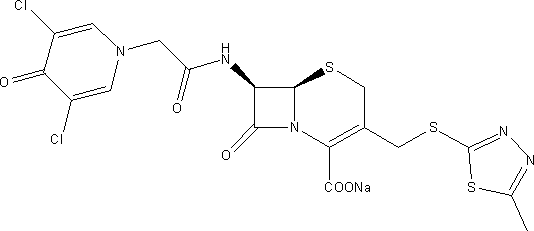
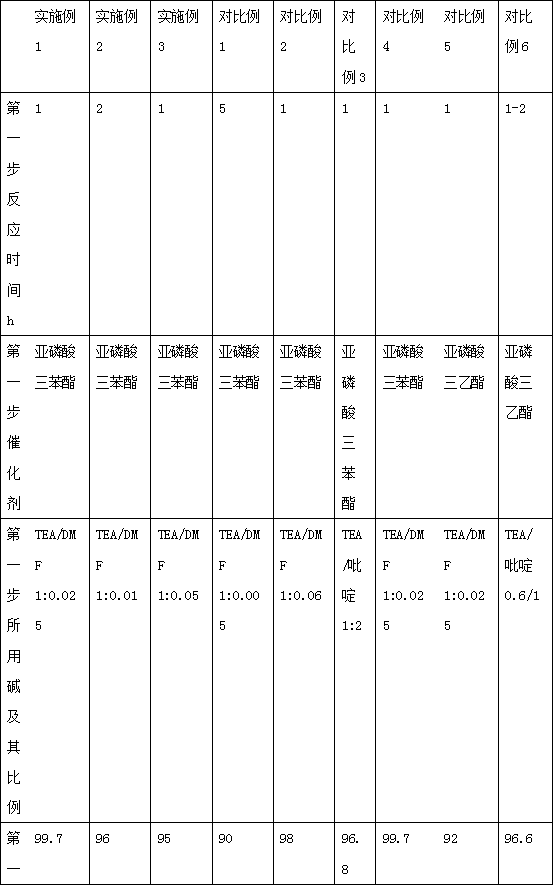
Examples
Embodiment 1
[0030] (1) Preparation of Thioester Compounds
[0031] In a dry reaction flask, add 200ml of dichloromethane, 22.2g (0.1mol) of 3,5-dichloro-4-pyridone-1-acetic acid and 2-mercapto-5-methyl-1,3,4 -Thiadiazole 14.55g (0.11mol), stirred, then added triethylamine 10.1g (0.1mol), DMF 1.83g (0.025mmol) stirred at room temperature for 1 hour, then slowly added dropwise the catalyst triphenyl phosphite Dichloromethane solution (31g of triphenyl phosphite dissolved in 50ml of dichloromethane, 0.1mol), dripped within 1 hour, controlled the temperature at 20-25°C, stirred and reacted for 1 hour, cooled to below 10°C, filtered, and the filtrate Spin dry, and vacuum dry below 40°C to obtain 33.5 g (0.099 mol) of the thioester compound, with a yield of 99.7% and an HPLC purity of 99.5%.
[0032] (2) Preparation of Cefazedone Sodium:
[0033] Under the protection of nitrogen, add 24.5g (0.09mol) of 7-ACA and 3.6g (0.09mol) of sodium hydroxide into the mixed solvent of water and acetonitri...
Embodiment 2
[0035] (1) Preparation of Thioester Compounds
[0036]In a dry reaction flask, add 200ml of dichloromethane, 22.2g (0.1mol) of 3,5-dichloro-4-pyridone-1-acetic acid and 2-mercapto-5-methyl-1,3,4 -Thiadiazole 14.55g (0.11mol), stirred, then added triethylamine 10.1g (0.1mol), DMF 0.73g (0.01mmol) stirred at room temperature for 1 hour, then slowly added dropwise the catalyst triphenyl phosphite Dichloromethane solution (31g of triphenyl phosphite dissolved in 50ml of dichloromethane, 0.1mol), dripped within 1 hour, stirred and reacted at 20-25°C for 2 hours, cooled to below 10°C, filtered, The filtrate was spin-dried and vacuum-dried below 40°C to obtain 32.3 g (0.096 mol) of the thioester compound with a yield of 96% and an HPLC purity of 99.5%.
[0037] (2) Preparation of Cefazedone Sodium:
[0038] Under the protection of nitrogen, add 24.5g (0.09mol) of 7-ACA and 3.6g (0.09mol) of sodium hydroxide into the mixed solvent of water and acetonitrile (100ml of water and 200ml ...
Embodiment 3
[0040] (1) Preparation of Thioester Compounds
[0041] In a dry reaction flask, add 200ml of dichloromethane, 22.2g (0.1mol) of 3,5-dichloro-4-pyridone-1-acetic acid and 2-mercapto-5-methyl-1,3,4 -Thiadiazole 14.55g (0.11mol), stirred, then added triethylamine 10.1g (0.1mol), DMF 3.65g (0.05mmol) stirred at room temperature for 1 hour, then slowly added dropwise the catalyst triphenyl phosphite Dichloromethane solution (31g of triphenyl phosphite dissolved in 50ml of dichloromethane, 0.1mol), dripped within 1 hour, controlled the temperature at 20-25°C, stirred and reacted for 1 hour, cooled to below 10°C, filtered, and the filtrate Spin dry, and vacuum dry below 40°C to obtain 31.9 g (0.095 mol) of the thioester compound, with a yield of 95% and an HPLC purity of 99.5%.
[0042] (2) Preparation of Cefazedone Sodium:
[0043] Under the protection of nitrogen, add 24.5g (0.09mol) of 7-ACA and 3.6g (0.09mol) of sodium hydroxide into the mixed solvent of water and acetonitrile ...
PUM
 Login to View More
 Abstract
Description
Claims
Application Information
 Login to View More