Preparation method of monodisperse polymer metal composite conductive microspheres
A metal composite, polymer technology, applied in metal material coating process, liquid chemical plating, coating and other directions, can solve the problem of limited use range, achieve the effect of reaction safety, improve production efficiency, and avoid roughening process
- Summary
- Abstract
- Description
- Claims
- Application Information
AI Technical Summary
Problems solved by technology
Method used
Image

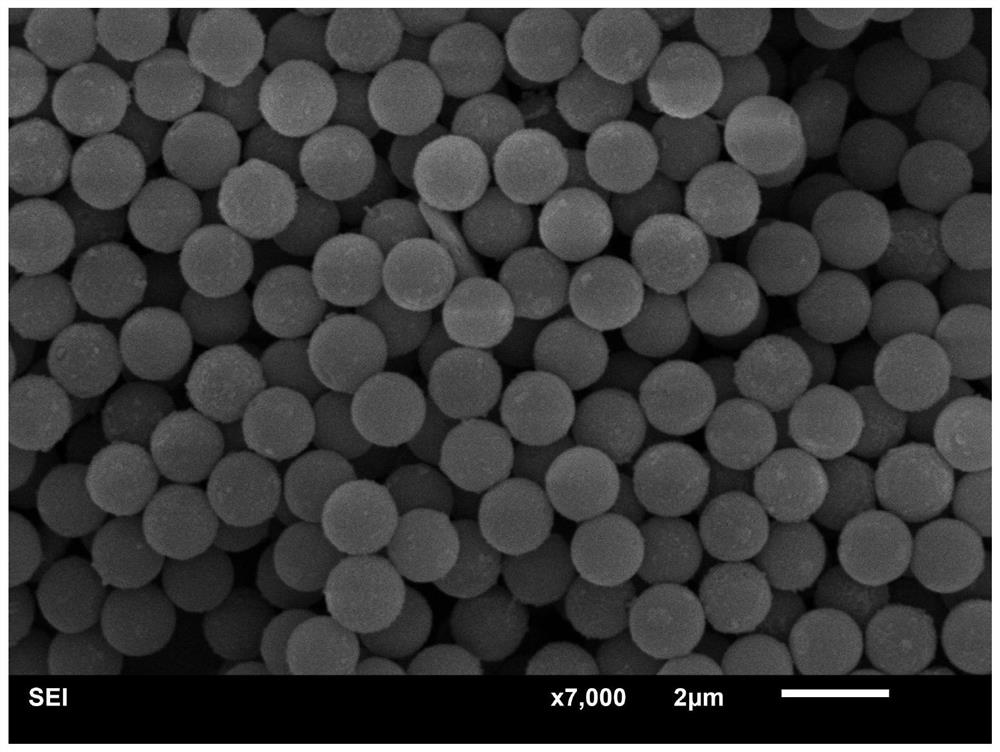


Examples
Embodiment 1
[0031] (1) Put 10 g of styrene, 3 g of polyvinylpyrrolidone, 0.1 g of azobisisobutyronitrile, and 90 g of ethanol in a reaction kettle, feed nitrogen gas to remove the air in the reaction kettle, raise the temperature to 70°C, and react for 10 hours, Add 1 g of p-chloromethylstyrene dropwise to the system, and continue to react for 6 hours after the dropwise addition to obtain the chloromethylated polymer microsphere dispersion;
[0032] (2) Take 30 g of the chloromethylated polymer microsphere dispersion prepared in the step (1), add 2 g of thiourea, react at 80° C. for 3 h, then reflux hydrolyze with 50 wt % sodium hydroxide aqueous solution for 6 h, and centrifuge, Wash twice with deionized water, then wash twice with ethanol, and centrifuge again to obtain polymer microspheres with sulfhydryl groups on the surface;
[0033] (3) Place 5 g of polymeric microspheres with mercapto groups on the surface prepared in the step (2) in 30 g of 2 wt % tin chloride hydrochloric acid a...
Embodiment 2
[0038] (1) Put 10g of styrene, 3g of polyvinyl alcohol, 0.1g of azobisisobutyronitrile, 80g of ethanol, and 10g of water into a 500mL reactor, pass nitrogen gas to remove the air in the reactor, raise the temperature to 70°C, and react for 8h Finally, 1 g of p-chloromethylstyrene was added dropwise to the reaction system, and the reaction was continued for 5 h after the dropwise addition to obtain the chloromethylated polymer microsphere dispersion;
[0039] (2) Get 30 g of the chloromethylated polymer microsphere dispersion prepared in the step (1), add 2 g of thiourea, react at 80° C. for 4 h, then reflux hydrolyze with 50 wt % sodium hydroxide aqueous solution for 6 h, centrifuge, Wash twice with deionized water, then wash twice with ethanol, and centrifuge again to obtain polymer microspheres with sulfhydryl groups on the surface;
[0040] (3) Place 5 g of polymeric microspheres with mercapto groups on the surface prepared in the step (2) in 30 g of 2 wt % tin chloride hyd...
Embodiment 3
[0045] (1) Put 10g of methyl methacrylate, 3g of polyvinyl alcohol, 0.2g of potassium persulfate, 80g of methanol, and 10g of water into a 500mL reactor, pass nitrogen gas to remove the air in the reactor, raise the temperature to 65°C, and react for 8h Finally, 1 g of p-chloromethylstyrene was added dropwise to the reaction system, and the reaction was continued for 5 h after the dropwise addition to obtain the chloromethylated polymer microsphere dispersion;
[0046] (2) Get 30 g of the chloromethylated polymer microsphere dispersion prepared in the step (1), add 2 g of thiourea, react at 80° C. for 4 h, then reflux hydrolyze with 50 wt % sodium hydroxide aqueous solution for 6 h, centrifuge, Wash twice with deionized water, then wash twice with ethanol, and centrifuge again to obtain polymer microspheres with sulfhydryl groups on the surface;
[0047] (3) Place 5 g of polymeric microspheres with mercapto groups on the surface prepared in the step (2) in 30 g of 2 wt % tin c...
PUM
 Login to View More
 Abstract
Description
Claims
Application Information
 Login to View More
PatSnap Eureka turns technology decisions into work you can execute. Powered by our Innovation Knowledge Graph, it runs expert workflows across engineering, life sciences, materials and intellectual property. Get your review-ready output in minutes.


