[0010]Systems and methods in accordance with various embodiments of the present invention provide for the re-circulation of a fluid in a
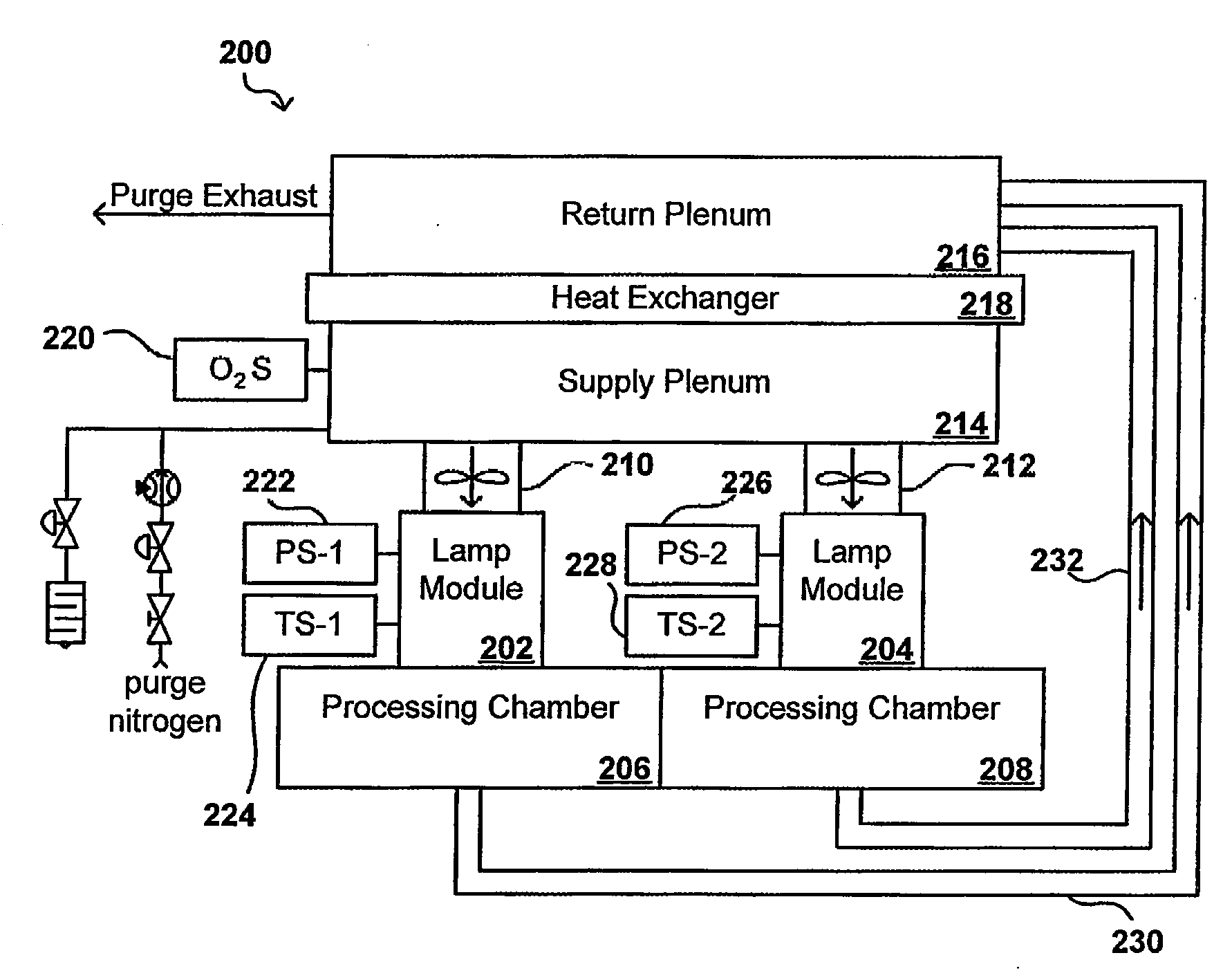
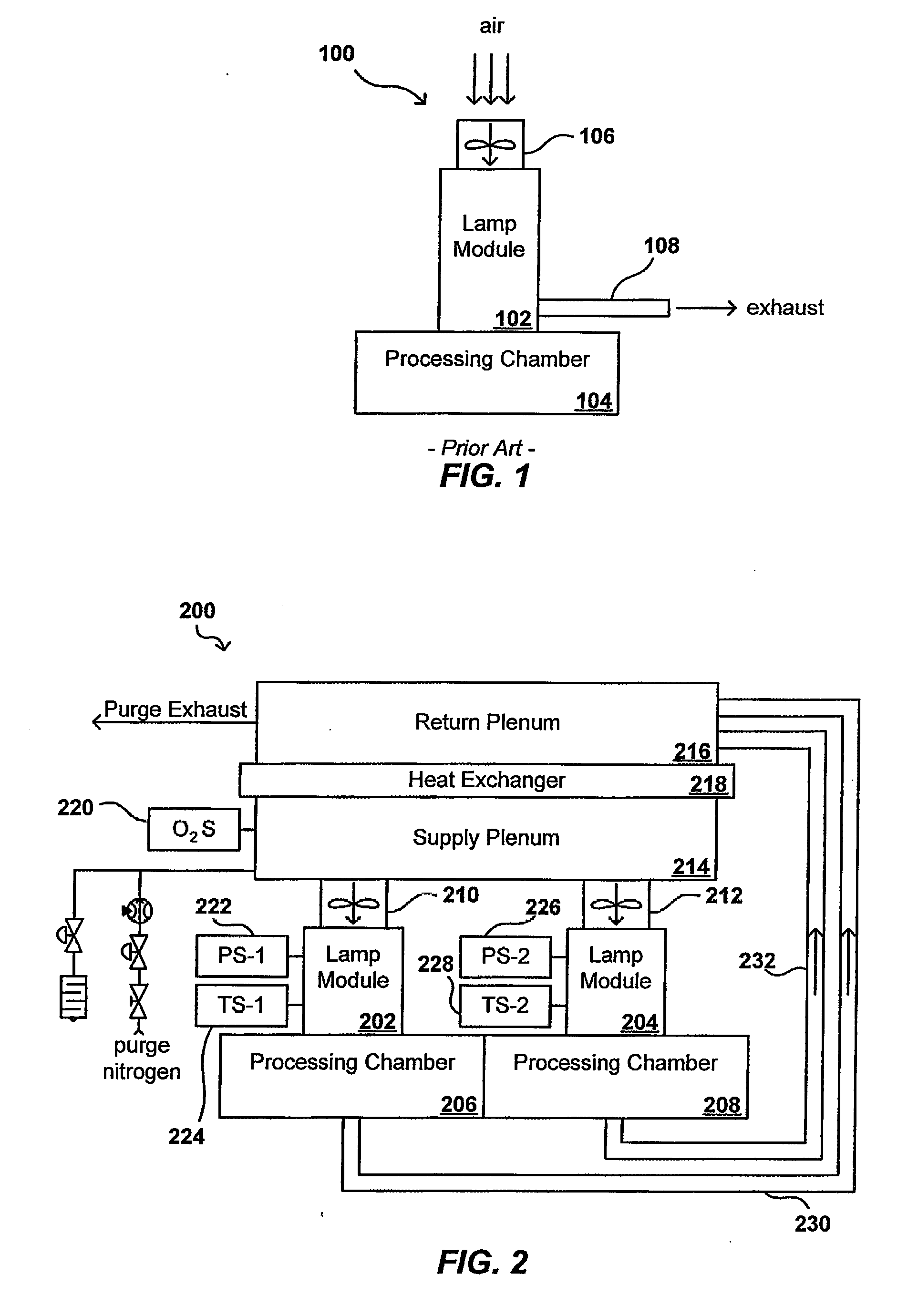
UV curing system or device, such as by utilizing a re-circulation cooling system or closed-loop cooling system (CLCS). Such re-circulation can reduce the exhaust and seal requirements for the curing system. The use of a re-circulating fluid such as nitrogen also can reduce the production of ozone in the system, and can allow for operation of the curing system at lower wavelengths. Such re-circulation also can provide for the reduction of
ozone concentration in the re-circulating fluid.
[0011]In one embodiment, a system for providing cooling for a
UV curing system including a UV lamp source and a curing chamber includes a supply reservoir operable to contain a volume of fluid. A flow generating device, such as a blower, can direct a flow of fluid from the supply reservoir past the UV lamp source, such that the flow of fluid can remove
heat energy from the UV lamp source. Return
piping connected to the curing chamber can receive the heated flow of fluid and direct the flow of heated fluid to a return reservoir. A
heat exchanger positioned along a flow path between the return reservoir and the supply reservoir can remove the
heat energy from the heated flow of fluid, whereby the flow of fluid can be directed back into the supply reservoir to be re-circulated as a
cooling fluid. The fluid can be any appropriate liquid or gas, such as a
nitrogen gas or nitrogen-enriched gas. A
gas separation module can be used that receives a flow of feed air and separates out at least one component of the feed air to generate a source of the fluid for the supply reservoir. The
gas separation module can include a
gas separation membrane, for example, which can receive a flow of feed air and produce a flow of nitrogen.
[0012]In one embodiment, an air module is provided for generating a re-circulating flow of
cooling fluid for a radiation-based curing device. The module contains a supply reservoir operable to receive and contain a volume of fluid. A flow generating device can direct a flow of fluid from the supply reservoir to the radiation-based curing device, the flow of fluid operable to remove
heat energy from the curing device. A return reservoir can receive the heated flow of fluid exiting the radiation-based curing device. The module also can include a
heat exchanger positioned along a flow path between the return reservoir and the supply reservoir. The heat exchanger can remove heat energy from the heated flow of fluid and direct the flow of fluid back into the supply reservoir.
[0014]In one embodiment, a system for reducing the presence of ozone in a
UV curing system includes a supply reservoir for containing a volume of fluid and a flow generating device operable to direct a flow of fluid from the supply reservoir past a UV lamp source, such that the flow of fluid can remove heat energy from the UV lamp source. A first run of
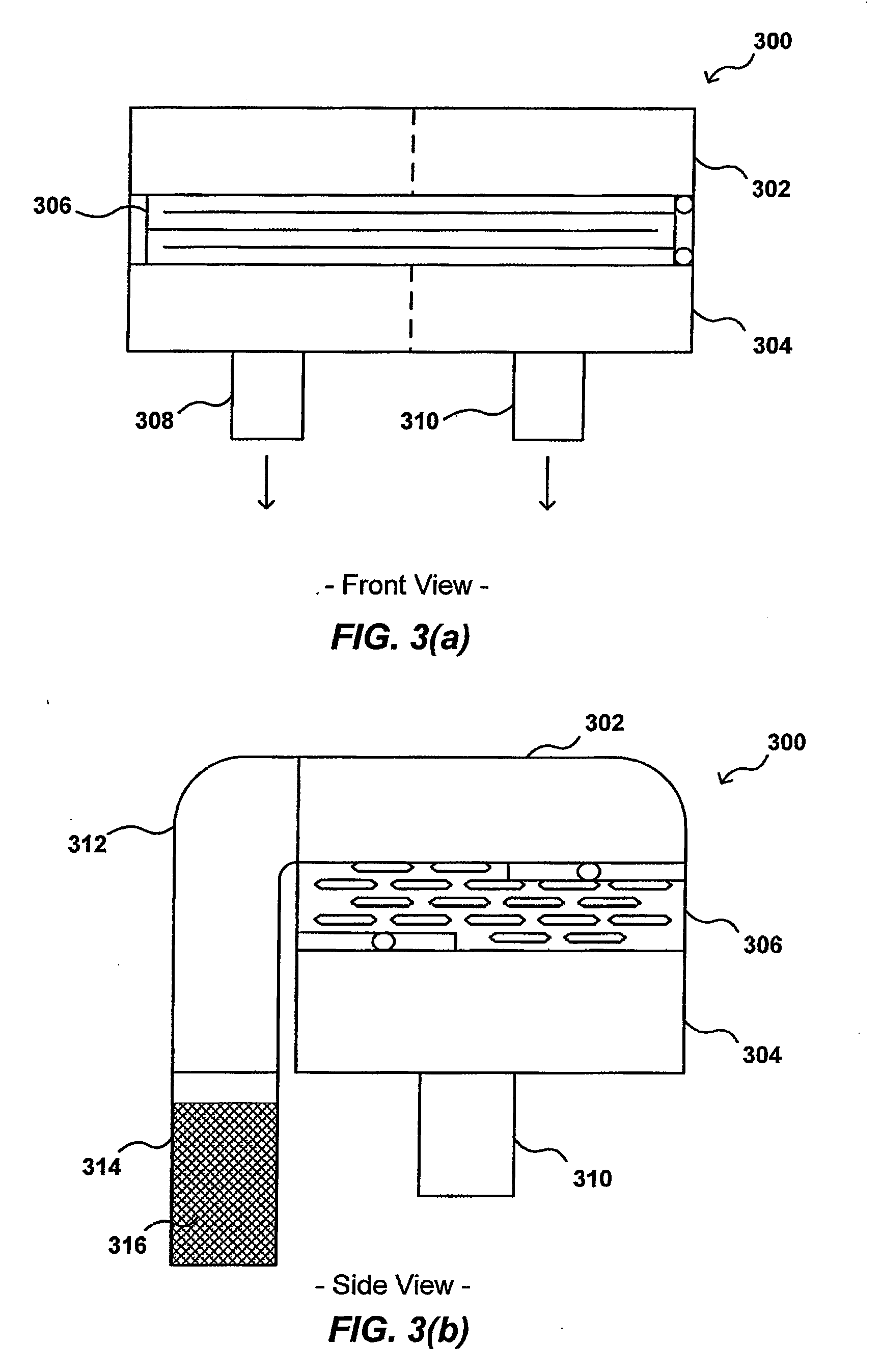
piping connected to the curing chamber can receive the heated flow of fluid and direct the flow of heated fluid to an ozone destruction unit. The ozone destruction unit can receive the flow of heated fluid and reduce the concentration of ozone contained therein. A second run of
piping connected between the ozone destruction unit and the supply reservoir then can direct the ozone-reduced flow of fluid hack into the supply reservoir. The ozone destruction unit can include a catalyst selected to cause a reaction with the heated flow of fluid that breaks down at least a portion of any ozone contained in the fluid. The catalyst can be any appropriate catalyst for breaking down ozone, such as is selected from the group consisting of MnO2 / CuO, MnO2 / CuO / Al2O3,
activated carbon, Pd / MnO2, Pd / MnO2 / Silica-
Alumina, MnO2 based catalysts, and
precious metal pt / pd catalysts. The catalyst can be in the form of
pellets contained in the ozone destruction device, or can be in the form of a
coating on one of a
honeycomb and a radiator device in the ozone destruction device.
[0016]In one embodiment, a method of reducing the presence of ozone in a UV curing tool includes receiving a flow of heated fluid exiting the UV curing tool. The flow of heated fluid is directed along a flow path having a length and shape such that the flow of fluid has a selected
residence time in the flow path for a given flow rate. The flow path has a catalyst positioned on a surface thereof, or contained therein, whereby the flow of fluid in the flow path is in contact with the catalyst for the selected
residence time. The catalyst is selected to cause a reaction with the flow of fluid that breaks down at least a portion of any ozone contained in the fluid. The ozone-reduced flow of fluid then is directed from the flow path back to the UV curing tool, whereby the flow of fluid can be re-circulated through the UV curing tool.



 Login to View More