
Self assembled controlled luminescent transparent conductive photonic crystals for light emitting devices
a technology of luminescent transparent conductive and self-assembling, which is applied in the direction of crystal growth process, polycrystalline material growth, instruments, etc., can solve the problems of low efficiency of silicon carbide (sic) leds, difficulty in fabricating low resistance ohmic contacts to p-type gan, and difficulty in diamond and zno based emitters. , to achieve the effect of minimizing light trapping, minimizing current spreading, and maximizing light extraction
- Summary
- Abstract
- Description
- Claims
- Application Information
AI Technical Summary
Benefits of technology
Problems solved by technology
Method used
Image

Examples
Embodiment Construction
MOCVD Equipment
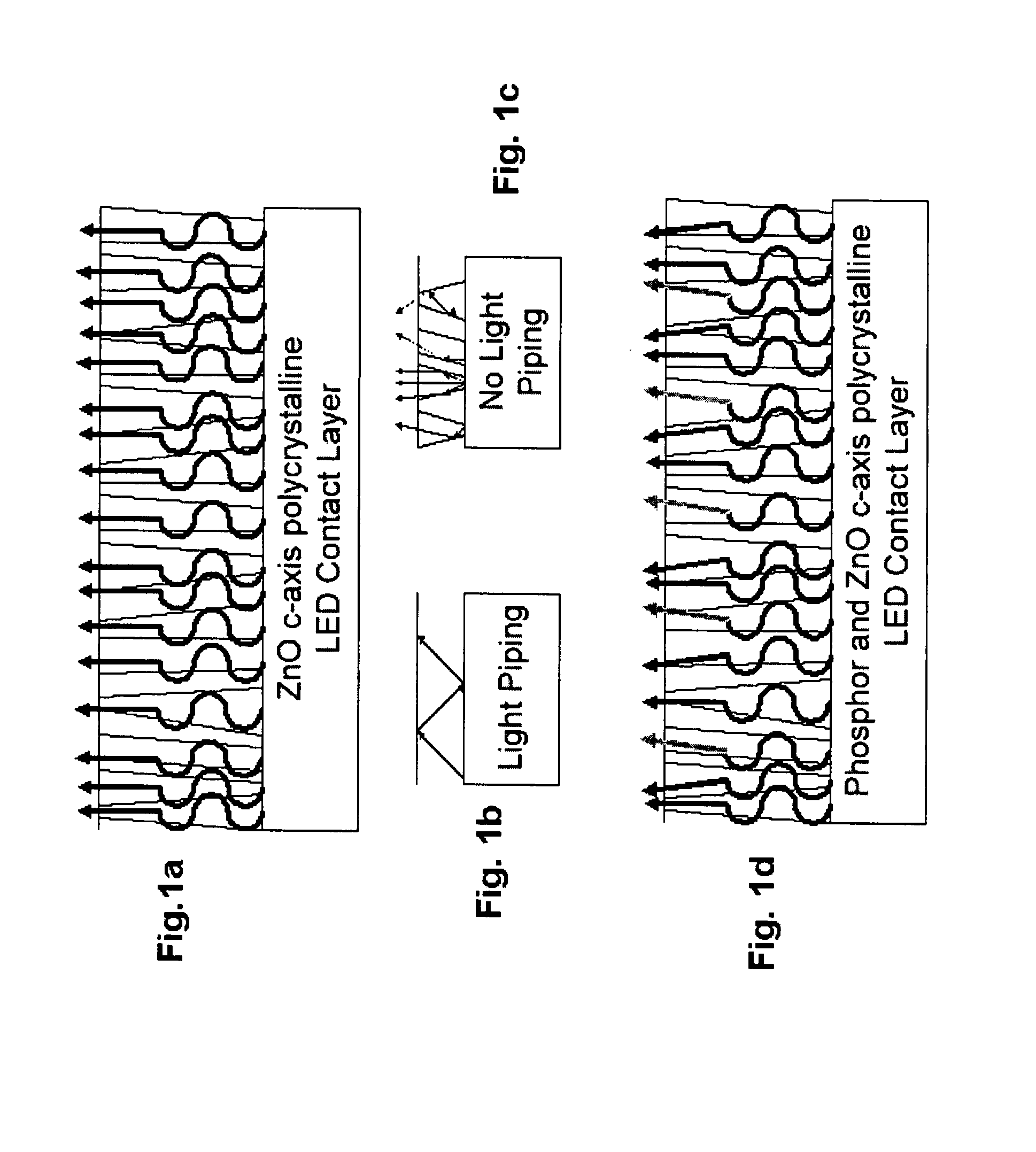
[0028]FIG. 1 of the drawings illustrates the effect of a transparent conductive film with a self assembled columnar (or semicolumnar) photonic crystal (or wire) grain structure to enhance light output from an LED. In FIG. 1A the columnar grains of MOCVD deposited ZnO channel and scatter the emitted light in a direction normal to the film surface, and minimize light loss in the direction parallel to the film surface. In FIG. 1B TCO films with equiaxed grains, or amorphous films such as ITO or ZnO films not deposited as described herein, allow lateral propagation or “light piping” of the LED emission in a direction parallel to the film surface which diminishes the usable light output from the device. FIG. 1C shows TCO films with columnar grain structures which inhibit undesirable parallel light piping. FIG. 1D shows that when combined with a thin film phosphor, the columnar grain structure of the transparent conductive oxide film results in utilization of the LED emissi...
PUM
| Property | Measurement | Unit |
|---|---|---|
| Temperature | aaaaa | aaaaa |
| Angle | aaaaa | aaaaa |
| Power | aaaaa | aaaaa |
Abstract
Description
Claims
Application Information
 Login to View More