

Methods of and Systems for Isolating Nutraceutical Products from Algae
a technology of nutraceutical products and algae, applied in the field of extracting and fractionating algal products, can solve the problems of high cost, high cost of extraction of petroleum oil from the earth, and often at the expense of the environment, and achieve the effects of reducing the number of algae in the body, and increasing the risk of contamination
- Summary
- Abstract
- Description
- Claims
- Application Information
AI Technical Summary
Benefits of technology
Problems solved by technology
Method used
Image

Examples
example 1
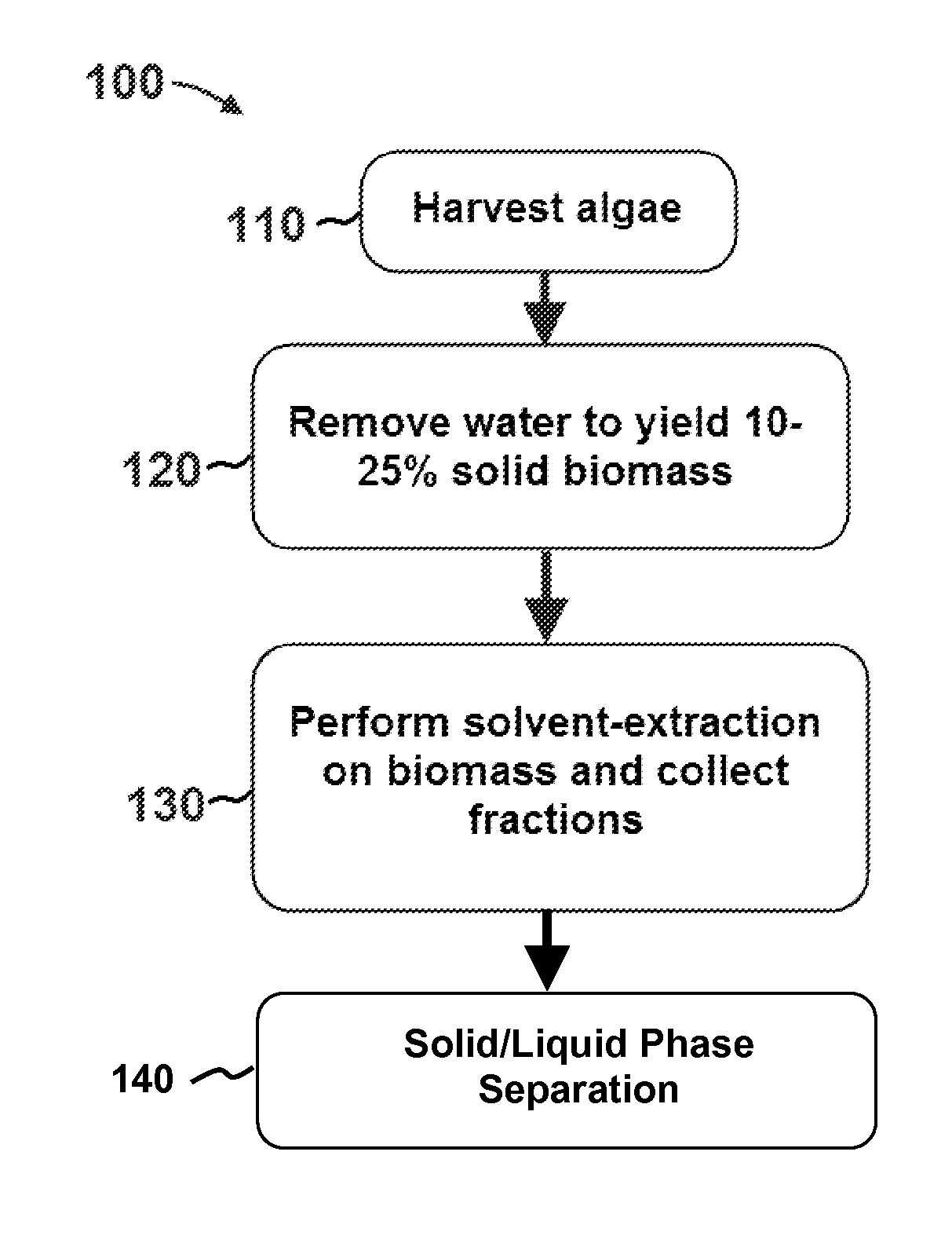
[0193]Green microalgae Scendesmus dimorphus (SD) were cultured in outdoor panel photobioreactors. SD samples of varying lipid contents were harvested. After removal of bulk water by centrifugation, the algal samples were stored as 3-5 cm algae cakes at −80° C. until use. A pre-calculated amount of wet algal biomass (15 grams dry algae weight equivalent) and 90 mL of ethanol solvent was added into a three-neck flask equipped with condenser, mechanical stirring and a thermocouple. In one experiment, the mixture was refluxed for 10 min under microwave irradiance. In a second, the mixture was refluxed for 1 h with electronic heating. Afterwards, the mixture was cooled to room temperature and separated into a diffusate and retentate by filtration.
[0194]The total lipids of algal samples were analyzed using a chloroform-methanol-water system according to Bligh and Dyer's lipid extraction method. This total lipid value was used as reference for the lipid recovery calculation. Total lipids w...
example 2
Protein Extraction from Algal Biomass
[0196](1) Acid Leaching: Algal biomass was soaked in water at pH 4.5 for 1 hour. The samples were then centrifuged at 3000 rpm for three minutes, and the supernatant removed. The remaining solids were washed 3 times with dilute acid (pH 4.5) and freeze dried.
[0197](2) Alkaline extraction: Algal biomass was soaked in water at pH 11 for 1 hour. following the addition of pH-adjusted water. The samples were then centrifuged at 3000 rpm for three minutes, and the supernatant removed. The supernatant was neutralized with acid (pH 4.5) following the centrifugation. The remaining solids were washed 3 times with dilute acid (pH 4.5) and freeze dried.
[0198]The results of acid leaching and alkaline extraction are shown below in Table 4.
TABLE 4Protein PurityProtein Yield(% weight ofProcess(% weight)protein yield)Alkaline Extraction1645Acid Leaching7032.5
[0199]Protein yield was calculated on a weight basis, comparing the weight of the freeze dried solids to t...
example 3
Extraction of Proteins from Saltwater Algal Biomass
[0200]The saltwater algal culture initially made up of about 1-10% w / w solids in saltwater was heated to 50° C. and maintained at this temperature for 1 hr. The resulting slurry was centrifuged to separate the liquid phase from the solid phase. The liquid extract was determined to be rich in globulin proteins (about 10% of the total proteins present in the original algal biomass).
[0201]The solids were then suspended in fresh water and heated to about 50° C. and maintained for about 1 hour. The resulting slurry was centrifuged again to separate the liquid from the solid phase. The liquid phase was determined to be rich in albumin proteins (about 10% of the total proteins present in the original algal biomass).
[0202]The solids were then suspended in ethanol to achieve a 70% w / w mixture. This mixture was heated to about 75° C. and maintained at that temperature for about 1 hour. The resulting slurry was centrifuged to separate the liqu...
PUM
 Login to View More
 Abstract
Description
Claims
Application Information
 Login to View More