Chemical amplification type positive resist composition, and resist film, resist coated mask blanks and resist pattern forming method using the composition

a technology of positive resist and composition, applied in the direction of photomechanical instruments, originals for photomechanical treatment, photomechanical apparatus, etc., can solve the problems of reducing dimensional accuracy, reducing resolution or the decrease of exposure latitude (el), uneven edges, etc., and achieve high resolution , high sensitivity, high resolution

a technology of positive resist and composition, applied in the direction of photomechanical instruments, originals for photomechanical treatment, photomechanical apparatus, etc., can solve the problems of reducing dimensional accuracy, reducing resolution or the decrease of exposure latitude (el), uneven edges, etc., and achieve high resolution , high sensitivity, high resolution

US20120202141A1Inactive Publication Date: 2012-08-09FUJIFILM CORP

Image

Smart Image Click on the blue labels to locate them in the text.
Viewing Examples
Smart Image
  • Chemical amplification type positive resist composition, and resist film, resist coated mask blanks and resist pattern forming method using the composition
  • Chemical amplification type positive resist composition, and resist film, resist coated mask blanks and resist pattern forming method using the composition
  • Chemical amplification type positive resist composition, and resist film, resist coated mask blanks and resist pattern forming method using the composition

Examples

Experimental program
Comparison scheme
Effect test

synthesis example 1

Synthesis of High Molecular Compound (P-1)

[0152]First, 30 g of poly(p-hydroxystyrene) (VP-2500, available from Nippon Soda K.K.) as a polyhydroxystyrene compound was dissolved in 120 g of propylene glycol monomethyl ether acetate (PGMEA). To this solution, 15.80 g of 2,6-diphenylphenyloxyethyl vinyl ether (hereinafter, sometimes referred to as “VE-1”) as a vinyl ether compound, and 1.45 g of 2% by mass of camphorsulfonic acid (PGMEA solution) were added, and the mixture was stirred at room temperature for 2 hours. Second, 1.05 g of 10% by mass of triethylamine (PGMEA solution) was added thereto, and after stirring for a while, the reaction solution was transferred to a reparatory funnel containing 165 mL of ethyl acetate. This organic layer was washed with 200 mL of distilled water 3 times, and then the organic layer was dried to solid under reduced pressure.

[0153]The resulting polymer was dissolved in 120 g of N,N-dimethylformamide (DMF), and 19.75 g of pyridine, 2.76 g of 2-sulfob...

reference example 1

Synthesis of Nf-PHS

[0160]First, 30 g of VP-2500 was dissolved in 120 mL of acetone, 4.35 g of potassium carbonate, 1.18 g of sodium iodide and 2.78 g of 1-choloromethyl naphthalene were added thereto, and the mixture was refluxed for 4 hours. The reaction solution was left standing at room temperature, approximately 60 g of acetone was removed on an evaporator, and thereafter the reaction solution was transferred to a separatory funnel containing 200 mL of ethyl acetate. The organic layer was washed with 200 mL of 1N aqueous hydrochloric acid solution twice and with 200 mL of distilled water twice, and thereafter the organic layer was concentrated to dryness to obtain Nf-PHS.

reference example 2

Synthesis of Bn-MHS

[0161]Bn-MHS was obtain in the same manner as in the Reference Example 1, except that VP-2500 was replaced with the MHS and that 2.78 g of 1-choloromethyl naphthalene was replaced with 2.69 g of benzyl bromide.

the structure of the environmentally friendly knitted fabric provided by the present invention; figure 2 Flow chart of the yarn wrapping machine for environmentally friendly knitted fabrics and storage devices; image 3 Is the parameter map of the yarn covering machine
Login to View More

PUM

PropertyMeasurementUnit
dispersityaaaaaaaaaa
widthaaaaaaaaaa
carbon numberaaaaaaaaaa
Login to View More

Abstract

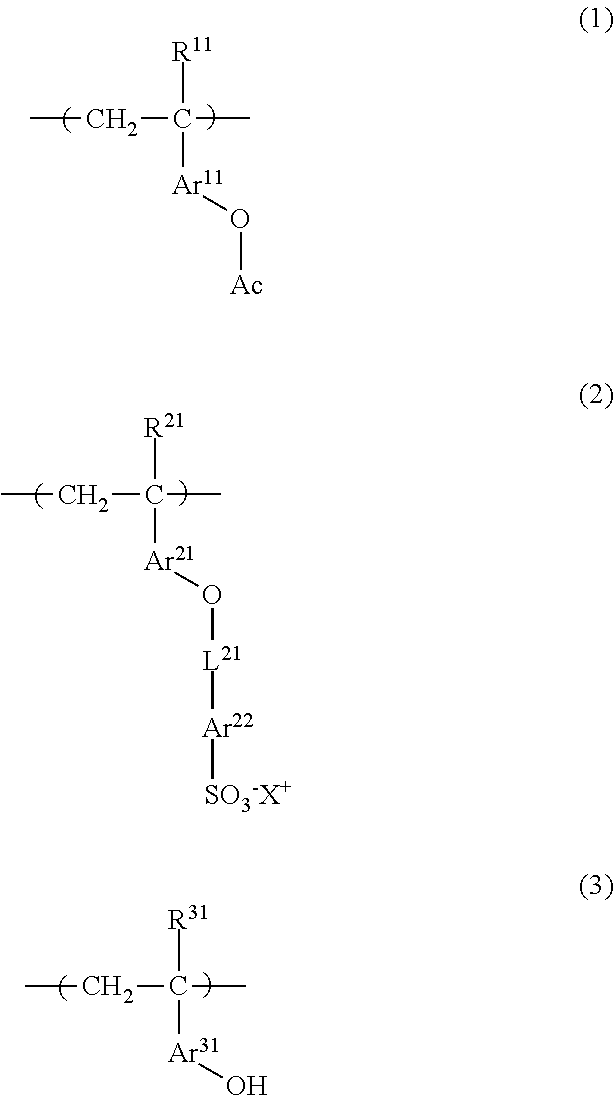
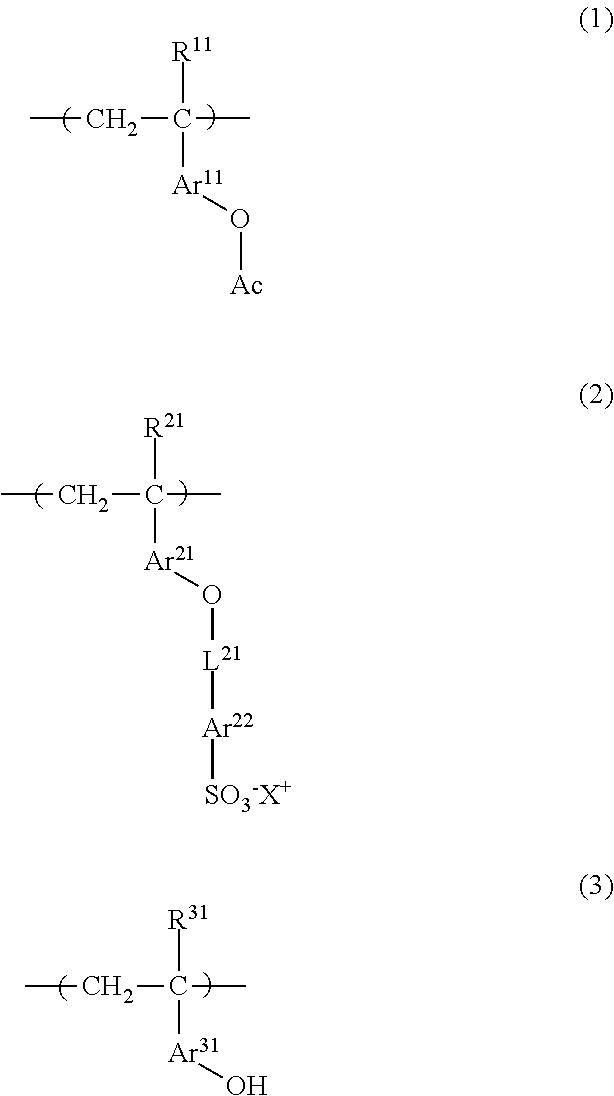
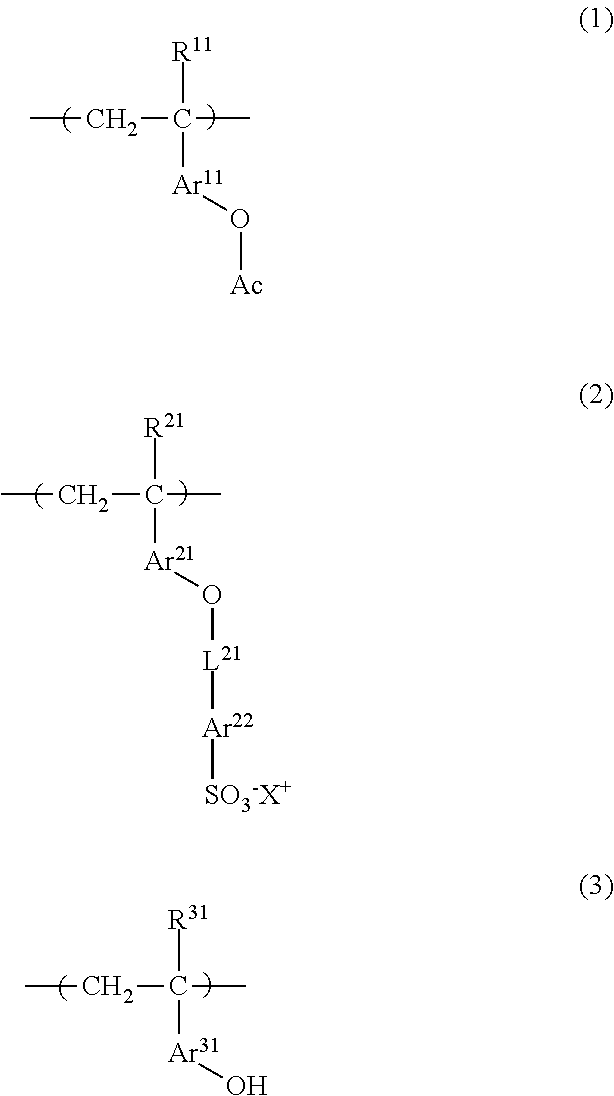
The object of the present invention is to solve the technical problems in the microfabrication of photomasks or semiconductors and is, in particular, to provide a chemical amplification type positive resist film, and a resist film, resist coated mask blanks and a method of forming a resist pattern using the composition, which satisfy at the same time all of high sensitivity, high resolution (for example, high resolving power), good exposure latitude (EL), and good line edge roughness (LER).A chemical amplification type positive resist composition comprising: a high molecular compound (A) having a repeating unit represented by the following general formula (1), a repeating unit represented by the following general formula (2), and a repeating unit represented by the following general formula (3).

Description

BACKGROUND OF THE INVENTION[0001]1. Field of the Invention[0002]The present invention relates to a chemical amplification type positive resist composition which is capable of forming a high precision pattern using an electron beam, a resist film, resist coated mask blanks and a method of forming a resist pattern using the composition. The chemical amplification type positive resist composition of the present invention is suitably used in ultramicrolithography which is applicable to a production process such as the production of VLSI or high capacity microchips, a manufacturing process of a nanoimprinting mold and a production process of a high density information recording medium, and the like, and other photofabrication processes. In particular, the present invention relates to a chemical amplification type positive resist composition used in a process using a substrate having a particular undercoating layer, and a resist film, resist coated mask blanks and a resist pattern forming...

Claims

the structure of the environmentally friendly knitted fabric provided by the present invention; figure 2 Flow chart of the yarn wrapping machine for environmentally friendly knitted fabrics and storage devices; image 3 Is the parameter map of the yarn covering machine
Login to View More

Application Information

Patent Timeline
09 Aug 2012
Publication
US20120202141A1
IPC
G03F1/78; G03F1/76; G03F1/50; C08F228/02
CPC
G03F7/0045; G03F1/78; C08F228/02; G03F7/0392; G03F7/00; G03F7/0046; G03F7/039
Inventors
INASAKI, TAKESHI; TSUCHIMURA, TOMOTAKA